 Capacity Ledger
Aromatics Gave Back. The Intermediates Kept It.
July's producer price data landed this morning: the aromatics index fell 2.6% and the cyclic intermediates made out of it fell 0.7%, which is neither of the two outcomes we wrote down on Tuesday. The June number they both get measured against changed too.
Aromatics fell 2.6% in July. The cyclic intermediates made out of them fell 0.7%.
That is this morning's producer price data, out at 8:30 ET, and it is neither of the two things this desk wrote down on Tuesday.
The setup, quickly. Between February and June the BLS aromatics index (WPU06140197) ran away from the cyclic intermediates index (WPU06140281) that sits one rung downstream of it, and in June the derivative layer finally answered with a +7.6% month. We said July would tell you what kind of answer that was, and we gave it two branches: another 7 to 8% print meant the pass-through was running on a schedule, and a flat print with aromatics holding meant somebody downstream was still eating the cost.
July printed flat. Aromatics did not hold.
"If the feedstock gave back three points off its high, why did the layer that buys it give back less than one?"
The Branch We Didn't Write
Aromatics now sits at 358.176, down 2.6% on the month and 3.3% off its May high. Cyclic intermediates sit at 249.002, down 0.7% on the month and 0.7% off their own high, which was June (chart below).
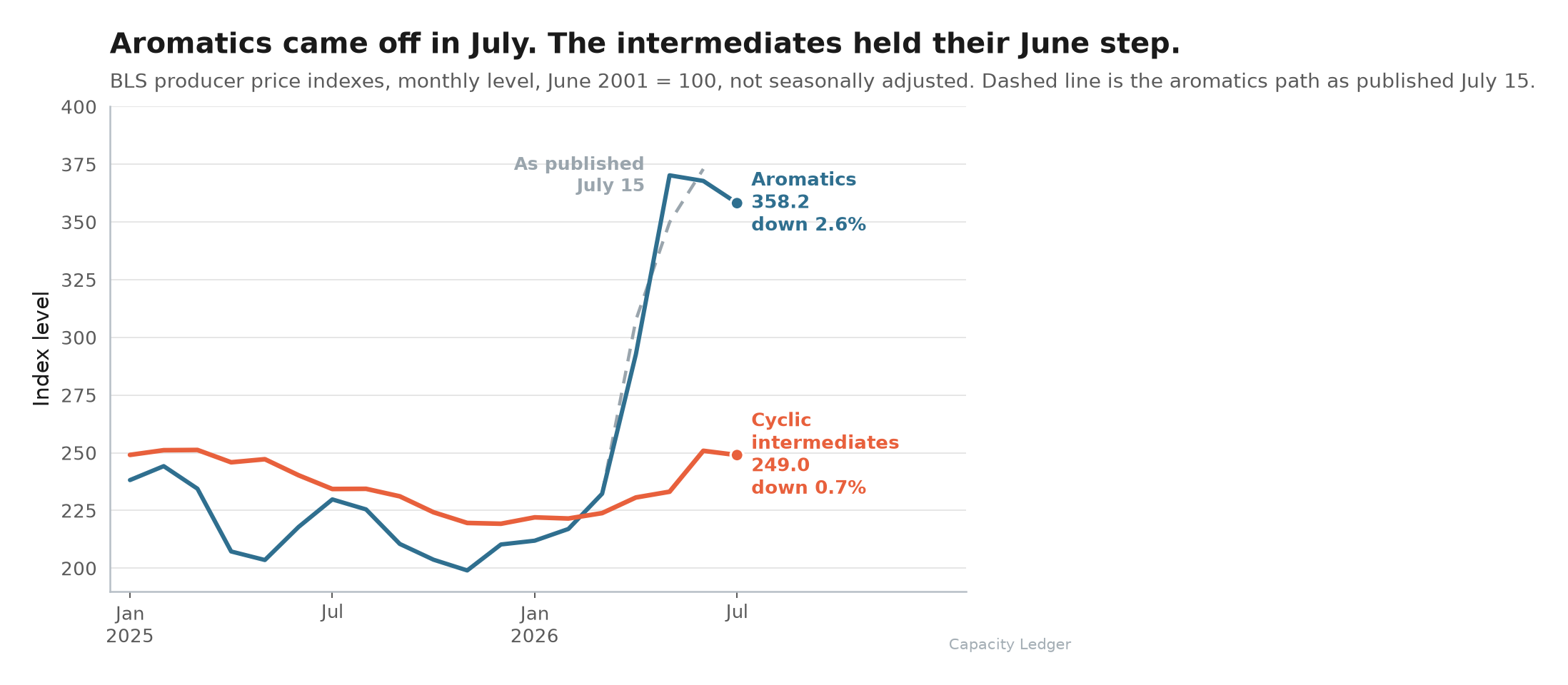
Since February, aromatics are up 65.1% and the intermediates up 12.4%. That is still a bit over five to one, and the gap between the two index levels has closed only from 116.9 points to 109.2.
The fall at the feedstock end is real and it is broad. Basic organic chemicals (WPU0614) fell 3.5% on the month, liquid refinery gases 12.6%, and BLS names it in the release itself, listing basic organic chemicals among the July decliners alongside jet fuel and gasoline.
Basic inorganic chemicals moved -0.1%. That is the check you want if you are asking whether this is an aromatics event or a general energy unwind, and it says aromatics.
So the June step in the intermediates is holding while the thing it was blamed on unwinds.
One month is one month, and we would not call a single flat print durable. It does remove the easiest version of the seller's story, which was that June was a spike.
Which June Do You Mean?
Here is the catch. The June aromatics figure we published on Tuesday is not the June aromatics figure BLS published this morning.
PPI indexes stay open. "All indexes are subject to revision for 4 months after their originally scheduled publication to incorporate late reports and corrections by survey respondents," per the release, so this morning's file closed March 2026 and reopened everything after it.
Against the vintage that was live on July 15, aromatics moved like this:
- April: 307.488 became 292.630, down 4.8%.
- May: 349.864 became 370.231, up 5.8%.
- June: 372.966 became 367.802, down 1.4%.
Cyclic intermediates over the same three months:
- April: unchanged at 230.617.
- May: up 0.014 of a point.
- June: down 0.047 of a point.
Same release, same agency, same June 2001 base.
One index was rewritten by twenty points in a month that had already happened. The other moved by five hundredths of one.
Two of our own derived numbers go with it, and we would rather restate them than leave them standing.
April's aromatics month was +32.4% on Tuesday's data and is +26.0% on today's. June's was +6.6% and is now -0.7%, because May got revised up underneath it. February to June was +71.9% and is +69.5%.
What a Q4 Reset Inherits
If your price formula references a published index rather than a negotiated number, both findings land in the same clause.
- Name the vintage, not just the month. April alone moved 4.8% between two consecutive publications, which is larger than most annual escalators in these contracts. A clause that says "the April index" without saying which printing of it has an open number in it.
- April 2026 is still open. On the four-month rule it goes final in the September 10 release, which is also the first print carrying August.
- The feedstock-came-down argument now runs against your own index. If you buy cyclic intermediates, the series you settle on says the feedstock came off and your layer did not follow. Your supplier will have read the same file.
- The aromatics series is the volatile one in both senses. It moves more between months and it moves more between printings of the same month. Anything indexed to it needs a lag long enough to settle, or a cap.
Final Thoughts
A producer price index is a document that keeps changing after you have already used it. That is the arithmetic of a survey that accepts late reports, and it is exactly why the four-month rule exists.
What is useful this morning is which of the two layers moved and which did not. The one nobody invoices you for is off its high and got rewritten by twenty points in a single release. The one on your invoice is within a point of its own high, and this morning's revisions barely touched it at all. Whatever the fourth quarter does to the feedstock, the layer you actually buy is the steadier of the two, and steady is not the same thing as cheap.
Thanks for reading.