 Capacity Ledger
Cleveland Still Makes the Phosphor
The chemical division of GE Lighting became Current Chemicals in February, 250,000 square feet running from gram-scale to full-scale production. It sits against a luminophore import line that has fallen 87 percent since 2016, and a rare-earth compound line where 78 percent of the weight arrives from China.
If you specify a phosphor, your list of places to buy one is shorter than your purchasing system thinks.
Here is the whole national picture. The United States imported 89,707 kilograms of luminophores in 2025 under HS 3206.50, worth $7.1 million.
Call it 90 tonnes. That is the entire import book for a country running LED lighting, displays, sensors and everything else that converts one wavelength into another.
"Where does a seventy-five-year-old phosphor shop point itself once the lamp business is gone?"
In Cleveland, it went and got its own name.
Seventy-Five Years, Then a Name of Its Own
On February 2, 2026, the chemical division of GE Lighting launched as Current Chemicals, Inc., a fully independent US specialty materials manufacturer, backed by Momentum Global Ventures out of the Netherlands.
The business is over 75 years old. The address is 1099 Ivanhoe Road, Cleveland, Ohio.
What sits there is 250,000 square feet, with production that runs from gram-scale prototyping through full-scale production.
That span is the whole proposition, and CEO Bill Cohen said so plainly in the launch release: "We're a scale-up partner. Our seasoned team has decades of experience navigating the critical gap between discovery and production, where ideas often stall."
Two families sit on the catalogue: phosphors and luminescence materials for LED TVs, lighting, luminescent displays, wearables and sensors, and rare earths and critical materials alongside them.
Worth noting what the company does not publish: a tonnage. No nameplate, no annual volume, no headcount, anywhere on the site or in the launch release.
The Line That Shrank
Now the market that plant sells into.
Fluorescent lighting was the phosphor industry's volume for fifty years, and the customs record shows what LEDs did to it (chart below).
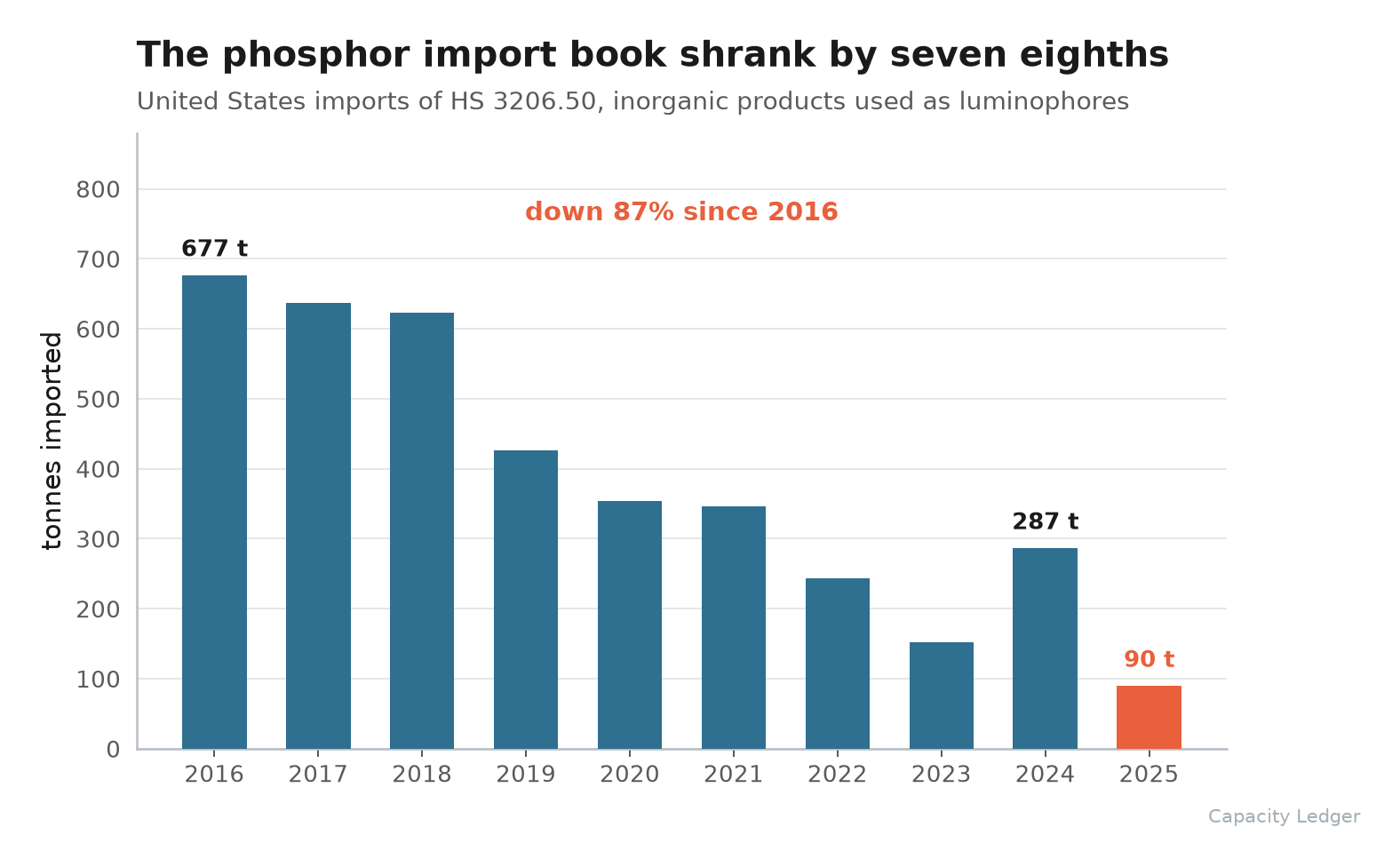
Imports on HS 3206.50 ran 676.6 tonnes in 2016. They ran 89.7 tonnes in 2025.
That is 87 percent off in nine years, and 69 percent off in the last year alone.
The 2025 book is small enough to read in full. Fourteen partner countries, and the partner rows sum exactly to the reported world row, so this is the complete book rather than a sample.
Portugal and China carry 67.5 percent of the weight between them. Japan ships 12,370 kilograms and collects $3,312,712 for it, which is 47 percent of the line's money on 14 percent of its weight.
A short list of names, a wide price band, a shrinking total. That is what a specialty looks like after its anchor application moves on.
Where the Volume Actually Is
Here is where it gets interesting, and it is why the rare-earth half of that catalogue is load-bearing.
Run the same pull on rare-earth compounds.
HS 2846.10, cerium compounds, brought in 2,063,856 kilograms in 2025 for $21.1 million. HS 2846.90, the other compounds of rare-earth metals, yttrium and scandium, brought in 13,369,931 kilograms for $180.2 million.
Together that is 15,434 tonnes and $201.3 million: 172 times the weight of the luminophore line and 28 times its value.
78 percent of that weight came from China.
That is the market a Cleveland plant with rare-earth processing history walks into. The company names its own targets: electric vehicles, wind energy, advanced displays and defense-adjacent technologies in the launch release, and on its site, EV and UAV motors, power-generation turbines, batteries, fuel cells and grid storage.
Momentum's investment director, Pieter Six, gave the thesis in one line: "Current Chemicals has tremendous growth potential thanks to its rare combination of legacy expertise, custom chemistry capabilities, and secure U.S.-based operations."
The same investor also owns Seaborough, a Dutch developer of nanoengineered phosphors. So there is a technology pipeline pointed at the luminescence side as well, which is a useful thing to know if you are the buyer deciding whether this is a supplier or a museum.
Final Thoughts
This desk mostly counts things that close. Current Chemicals is the other kind of entry, and it is scarcer than it should be: capability that was already in the ground, now selling under its own name to whoever needs it rather than to one parent.
There is no published volume to score it against yet, so the number we will be waiting on is the first one the company puts in public.
What the trade data already says is that the opening is real.
Ninety tonnes of luminophore imports is a line thin enough that one qualified domestic supplier changes the conversation. Fifteen thousand tonnes of rare-earth compounds at 78 percent Chinese is a line where every buyer in the country is carrying a second-source memo they have not been able to close.
Thanks for reading.