Does Your Antimony Contract Run Past November 27?
China banned antimony exports to the United States in December 2024 and the price nearly tripled. Beijing suspended that ban last November, the price round-tripped, and the suspension runs out on November 27. Montana's only primary smelter finished nine new furnaces into the trough, and has a $245m government contract standing in front of your order.
On December 3, 2024, China's Ministry of Commerce published Announcement No. 46 and prohibited the export of antimony to the United States.
The price did what you would expect it to do. Antimony metal averaged $9.80 a pound in August 2024, $18.10 by December, and $27.50 by June 2025.
Then Beijing suspended the ban, and the whole move came back (chart below).
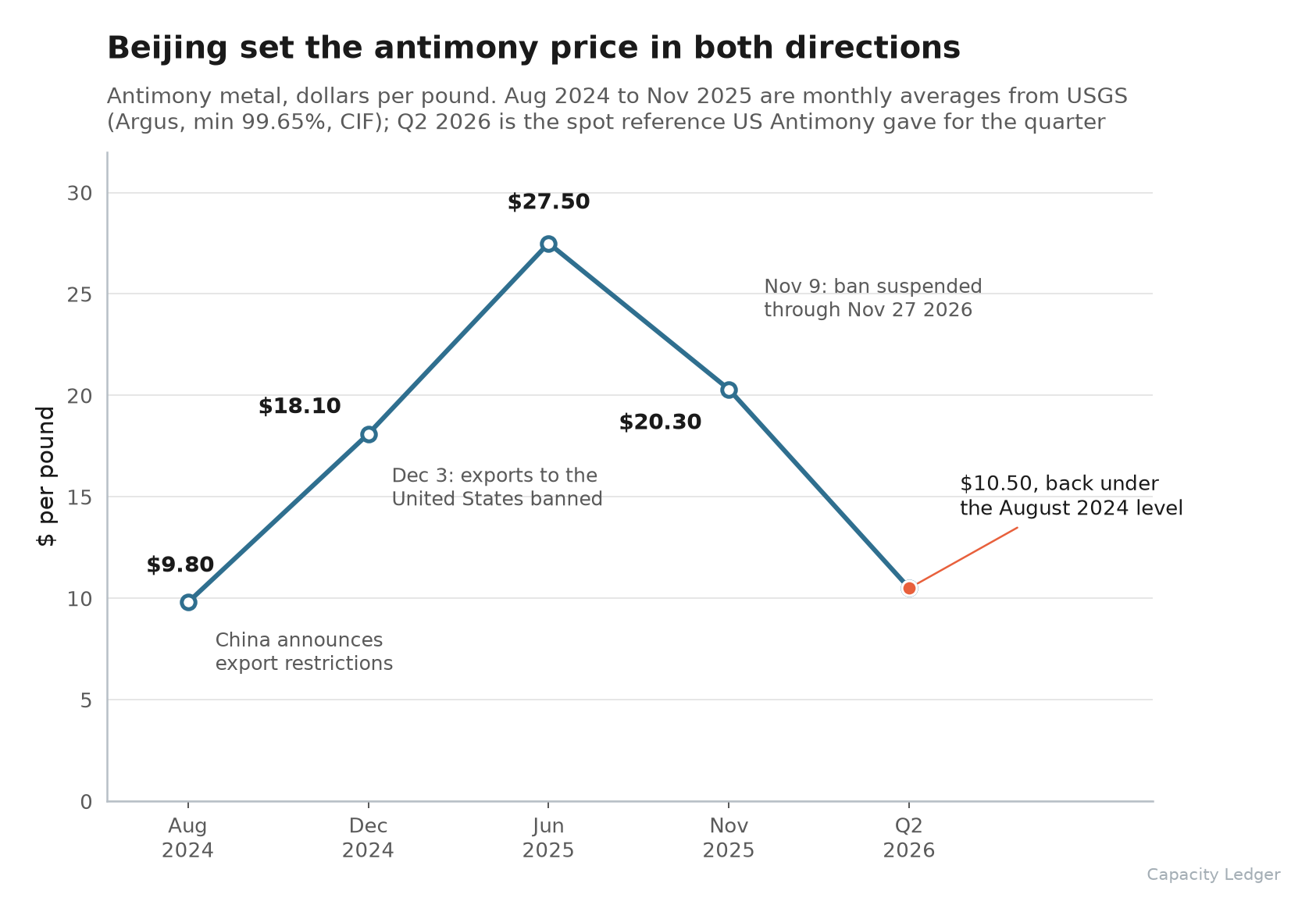
"If the price that justified a domestic plant was set by an export control, what happens to the plant when the control gets switched off?"
We have a live answer this week. The only company running a primary antimony smelter in this country reported its second quarter on August 11 and filed the call transcript as an 8-K on Monday, and between the two documents it says exactly what a capacity addition looks like when it arrives at the bottom.
Nine Furnaces, Half the Guidance
US Antimony fired the first of nine new gas-fired furnaces at Thompson Falls, Montana in May, and told the market in June that each one carries a 300% capacity increase over what it replaces. When the older smelter next door is renovated and all fifteen furnaces run, the company puts total output at three to four times historical production.
That renovation has been pushed to 2027. The new nine are what exists.
The company spent $22.8m of gross capital in the first half to get there, against which the Department of War paid $12.8m in April on milestones under a Defense Production Act Title III grant. Net capital deployed for the half, on the CFO's own arithmetic: about $10m.
So the plant works. Here is what happened to the economics while it was being built.
Full-year revenue guidance went from $125m to $60m-$75m. The company gives three reasons and leads with the price: spot antimony "exceeded $28 per pound" when the guidance was set in late 2025, against "approximately $10.50 per pound during the second quarter."
Realized pricing tells the same story with the volume attached. Pounds sold rose 26% to 428,425, and the average selling price fell 52% to $13.70 from $28.32.
Cost per pound came down too, to $13.34.
That is a 36 cent gross spread on a pound of antimony. Chairman Gary Evans put it plainly on the call: "The thing that I cannot control or any of the management team can control is world antimony prices."

The rest of this brief is for subscribers.
The capacity math, the trade-flow read, and what it means for the products you buy.
$50 a month, or $400 a year.
Already a subscriber? Sign in