 Capacity Ledger
Eleven Months to a New Fluorination Line
Navin Fluorine's board put ₹75 crore behind a debottleneck of a plant it already owned at Dahej last October, against a crop protection molecule a customer had already ordered. Commercial dispatch started Tuesday, a quarter ahead of the published target. The same site's last new acid plant took thirty five months.
Seventy five crore rupees is a small number to find in a specialty chemical capex book.
Navin Fluorine's board approved that much on October 30, 2025 to debottleneck a plant the company already owned at Dahej. On Tuesday it told the exchanges the line is commissioned and the product is shipping.
Eleven months, approval to dispatch.
What ₹75 Crore Bought
The asset is the Multi-Purpose Plant at Dahej, held by Navin Fluorine Advanced Sciences, the wholly-owned subsidiary that runs the site. The MPP started production there in 2023, so this is a three-year-old plant being asked for more rather than a new one being stood up.
What comes off it is a crop protection molecule. The FY26 annual report says it flatly: the money went "towards debottlenecking of MPP to cater to a novel molecule in crop protection space."
The customer is named only as a global innovator, and the order was on the books before the capex was. Under the project's rationale, the August investor deck lists one line: "Purchase order received for CY26."
So the sequence ran order, then cheque, then commissioning. Against ₹75 crore the company publishes a peak revenue potential of ₹140 crore to ₹160 crore a year.
Eleven Months Against Thirty Five
The published target for this project was Q3 FY27, which on an April-to-March calendar means October through December of this year. Dispatch started September 29, the last working day of the quarter before.
A deck the company filed today was prepared on August 5 and still had the project as "on track for commissioning in Q3 FY27."
Set that against the same site's last new plant (chart below).
Navin Fluorine told the exchanges on March 17, 2023 that it was spending ₹450 crore on a 40,000 tonne a year anhydrous hydrofluoric acid unit at Dahej. Commercial production started February 6, 2026, which is 34.7 months later, on a project that by every public account went fine.
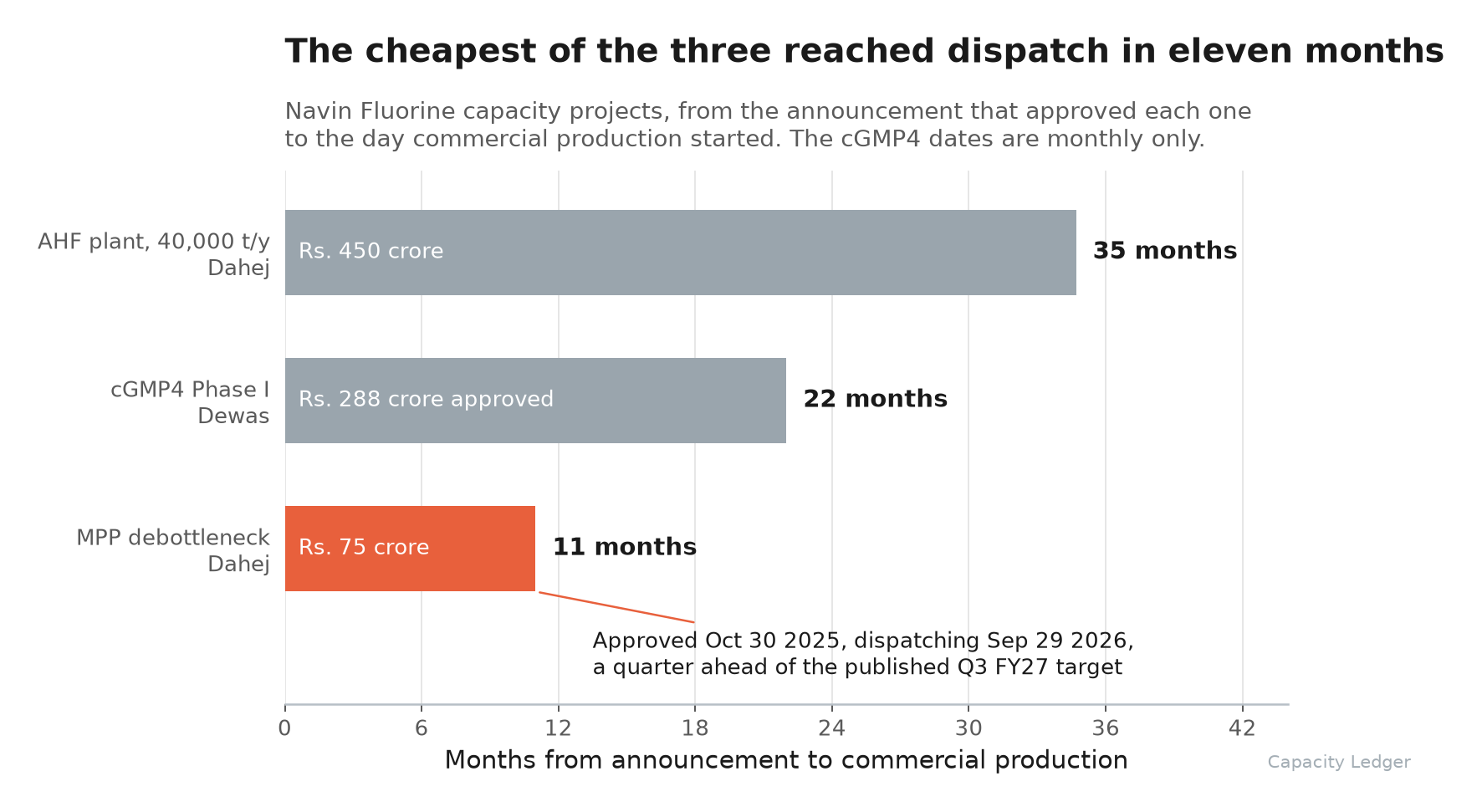
That gap measures the distance between a plant that has to be permitted, poured, erected and commissioned from nothing and a reactor train that already has its utilities, its effluent route, its operators and its consents. A debottleneck inherits all of it.
The price of inheriting it is that you only get whatever capacity the old constraint was hiding, which is why what the company published here is a revenue range rather than a tonnage.
What Else Is Coming Off That Site
The ₹75 crore line is the smallest of the five production projects on the capex slate the company published in August, and the rest of that slate tells you where it thinks fluorine is going:
- ₹236.5 crore for additional HFC capacity equivalent to up to 15,000 tonnes a year of R32, targeted at Q3 FY27, with a published peak revenue potential of ₹600 crore to ₹825 crore.
- ₹120 crore, 35 percent of it funded by the customer, for the initial commercial capacity to make Chemours' Opteon two-phase immersion cooling fluid, targeted at the end of Q2 FY27. That agreement dates to May 2025, and in Navin Fluorine's own words it is aimed at "the cooling demands of large scale, hyper data centres."
- ₹90 crore of adoption capacity for the new advanced materials vertical by Q2 FY28, alongside a DRDO-funded process development project for a defence material.
- ₹125 crore for Phase II of the cGMP4 plant at Dewas by Q4 FY27, behind a European CDMO major whose existing molecule is pulling harder.
Two of those four point the same way. On the refrigerant leg the company's own read is that "global R32 demand supply is in tight balance and likely to remain the way for the foreseeable future," and the coolant leg exists because Chemours went looking for somebody to make Opteon and then paid 35 percent of the plant's cost to get it built.
The Dewas site already carries customer product approvals for regulated markets including the United States, Canada and Japan, and cleared 40 customer audits and visits last fiscal year.
Final Thoughts
The interesting thing about a debottleneck is how little noise it makes. This one arrived as a two paragraph Regulation 30 intimation on a Tuesday evening in Mumbai, with no tonnage, no molecule and no customer named, and it added a commercial product line faster than most companies can get a permit modification signed.
Group capex has been falling the whole time this was happening, from ₹757.71 crore in FY23 to ₹489.26 crore in FY26, while consolidated revenue ran to ₹3,313.90 crore last year and the specialty vertical grew 48 percent year on year in the June quarter. Sweating the assets is a phrase every chemical management team uses. Here is what it looks like when the arithmetic actually works.
If you are trying to find where the next tonne of a fluorinated intermediate is going to come from, the greenfield announcements are the ones you can see coming three years out. The ones that land inside a year get a filing nobody reads.
Thanks for reading.