 Capacity Ledger
Everyone Chemical Manufacturing Hired Since 2019 Works in Pharma
US chemical manufacturing employs 42,400 more people than it did at the end of 2019, and pharmaceuticals alone added 47,200 of them. Subtract the drug plants and the industry you actually buy from is smaller than it was before the pandemic.
Chemical manufacturing employed 898,800 people in July.
That is 42,400 more than at the end of 2019, which reads like an industry that grew through the closure wave this desk spends every morning counting.
Pharmaceutical and medicine manufacturing added 47,200 over the same stretch.
Both numbers come out of the same BLS file, and the subtraction is the story.
"If chemical manufacturing is bigger than it was in 2019, which part of it got bigger?"
The Two Lines
Pharma is NAICS 3254, and 3254 sits inside NAICS 325 with basic chemicals, resins, ag chem, coatings and surfactants. Every headline about chemical industry employment is that sum.
Take the published 325 aggregate, remove the published pharma line, and the rest of chemical manufacturing employed 542,300 people in June against 545,100 in December 2019 (chart below).
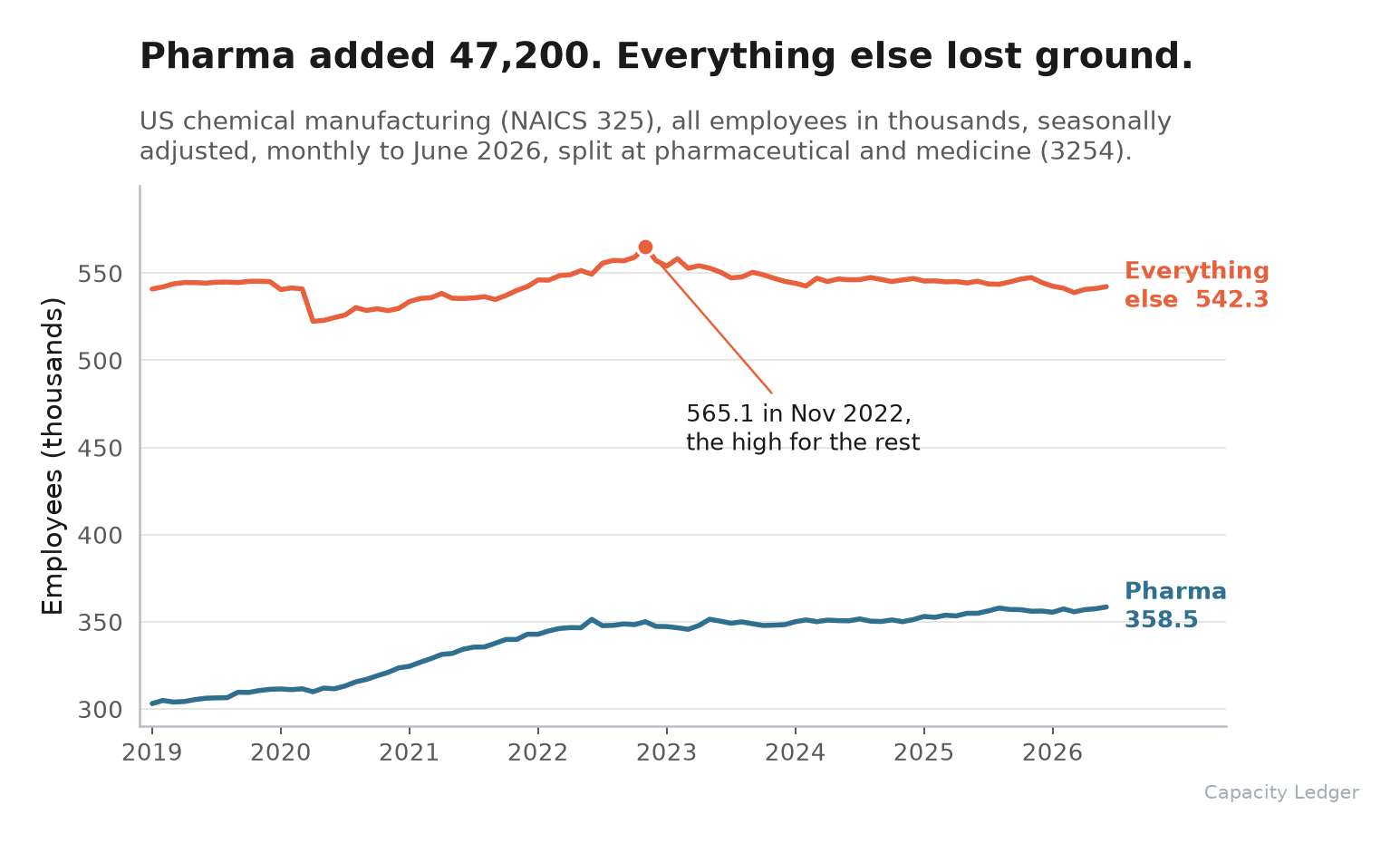
Six and a half years, and the non-pharma industry is 2,800 people lighter.
Pharma's June print of 358,500 is the highest month in a series that begins in 1990. It has taken its share of chemical manufacturing employment from 36.3% at the end of 2019 to 39.8%.
One arithmetic note, because someone will check: we derive the non-pharma line as the published 325 total minus the published 3254 series.
Adding up the seven other sub-industries instead gets you 901,100 for June against the 900,800 BLS publishes for the whole, since each series is seasonally adjusted on its own. We use the number the agency stands behind.
Nobody Else Is at a High
The rest of chemical manufacturing peaked in November 2022 at 565,100 and has given back 22,800 people, or 4.0%, since.
The aggregate hides that. Total 325 peaked the same month at 915,200 and is down 1.8%, which looks like a soft patch rather than a four-year slide, because pharma has been climbing through it the whole time.
Here is where the give-back sits, each sub-industry against its own post-2019 high, all as of June:
- Paint, coating and adhesive (3255): 65,800, down 13.9% from November 2022. The steepest of the seven by a wide margin.
- Other chemical product and preparation (3259): 78,300, down 7.6%, and its high was June 2019.
- Pesticide, fertilizer and other ag chemical (3253): 37,400, down 4.1% from a high set only last November.
- Basic chemical (3251): 151,600, down 3.5% from November 2024, and below its December 2019 level of 152,100.
- Resin, synthetic rubber and fibers (3252): 94,500, down 3.5% from October 2022.
- Soap, cleaning compound and toilet preparation (3256): 115,000, down 3.0% from November 2021.
Seven sub-industries, none at its own high. The eighth is pharma, and pharma set its record in the most recent month it reported.
The Same Finding, From a Different Agency
We ran this from the other direction on July 27, using the Federal Reserve's G.17: the capacity index for NAICS 325 had risen every month for close to six years while the production index rolled over, and the reason 325 keeps adding capacity on paper is that pharma is inside it.
That was one agency's index, built from company capacity surveys. This is a different agency's establishment survey, counting people.
They agree, which is the useful part. The aggregation problem is in the code, not in either instrument.
Final Thoughts
Headcount is a rough proxy for operating footprint and we would not push it further than that. A plant running one crew instead of three still shows up in this survey, and a national monthly survey never tells you which site moved.
What it does tell you is which argument to stop making. Anyone citing chemical manufacturing employment as evidence that US chemical capacity is holding up is citing a number that is 40% drug plants and rising, and the other 60% has been shrinking since late 2022.
Your suppliers are in the 60%. So is every plant on the closure list.
Thanks for reading.