 Capacity Ledger
Five Hundred Thousand Pounds, No New Plant
Ascent Industries' process engineers pulled more than 500,000 pounds a year of extra capacity out of a reaction asset it already owned. Total capital spending across the company that quarter was $754,000. Nothing about it will ever appear in a capacity database, including ours.
Capacity going away leaves a paper trail. A WARN notice, an 8-K, a charge against earnings, sometimes a surrendered air permit.
Capacity arriving leaves one too, as long as somebody breaks ground and issues a photo.
Then there is the third kind, which is a plant quietly making more of something than it made last year, and which produces no document at all.
"What does new capacity cost when nobody builds anything?"
The Three Plants
Ascent Industries Co. (Nasdaq: ACNT) runs out of Schaumburg, Illinois, and was incorporated in 1958 as the successor to a chemical manufacturing business founded in 1945 as Blackman Uhler Industries.
It spent 2025 selling its stainless tubing businesses, and it now files one reportable segment: Specialty Chemicals.
Three production facilities, all in the Southeast:
- Fountain Inn, South Carolina, 136,834 square feet on 16.9 acres, leased
- Danville, Virginia, 135,811 square feet on 55.3 acres, owned
- Cleveland, Tennessee, 122,800 square feet on 18.8 acres, leased
What comes out of them is surfactants, defoamers, lubricating agents, flame retardants and chemical intermediates, petroleum-derived and bio-based, going into oilfield production chemicals, cleaners, coatings, metalworking fluids, water treatment and agrochemical formulations. The company puts its reaction fleet at more than 80,000 gallons: multiple 8,200-gallon and 3,000-gallon stainless reactors on hot oil in South Carolina, 7,500, 6,000 and 4,000-gallon jacketed reactors in Tennessee, and in Virginia a horizontal reactor bank running 130 litres to 15,000.
That is a custom and toll manufacturer's asset list. Nothing on it is a world-scale anything.
What the Process Engineers Did
On the August 4 earnings call, president and chief executive J. Bryan Kitchen described what his engineering team had done in the quarter:
"During the quarter, our process engineering team developed and implemented an OE-driven debottlenecking initiative that increased the effective capacity of a key reaction asset, unlocking more than 500,000 pounds of incremental annual capacity."
Neither the asset nor the site is identified, and the number is in neither the 8-K exhibit nor the 10-Q.
It exists as one sentence, spoken once.
Now put it against the capital account. Ascent's purchases of property, plant and equipment ran $1.176 million for the whole first half, against $422,000 in the first quarter, which leaves $754,000 for the quarter in which half a million pounds of annual capacity appeared.
That is the entire company, three plants, all in. Guidance for the rest of fiscal 2026 is "as much as $3.0 million."
Kitchen said the quiet part on the same call: these improvements matter "because they allow us to support profitable growth with limited future capital investments."
The Quarter It Landed In
2025 took the volume out. Full-year net sales fell 7.2% to $74.9 million on a 17.7% drop in pounds shipped, with a 10.9% price increase carrying what was left.
Which is the trough the debottleneck was designed into. Nobody goes looking for capacity in a year like that unless somebody has told them to.
Then the second quarter of 2026 broke the range (chart below). Net sales $25.7 million against $18.7 million a year earlier, up 37.6%.
Pounds shipped up 15.2%, average selling prices up 23.0%. Gross profit $5.5 million, adjusted EBITDA $1.5 million against a $300,000 loss.
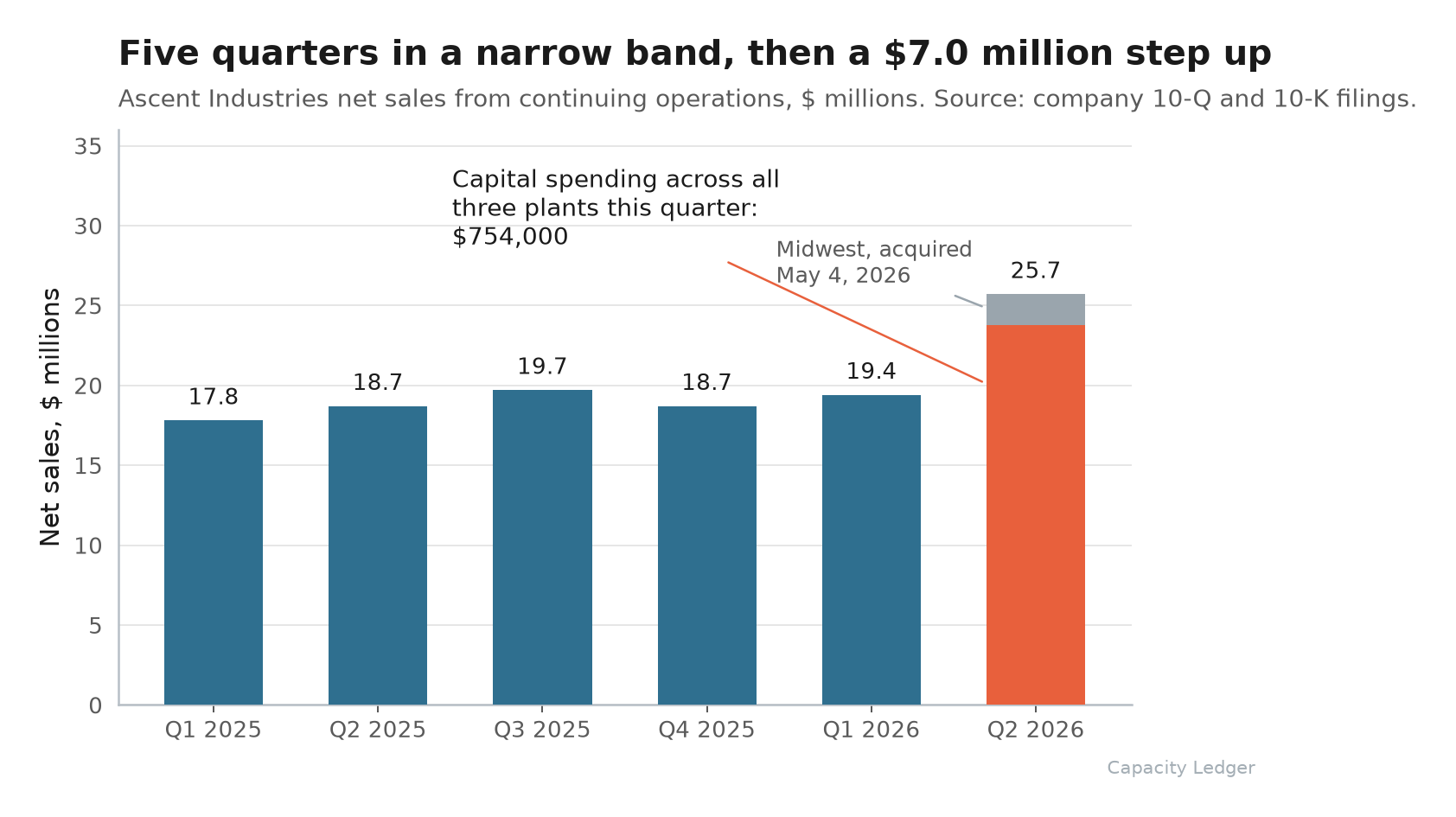
Price did more of that than volume, and margin still ran 447 basis points below last year at 21.6%.
The operating story holds anyway: the company credits the gross profit gain to cost recovery on higher production, lower utilities, and lower repairs and maintenance. That is the language of a plant network running warmer.
The $1.9 million grey slice on the last bar is Midwest Graphic Sales and Sigma Coating, bought May 4 for approximately $13.5 million out of cash on hand, a coatings and inks formulator serving food, pharmaceutical, personal care and consumer packaging. Its manufacturing is being moved into the Ascent network. Which is exactly the kind of thing you can do when a reaction asset just got 500,000 pounds a year roomier.
The balance sheet behind all of it: $28.1 million of cash, nothing drawn on the $30 million revolver, and 209,868 shares bought back in the quarter at an average of $13.80.
Final Thoughts
We keep a ledger of announced capacity for a living, and this desk would have missed this one entirely if it had not read a small-cap earnings transcript on a slow August afternoon.
Debottlenecks are the cheapest tonnes in the industry and the least visible. TPC Group told the market in March that hydrotreater debottlenecking would lift its hydrotreating capacity 19% this year, and put "small capital investments" behind the phrase. Ascent's engineers found half a million pounds inside an asset that was already paid for. Neither event will show up in anyone's capacity balance next to a closure, because there is no filing that captures it and no ribbon to cut.
If you buy custom or toll volume from a mid-sized formulator, your supplier's real capacity is whatever their asset list says plus whatever their process engineers found last quarter. The only place that second number gets said out loud is a call almost nobody dials into.
Thanks for reading.