Fluoropolymers Were Supposed to Be the Safe Business
AGC proposes to shut its Hillhouse PTFE and ETFE plant by year end, four straight loss years into the chemistry every producer calls defensive. What that leaves for anyone buying Fluon in the West.
In September 1999, Asahi Glass bought Imperial Chemical Industries' fluoropolymers business, a book carrying $110 million of sales.
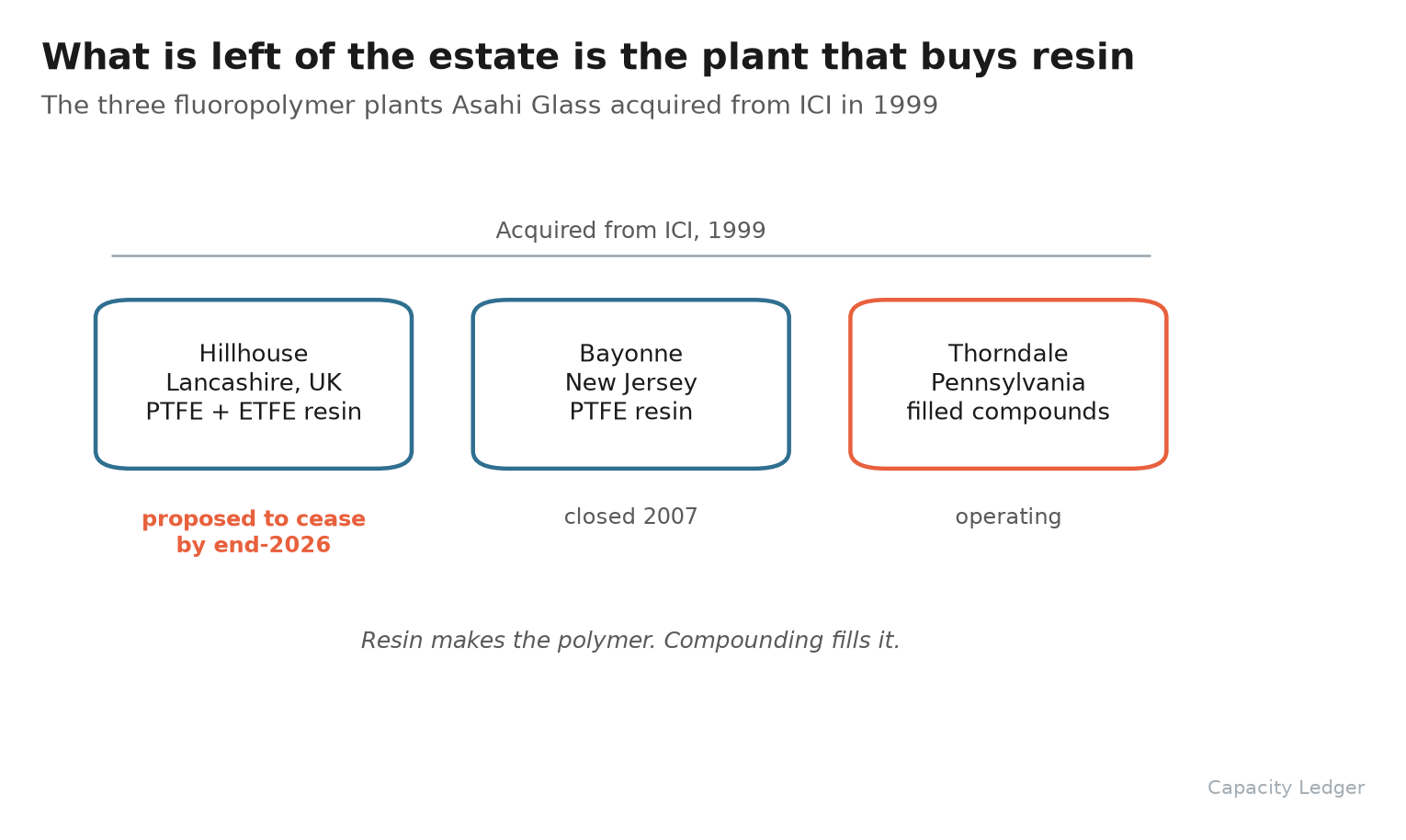
The deal came with three plants. A PTFE line at Hillhouse in Lancashire, a second PTFE line at Bayonne, New Jersey, and a plant at Thorndale, Pennsylvania that took resin and filled it.
AGC said at the time the purchase would triple a global PTFE share then sitting around 6%.
Bayonne went dark in 2007.
On July 13 this year, AGC Chemicals Europe opened consultation on a proposal to cease production at Hillhouse. All roles at the site are affected, 190 employees and 18 agency staff, and if the proposal survives the consultation, production stops by the end of this calendar year.
Which leaves the estate down to the plant that buys resin rather than the plants that make it (chart below).
Four Straight Losing Years in the Defensive Chemistry
The release is unusually plain about why. The site has generated "a loss for the past four years," and "despite continued investment from AGC Inc.," the position is "no longer sustainable in the context of a volatile and competitive market."
Set that against what the same parent was doing with fluorochemicals three years earlier. In March 2023 AGC announced a ¥35 billion expansion of its Chiba plant in Japan, explicitly for semiconductor demand, with the work starting in the second quarter of 2025.
Capital went into fluorochemicals. It went to Chiba.
Now, the fluoropolymer pitch of the last decade has been that this is the defensive corner of a specialty portfolio. High barriers to entry, positions qualified into customer parts, semiconductors and hydrogen and EV thermal management all pulling volume. Every producer's investor deck runs some version of it.
Hillhouse is what that pitch looks like from underneath, when your grades sit at the general-industrial end of the range and the marginal tonne comes from a newer reactor with cheaper power behind it.
The Same Reason, Nineteen Years Apart
Bayonne is the tell. Plastics News put the 2007 closure at 157 jobs, with AGC pointing at lower-priced imported resin out of Russia and China that its own selling prices could not track.
Nineteen years later, on the other side of the Atlantic, the phrasing is "volatile and competitive market."

The rest of this brief is for subscribers.
The capacity math, the trade-flow read, and what it means for the products you buy.
$50 a month, or $400 a year.
Already a subscriber? Sign in