 Capacity Ledger
Hovione Started the Hastelloy One First
Hovione opened 89 Twin Rivers at its East Windsor campus on September 15 with two commercial-scale PSD-3 spray dryers, and the one it started first is built in Hastelloy because a customer needed acid service. Its VP for the Americas puts a single unit of that class at 30 metric tons a year, and spray drying is how 54 percent of the FDA's approved amorphous products get made.
If you buy a spray dried dispersion out of an American plant, you have two more commercial dryers to book than you did in the spring.
Both of them sit at one address in East Windsor, New Jersey, and Hovione cut the ribbon on the building around them on September 15.
"Who can dry an acidic dispersion at commercial scale in the United States?"
The list got one entry longer this month, and the reason why is the most useful sentence in the announcement.
A New Building Inside an Existing Registration
89 Twin Rivers is 31,000 square feet holding two GMP-ready, commercial-scale PSD-3 spray dryers. It will employ roughly 80 people, and it closes a $100 million US investment cycle that started in 2025.
The line that matters for anyone qualifying a supplier is quieter. Hovione's release has the building operating "under the campus´s existing FDA registration and harmonized quality system."
The campus has run at 40 Lake Drive since 2002 and took a "zero" observation on its most recent FDA inspection, so the two dryers arrive inside a system somebody already audited.
What else is on that campus, from Hovione's own equipment list:
- a fully automated API pilot plant from 100L to 3,000L, with hydrogenation to 7 bar and cryogenic service from -75 to 150 ºC
- highly potent handling down to 1 µg/m³
- continuous drug product: wet and dry granulation, direct compression, real time release
- an 18 mm co-rotating pharma twin screw extruder, plus wet milling
Drug substance, dispersion and tablet at one address.
East Windsor Mayor Janice S. Mironov and BioNJ president Debbie Hart cut the ribbon alongside co-CEOs Marco Gil and António Almeida.
Thirty Tonnes Is the Unit of Account
A PSD-3 has a published number attached to it. David Basile, Hovione's VP of technical operations for the Americas, told Contract Pharma in April that "we could do 30 metric tons annually out of this type of a unit."
He qualified it the way an operator would: product to product that differs, and the company has products that do put that volume out of a PSD-3.
Two units, so on the order of 60 tonnes a year of dispersion intermediate at East Windsor once both are campaigning.
Now hold that against the approved book. Forty-eight drug products containing amorphous solid dispersions cleared the FDA between 2012 and 2023, covering 36 unique amorphous drugs, and spray drying made 54% of the intermediates (chart below).
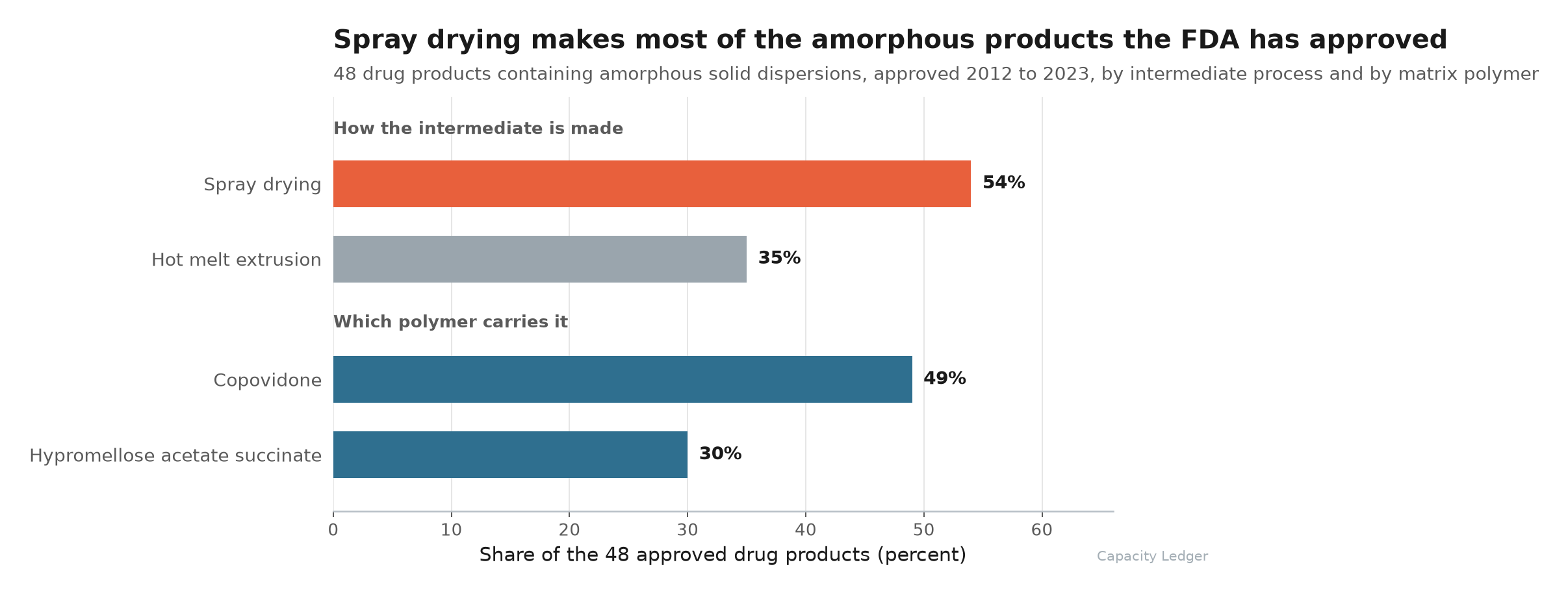
The polymer split is the half of that chart this readership actually buys. Copovidone carries 49% of those products and hypromellose acetate succinate 30%, so most of what leaves a commercial dryer is a vinyl copolymer or a cellulose ester bought by the drum.
HPMCAS reaches a formulator as Shin-Etsu's AQOAT, in USP/NF since 2005, or as Ashland's AquaSolve, launched at the AAPS meeting in November 2013. Every dryer hour booked in East Windsor is a purchase order on one of those lines.
The Hastelloy One
Here is where it gets interesting. The two PSD-3s differ, and they differ in metallurgy.
Basile, again in April: "The first machine that we will start up is a Hastelloy unit, which is unique. We took a pause [in the construction timeline] to make that upgrade, as we had a client that needed this configuration."
His reason: "you can do acidic solutions and more aggressive kinds of formulations as well as solvent-based formulations." The second machine he describes as "kind of a twin, but this one is standard 316 stainless steel."
A company moved its own construction schedule to put the corrosion-resistant dryer in first because one customer's solution needed it.
Wetted metallurgy is a hard boundary on what a dryer can be fed, and it gets frozen years before your molecule shows up. Two machines at one address with two metallurgies is two feed windows.
One number is worth reconciling as you read the coverage. The September release says the pair doubles US spray drying capacity, while Contract Pharma's September 3 tour piece says the whole program since 2025 tripled it.
Both hold. The difference is the size-2 dryer Hovione added at 40 Lake Drive along the way.
Who Else Is Adding Dryers
Six days before the ribbon cutting, Lonza said it will build two PSD-4 units at Bend, Oregon, with supporting infrastructure for solvent handling and storage, more than 80 jobs to start, and completion in 2029. Lonza's own framing is that the project makes it the United States' leading CDMO provider of commercial-scale PSD-4 capacity.
Hovione's next step up is the 15 acres next door: a 125,000 square foot building over five to ten years carrying laboratories, commercial-scale spray drying and drug product, with customers invited to co-invest for priority access.
Its PSD-4 class sits in Ireland today, where one unit went live late last year and nearly doubled Cork's local spray drying capacity, with at least one more in motion.
So the ladder, as a buyer sees it: PSD-3 class onshore is a booking this quarter, and the PSD-4 class announced this month is a 2029 date.
Final Thoughts
Spray drying spent twenty-five years as a particle engineering specialty a handful of people were genuinely good at. It is now the standing answer to a solubility problem Hovione puts at roughly 70% of small-molecule candidates.
What changes when a technique becomes the standing answer is where the constraint sits. It stops being know-how and starts being metal, floor space, and a registration somebody has already inspected.
Thirty tonnes a year covers one product, frankly. That is the honest limit on what opened this month.
It is also the most available thirty tonnes in the country, because it opened inside a quality system that already existed rather than beside one.
And the decision an operator will recognize instantly was made for a single customer: somebody looked at a construction schedule, looked at a feed solution, and moved the schedule.
Thanks for reading.