 Capacity Ledger
How Aberdeen Learned an Enzyme
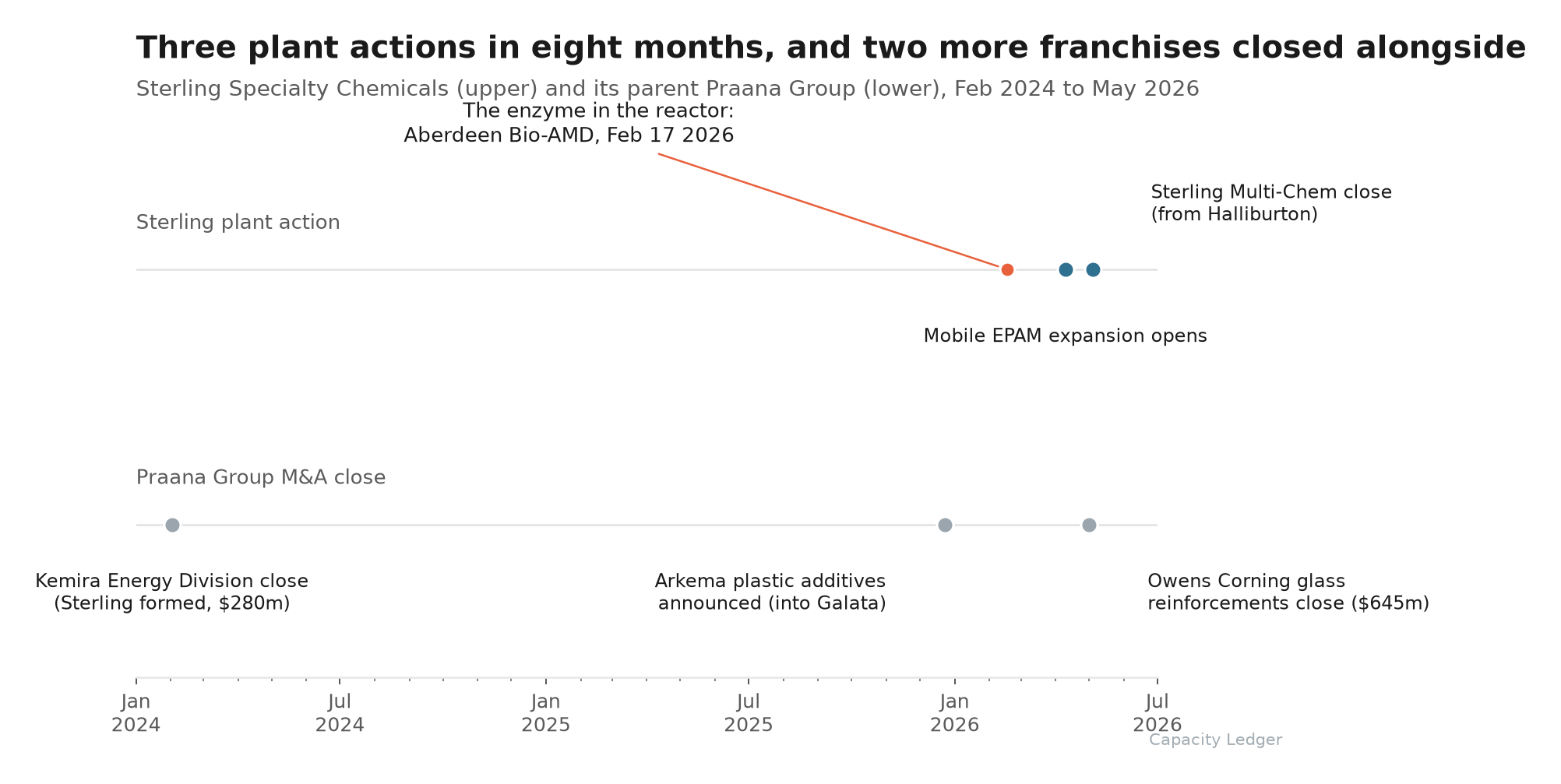
Sterling Specialty Chemicals ran three plant-level actions in eight months at the old American Cyanamid polyacrylamide franchise. Its parent Praana Group closed two more chemicals franchises in the same window.
On August 18, 1958, a chemist named Edwin Kolodny filed a patent for American Cyanamid.
The patent, US 3,002,960, described a polyacrylamide with a molecular weight above 12 million that thickened saline water enough to push oil out of a formation. Water flooding of oil-bearing formations. 0.05 to 0.5 percent by weight.
Sixty-eight years later, one plant makes almost exactly that product for almost exactly that end use, and its earliest polymer patents belong to the same American Cyanamid.
We looked at the calendar (chart below).
The plant is at 10930 Darracott Road in Aberdeen, Mississippi. Its owners today call it Plant 100.
Sterling Specialty Chemicals, LLC operates it. Kemira Chemicals owned it before Sterling did, and the Cyanamid lineage goes through Cytec first.
"What does the new owner of a sixty-eight-year-old US polyacrylamide franchise do first?"
Change the chemistry.
The February action: an enzyme in the reactor
On February 17, 2026, Sterling announced a new bio-based acrylamide platform, called Bio-AMD, at Plant 100.
The route is enzymatic hydration of a renewable feedstock. The company's own line on it: "a lower-energy, environmentally conscious alternative to conventional methods." The milestones listed in the release read like a plant that was already running before the announcement went out: equipment installation and commissioning, enzyme system calibration, trial production batches, quality validation, and regulatory approval.
The applications: friction reducers, chemical enhanced oil recovery, and water treatment flocculants.
That end-use list is worth reading twice against the Kolodny patent:
- Water flooding of oil formations is chemical EOR.
- Friction reducers are what polyacrylamides became in the shale era.
- Flocculants are how the same family entered municipal water treatment.
Aberdeen is running the same three markets Cyanamid's chemists opened in 1958, and it now makes the polymer by growing it.
The April action: EPAM opens in Mobile
On April 10, 2026, Sterling cut the ribbon on an expanded emulsion polyacrylamide line at Mobile, Alabama.
The end markets named in the release: hydraulic fracturing and water treatment. Two of the three from Aberdeen, downstream of the monomer.
The company's language about what the expansion buys them is direct: "SSC's ability to deliver reliable, scalable EPAM supply to customers across the energy and industrial markets." Read that beside the Aberdeen release from eight weeks earlier, and Sterling reads like a company that is deliberately feeding its own polymer chain.
Which brings you to May.
The May action: buying the field service arm
On May 4, 2026, Praana closed on a portion of Halliburton's Multi-Chem business. The acquired piece will operate as Sterling Multi-Chem.
Multi-Chem had been part of Halliburton since October 3, 2011, when Halliburton acquired the private San Angelo, Texas company founded in 1993.
Vishal Goenka, Vice Chairman of Praana Group, on the strategic frame:
"This acquisition aligns closely with Praana Group's long-term strategy of strengthening its global specialty chemicals platform through technology leadership, manufacturing excellence, and strong customer partnerships."
Read that beside the two production actions above. Aberdeen makes the monomer via enzymes, Mobile emulsifies the polymer, Sterling Multi-Chem takes it into the wellsite.
One company, three sites, one product family.
Three days before the Multi-Chem close, Praana closed something else.
The parent's parallel calendar
On May 1, 2026, Owens Corning completed the sale of its glass reinforcements business to Praana Group at a revised enterprise value of $645 million and approximately $280 million of upfront cash to Owens Corning. Different Praana subsidiary, different chemistry, same buyer, same week.
Also on Praana's docket, announced December 23, 2025 and slated for a Q1 2026 close: Arkema's plastic additives businesses, including the global methyl methacrylate butadiene styrene copolymers unit and the European and Asian acrylic impact modifier and processing aids activities. Roughly €44 million of 2024 revenue transfers, along with the Vlissingen, Netherlands production site. The recipient is Galata Chemicals, Praana's PVC additives arm.
So the eight months from February to May of this year carried three plant-level actions at Sterling (Aberdeen enzymes, Mobile EPAM, Multi-Chem folded in) and two portfolio-level closes above the company (Owens Corning on May 1, Arkema pending into Galata). One US polyacrylamide franchise, plus a fiberglass franchise, plus PVC additives, running on one owner's clock.
Final Thoughts
The Kolodny patent covered polyacrylamide for water flooding of oil-bearing formations at high molecular weight and low salt sensitivity. Sixty-eight years on, one Mississippi plant runs the same product family into the same end market, and the update is the chemistry that gets you there. That is what specialty chemicals in the United States usually looks like when it works: an old site inheriting a new process.
What is less common is doing three of those on one company's manufacturing footprint in the same eight months, while the parent above closes two more chemicals franchises. That is Sterling in 2026.
Thanks for reading.