 Capacity Ledger
How Bethlehem Got a Second Way to Make Sevoflurane
A 25,113 square foot building in Pennsylvania has been making inhaled anesthetic since 1992 and ships it to more than 100 countries. On August 31 this year, sixteen years to the day after the first foreign-trade zone application for the site, its operator asked the Board to add one more molecule, and that molecule sits a step further down the sevoflurane route than the one it named in 2010.
A building outside Bethlehem, Pennsylvania has been making inhaled anesthetic since 1992.
Minrad ran it first. Piramal Critical Care bought the site in 2009.
The following year the Lehigh Valley Economic Development Corporation asked the Foreign-Trade Zones Board to make the two sites on 4.3 acres a subzone. That application was formally filed on August 31, 2010.
Sixteen years later, to the day, the Board received another filing on the same plant.
"What has changed at a plant when the only new thing on the public record is one molecule?"
Twenty-Five Thousand Square Feet, a Hundred Countries
The 2010 paperwork is the last time anyone put real operating numbers for this site into the Federal Register: 95 employees, 445 metric tonnes of capacity, two sites, 23% of finished-product value coming from abroad, and an expectation that 40% of what shipped would be exported.
Those are 2010 figures and the company has not refreshed them in a public filing since. What it has published is the building.
The bulk manufacturing plant is 25,113 sq ft, with a 22,000 sq ft expansion finished in 2012 and about $20m spent on facility and quality upgrades since 2010.
It runs 24/7. Product goes to more than 100 countries.
And it holds the inspection record that export book requires: USFDA, MHRA, KFDA, the Turkish health ministry, SGS Australia, the Russian Federation and the GCC have all been through it.
Okay, so what does a plant that size actually do. The 2010 notice is specific: the manufacture and distribution of sevoflurane and isoflurane, from two bought-in intermediates, hexafluoroisopropyl methyl ether (HFMOP) and trifluoroethanol (TFE), each landing at a 5.5% duty rate.
Both finished anesthetics enter the United States duty free, which is the whole reason the subzone was worth asking for.
The Molecule the Board Wrote Down
The notification published on September 24 names three things: pharmaceutical-grade glass bottles, plastic integrated closures, and 2-(chloromethoxy)-1,1,1,3,3,3-hexafluoropropane, which the filing abbreviates HFCMOP. Duty rates run from free to 5.3%.
The chemists have a shorter name for the middle one. It is chlorosevo, CAS 26103-07-1, and it is the last thing that exists before sevoflurane does.
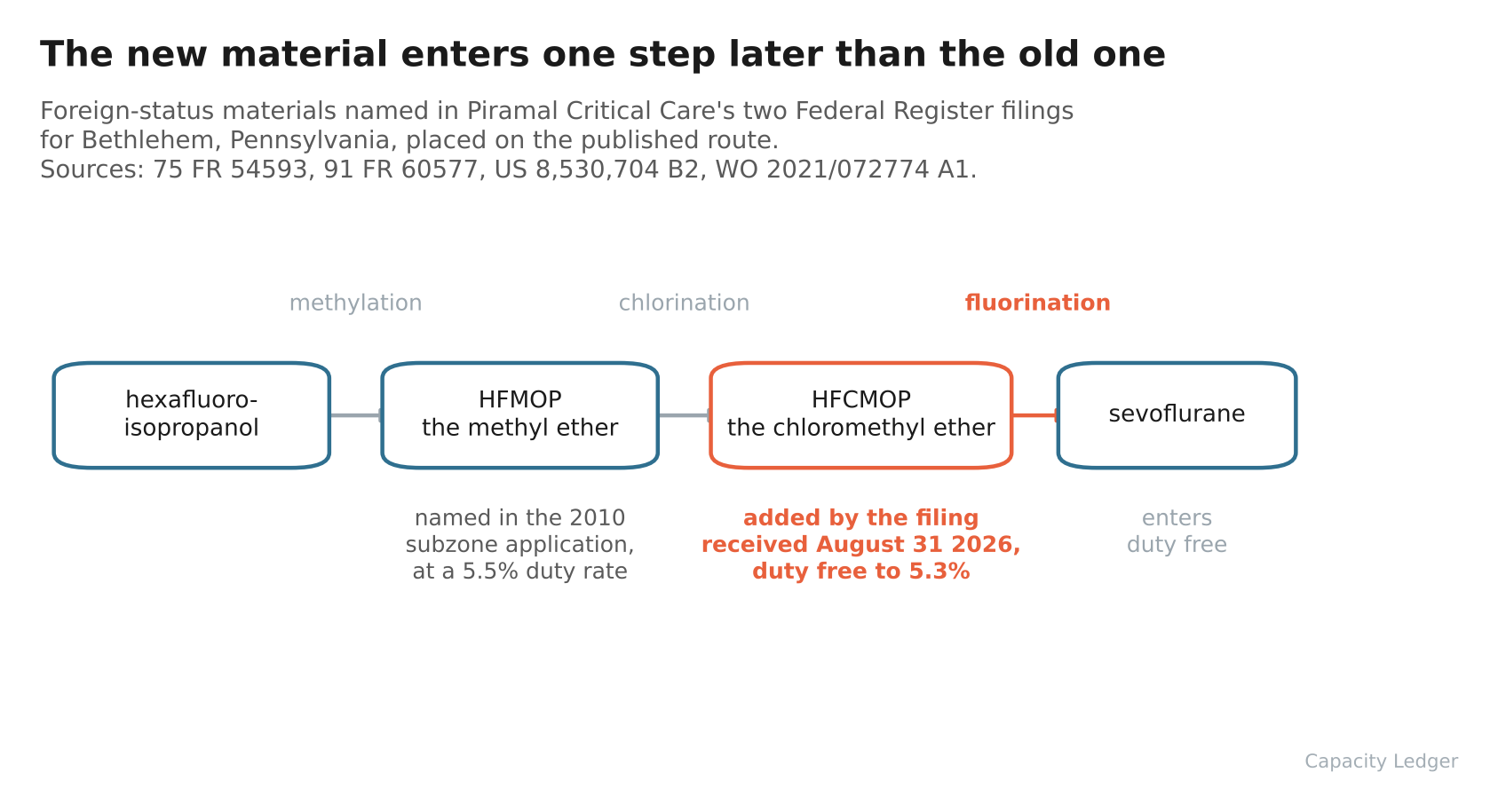
Here is why that matters. The published route runs in three moves:
- Hexafluoroisopropanol goes to the methyl ether, HFMOP.
- Chlorine takes HFMOP to the chloromethyl ether, HFCMOP.
- A fluoride source, potassium or sodium fluoride or HF itself, swaps that chlorine for fluorine and the product is sevoflurane.
So the material named in 2010 enters at step two and the material named this year enters at step three (chart below). The chlorination sits between them.
Worth being exact about what the Board is being asked for, because it is narrower than it looks. Under 15 CFR 400.14(b) the authority covers only the materials written down, and these would be added to production authority Bethlehem already holds.
Nothing in the notice retires HFMOP, names a volume, or says where HFCMOP would come from.
One line does carry a warning for anyone sourcing the same molecule. The request indicates certain materials are subject to section 301 duties depending on country of origin, and the applicable decision requires that merchandise be admitted in privileged foreign status under 19 CFR 146.41.
Privileged foreign status is a one-way door. You apply for it on admission, or any time before the material is worked in a way that changes its tariff classification, and the regulation is blunt about what follows: the status "cannot be abandoned and remains applicable to the merchandise even if changed in form by manipulation or manufacture".
Comments close November 3.
Forty-Seven Percent, and the Gas That Comes Back
The business this plant sits inside reports a 47% share of inhalation anesthesia, up from 45% in March 2024, on IQVIA data, and the group's FY2026 annual report describes that leadership as a US position. Complex Hospital Generics turned over ₹2,703 crore in FY26 against ₹2,633 crore the year before.
Supply has been spreading out rather than concentrating. The company started shipping sevoflurane from its Digwal site in India into selected rest-of-world markets this year, and its Dahej site, eleven acres with its own fluorination equipment, makes key starting materials in-house.
Then there is the stranger sourcing story, announced on February 5.
Piramal Critical Care and Blue-Zone Technologies of Ontario put together an arrangement where waste anesthetic gas gets captured in the hospital, collected, and processed back into sevoflurane USP for human use, approved in Canada.
Blue-Zone brings the capture hardware. Piramal does the processing.
Jeff Hampton, the company's president and COO, framed it as a clinical freedom rather than a green one: "By introducing gas capture technology, hospitals can choose the inhaled anaesthetic that best meets clinical needs."
For a buyer, the interesting part is the feedstock. A fluorinated ether that has already been through a patient is a specification problem of a very high order, and somebody has signed up to solve it at pharmacopoeial grade.
Final Thoughts
Nothing in any of this was announced. There is no press release about HFCMOP, no capacity number, no ribbon.
There is a one-page notice in the Federal Register, a molecule spelled out in full, and a comment window that closes in under a month.
That is usually how a plant tells you what it is going to do next. Thirty-four years in the same business, in a building you could walk end to end in a minute, and the news arrives as a chemical name in a government docket.
Thanks for reading.