 Capacity Ledger
How Israel Gained Fifty Thousand Tonnes of Bromine on Paper
USGS restated Israel's 2024 bromine production from 140,000 tonnes to 190,000 in the February edition of the same table, and carried the world total up 40,000 with it. Israel was 83% of US bromine imports over 2021 to 2024 and 89% through July 2025, and the concession that produces it runs to 2030.
USGS publishes the same bromine table every year. Seven producing countries, a world total, and a row for the United States that reads W for withheld, in every edition we pulled.
In February, the 2024 line for Israel changed from 140,000 tonnes to 190,000.
Nothing was built and nothing restarted. The tonnes were always there.
The number the market had been working from for thirteen months was about a third light, and the reason sits in one sentence above the table: production in 2024 for Israel was revised significantly based on a Government report.
"If the largest reported number in bromine can move 36% between two editions of the same table, what is your import concentration actually?"
Every other country in that table moved by less than 10,000 tonnes or not at all, so the whole of the 40,000 tonne lift in the world total is one country (chart below).
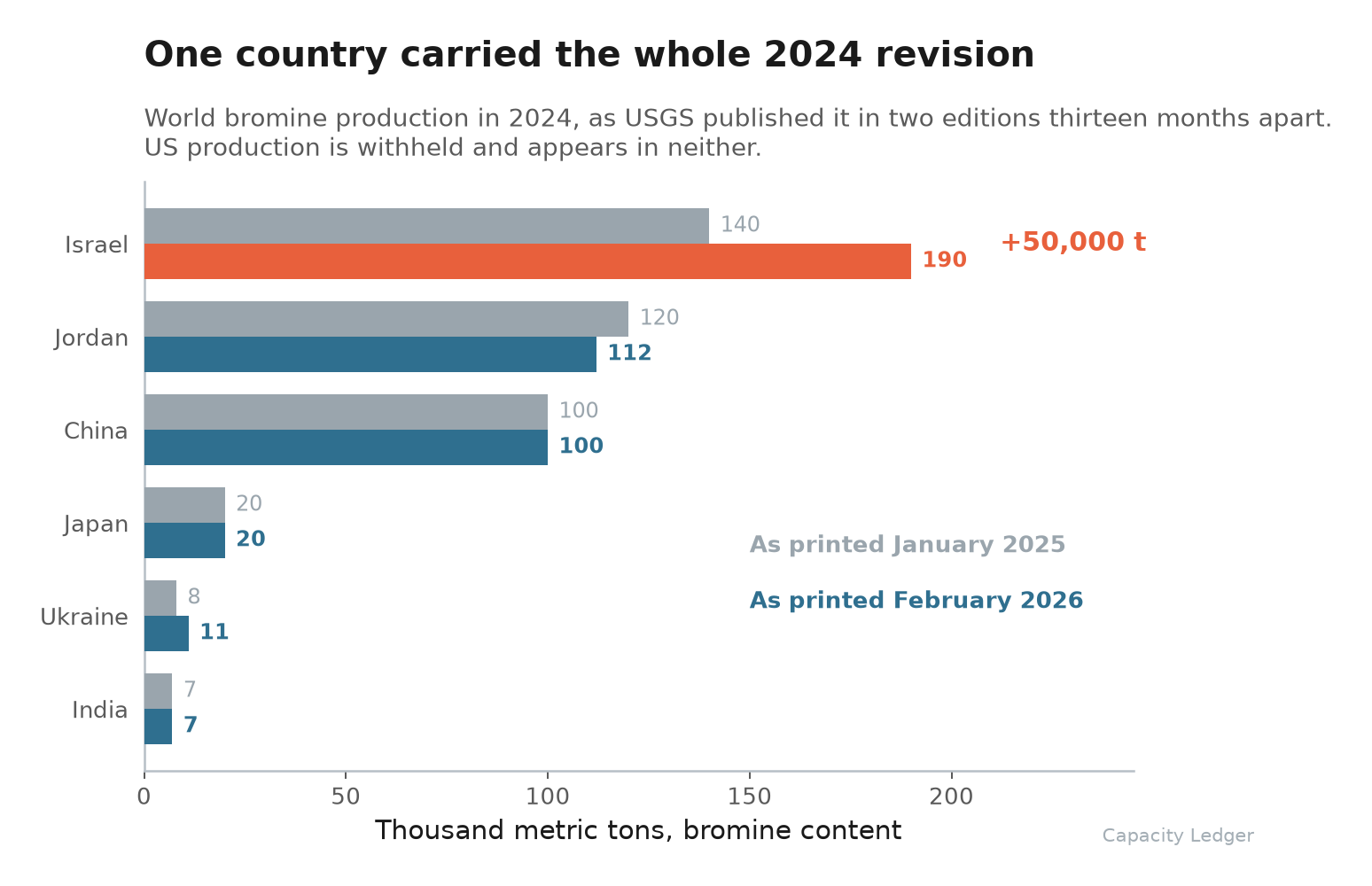
The number everyone was using
The January 2025 edition put world bromine production for 2024 at 400,000 tonnes, excluding withheld US output. The February 2026 edition puts the same year at 440,000.
Jordan came down 8,000 and Ukraine went up 3,000. Israel supplied the rest of it.
Carry that forward into the 2025 estimate and Israel prints 200,000 against a world total of 430,000. That is 46.5% of everything USGS counts, and the count excludes the two Arkansas producers whose tonnes nobody outside the agency sees.
So the honest version of the concentration number is that you cannot compute it from public data. What you can say is that nearly half of the bromine anyone can count now comes out of one country.
The import book got tighter while the old number was still in print
US imports of elemental bromine and compounds ran 27,200 tonnes in 2021, 50,800 in 2023, 58,300 in 2024, and an estimated 40,000 in 2025. That last step is a fall of about 30% in a single year.
The average unit value of those imports went the other way, to roughly $3.00 per kilogram, 12% above 2024.
Less volume at a higher price is the shape you get when the marginal supplier steps back rather than the buyer. And two of the four countries outside the Dead Sea did step back in 2025: China from 100,000 tonnes to 90,000, Ukraine from 11,000 to 6,000.
Source concentration moved with it. Over 2021 to 2024, US bromine imports ran 83% Israel, 12% Jordan, 3% China.
Through July 2025 the same measure reads 89% Israel and 6% Jordan.
Worth knowing which codes those tonnes actually arrive under, because the duty exposure is not where a procurement file usually puts it:
- Elemental bromine, HTSUS 2801.30.2000, carries 5.5% ad valorem at the normal trade relations rate.
- Sodium and potassium bromide (2827.51.0000) and ammonium, calcium or zinc bromide (2827.59.2500) enter free.
- Those two bromide lines are almost 90% of imported bromine by content.
What sits underneath the 190,000
One concession, and it has a date on it.
ICL signed a detailed and binding agreement with the State of Israel on January 27, 2026 covering the Dead Sea concession assets. The concession runs to April 1, 2030.
The state pays $2.54bn for the assets plus the harvest investments, and ICL agreed it will not object to the cancellation of its right of first offer under the current Concession Law.
The company says it intends to bid for the next concession and still believes it is the most suitable candidate to operate it. Intending to bid is a weaker position than the one the Concession Law used to give it, where matching a rival's offer was a right rather than a plan.
Three companies are named in that filing as the Dead Sea Companies: Dead Sea Works, Dead Sea Magnesium, and Dead Sea Bromine Company Ltd.
Bromine is inside the concession. So the asset behind nearly half of counted world supply goes to competitive tender inside four years, and the incumbent has agreed not to stand in the way of losing the clause that used to make the outcome a formality.
Final Thoughts
A statistical revision is not a supply event and we would not call this a shortage signal. Nobody lost a plant here, and Israel's 2025 estimate has output going up, not down.
What changed is the quality of the number underneath a lot of procurement arithmetic. If you sized your alternate-supply exposure off the world total, that denominator was 10% wrong for thirteen months, and the error was entirely in the one country you already buy most of your bromine from.
Our brief this morning had a Chinese bromine producer running a sixth of its plant. Set that next to a 10,000 tonne fall in China's national figure and a Dead Sea concession heading for tender, and the flame retardant and clear brine files are worth reopening before the 2027 contracts get written.
Thanks for reading.