 Capacity Ledger
How Lao Cai's Ore Problem Reached Your Phosphorus
US imports of elemental phosphorus ran 2,159 tonnes through August, down 62 percent on the same eight months of 2025. Two countries ship 97 percent of it, and only one of them has explained itself.
If you buy a phosphorus chloride, a phosphate ester, or anything else that starts life as P4, the US customs file has been strangely quiet all year.
Imports of elemental phosphorus ran 2,159.3 tonnes over the first eight months of 2026. The same eight months of 2025 brought 5,633.0 tonnes.
That is -61.7%. Eight months of this year landed less phosphorus than the first quarter of last year did on its own.
Two Origins and Nothing Behind Them
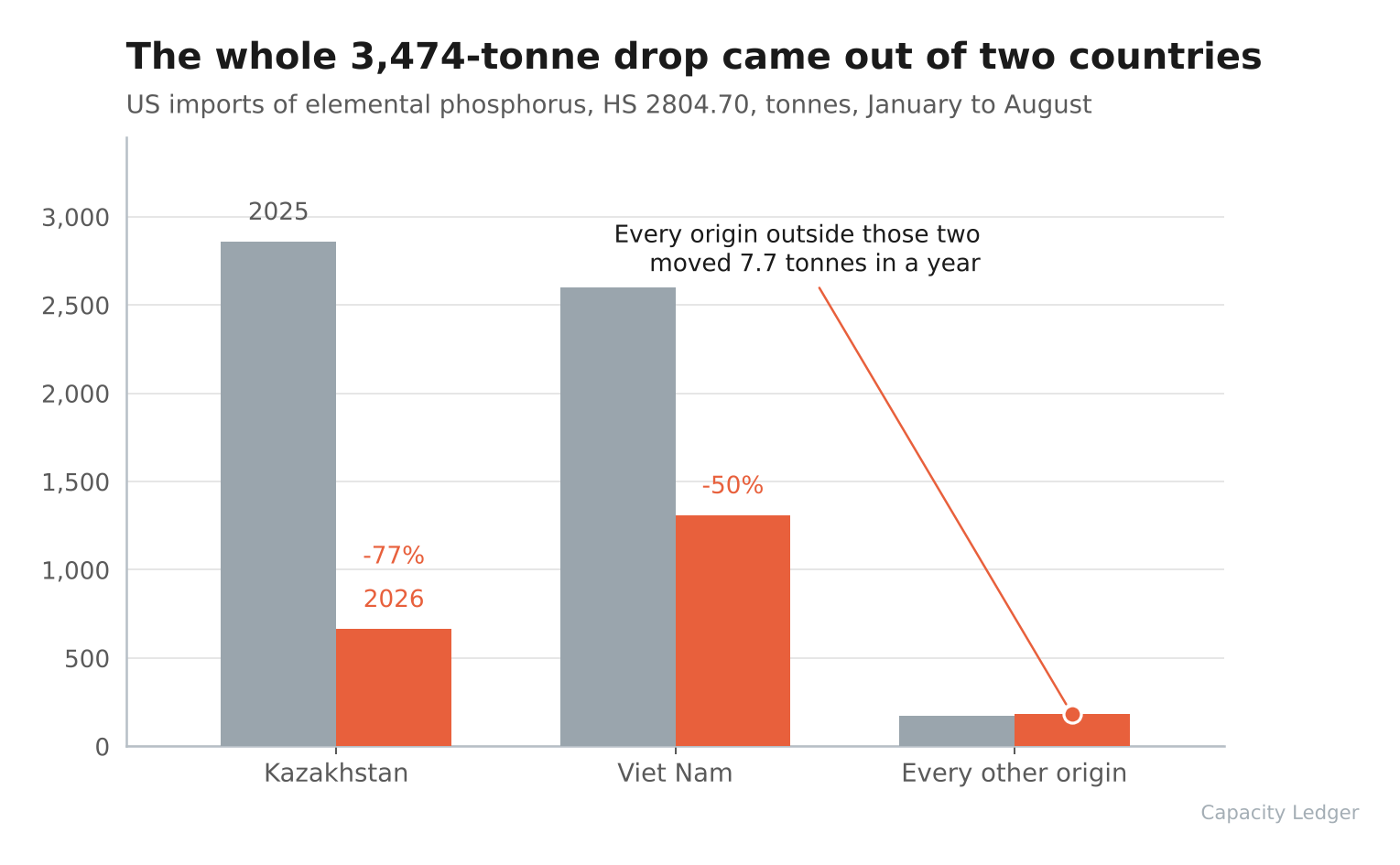
The concentration is the part worth holding onto. Across 2025, Kazakhstan and Viet Nam between them shipped 97.1% of the tonnes the US bought under HS 2804.70 and 94.2% of the dollars.
China, which mines more phosphate rock than any other country, sent 48.6 tonnes in the entire year.
So when both of the two slip in the same eight months, there is no third origin standing by to take the call.
Kazakhstan went from 2,860.5 t to 666.4 t, down 76.7%. Viet Nam went from 2,597.6 t to 1,310.3 t, down 49.6%.
Every other origin on the file, added together, moved 7.7 tonnes, and moved them upward (chart below).
Now, the ordinary reason an import series halves is that the buyer stopped buying. So check the price.
Implied landed value across those same eight months went from $3.85/kg to $4.48/kg, up 16.4%, and the Chinese P4 spot average for the first half of 2026 came in at RMB27,511.69/t, up 17.57% year on year.
Less volume at a higher price is a supply story.
Mining Site 25
One of the two origins has a documented reason, and it sits in a criminal file.
On 17 March, Vietnam's Ministry of Public Security detained Dao Huu Huyen, chairman of Duc Giang Chemical Group, along with his son Dao Huu Duy Anh, the deputy chairman. Among the allegations: illegal extraction of hundreds of thousands of tonnes of apatite ore, and illegal dumping of waste across dozens of hectares at the Tang Loong Industrial Park in Lao Cai.
Here is where it reaches you. Mining Site 25 was suspended so the investigation could run, which left Duc Giang buying entirely imported and externally purchased ore to feed its own furnaces.
First-half gross margin fell to 20.8% from 34.4% a year earlier. Vietcap's model now assumes the company has no captive ore at all through 2028.
The customs series keeps time with it. Viet Nam shipped 737.8 tonnes to the US in January 2026, before the arrests.
Across the seven months from February to August it shipped 572.5 tonnes in total.
To be fair to the company, Duc Giang is one Vietnamese producer, and Comtrade reports the country of origin without saying a word about which plant filled the container.
And it has held its order book: in results reported on Sunday, third-quarter overseas revenue came in near VND2,062 billion, up almost 4%. Whatever got rationed this year, American arrivals took the cut.
Kazakhstan Has Said Nothing At All
The larger fall is the one with no public explanation attached to it.
Kazakh shipments are down 76.7% on eight months, and the country is absent from the US file entirely in January, February, May and June. Nothing this desk found in 2026 reports an outage, a curtailment, an export restriction, or a reallocation at the Novodzhambul plant at Taraz.
That is the uncomfortable half of this chart: the origin that moved most is the one nobody has written about.
Two things worth putting on a watch list, because the series will not warn you:
- Whether Kazakh tonnes come back at scale in the September and October data, which publishes roughly two months in arrears.
- Whether Mining Site 25 reopens. Vietcap is modelling three years without it, and that is a broker's working assumption rather than anything Duc Giang has said.
Final Thoughts
Phosphate went onto the US critical minerals list on 7 November last year, at 90 FR 50494, alongside fifty-nine other entries. That listing is about rock, and the US mines plenty of rock: 20 million tonnes of marketable product in 2025.
Rock is not what lands in your drum. USGS puts more than 95% of domestic phosphate rock into wet-process acid, and says the remainder that becomes elemental phosphorus goes "to produce phosphorus compounds for industrial applications, primarily glyphosate herbicide."
Which leaves the designation and the molecule in your spec on two different supply chains. One runs to 20 million tonnes a year and sits inside the country.
The other runs to roughly seven thousand tonnes, arrives from two addresses, and has shed three fifths of its volume in eight months while getting 16% dearer per kilogram.
Worth knowing which of the two your contract actually leans on.
Thanks for reading.