 Capacity Ledger
How Much of the Chemical Tariff Did the Court Take?
Two Julys apart, US chemical imports cleared customs within twenty million dollars of each other, and the duty assessed on them fell by $249 million. The Supreme Court struck the IEEPA tariffs in February, and just over half the increase since 2024 is still standing.
Two Julys, the same book.
US chemical imports cleared customs at $27,609.8 million in July 2025. In July 2026 they cleared at $27,589.5 million.
Twenty million dollars apart on twenty-seven billion, which is about as close to a controlled experiment as trade data ever hands you.
The duty assessed on that identical book fell by $248.9 million.
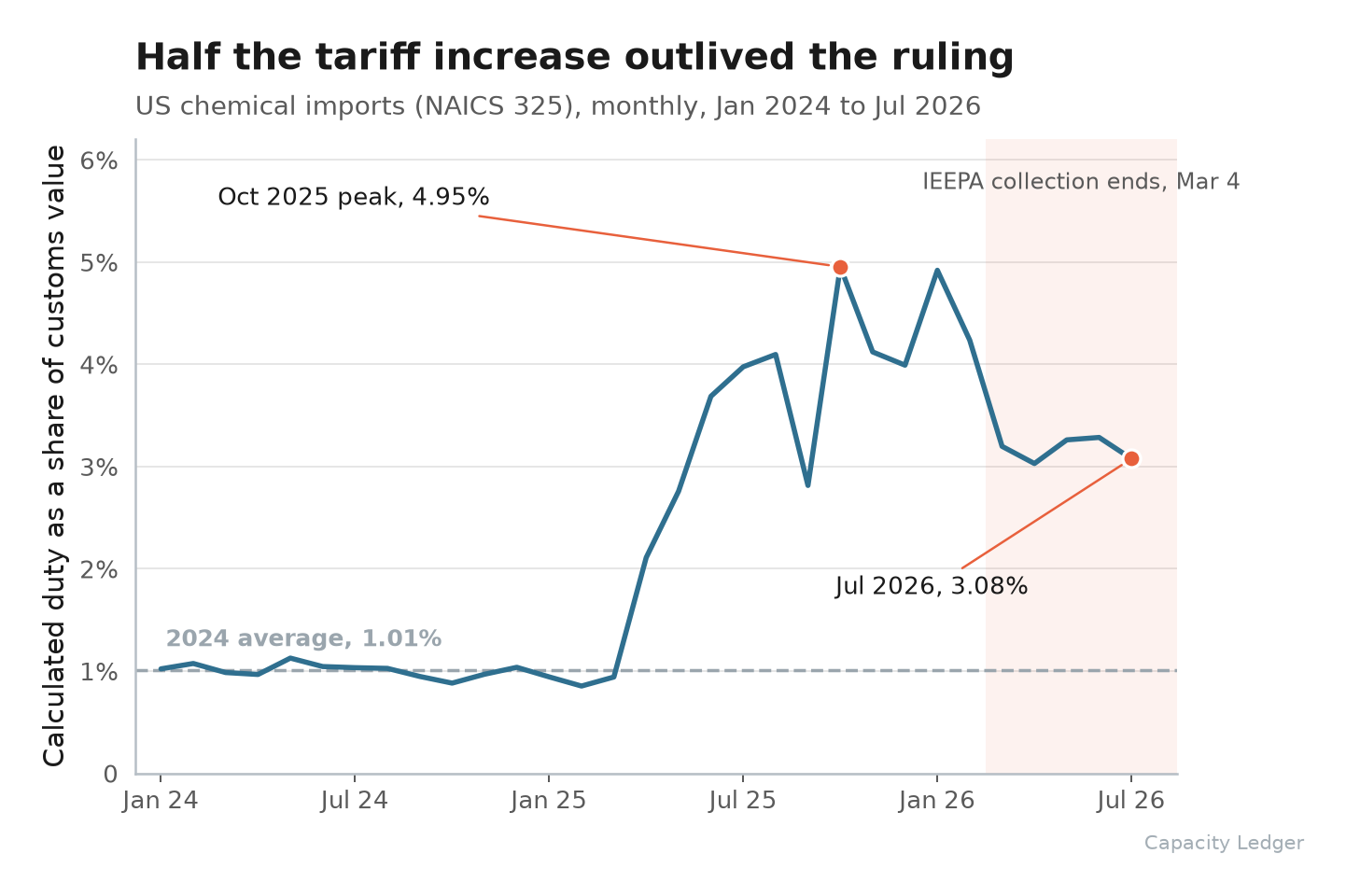
Census published the pair yesterday morning, in Exhibit 1 of the July FT-900, the table that carries imports for consumption and calculated duty side by side for every NAICS product code. Divide the second by the first and you get the number your landed-cost model is really arguing about: what a dollar of imported chemistry pays at the border. For chemicals it was 3.08% in July, against 3.98% a year earlier (chart below).
The Step That Only Half Came Back
Through all of 2024 that rate sat at 1.01% and refused to move. Twelve months, every one of them inside a band of 0.88% to 1.13%.
It broke in April 2025 and kept climbing: 2.11%, then 2.76%, then 3.69%. October peaked at 4.95%, and January 2026 printed 4.92%, near enough to the same thing.
Then the Supreme Court decided Learning Resources v. Trump on February 20, held 6-3 that IEEPA does not authorize tariffs, and voided both the reciprocal tariffs and the trafficking tariffs.
The Court of International Trade told CBP on March 4 to liquidate and reliquidate entries without them.
March printed 3.20%. Every month since has landed between 3.03% and 3.29%.
So of the 395 basis points the rate put on between the 2024 baseline and the October peak, 52% is still there.
What the Ruling Could Not Reach
The half that stayed is the half nobody litigates away in a season. Section 232, Section 301, the antidumping and countervailing orders and plain MFN duty all came through the holding untouched, and they are what the 3.08% is made of now.
Worth keeping in proportion, though. Chemicals still pay less than half what the rest of manufactured imports pay: the same Exhibit 1 puts all manufacturing at 7.17% in July and the grand total of US imports at 6.45%.
That gap is the thing to price. A chemical book paying 3.08% in a country whose average manufactured import pays 7.17% is nowhere near a ceiling.
September 29 Lands on the Same Code
The April 2 proclamation under Section 232 covers patented pharmaceuticals and their active ingredients, and the text reaches key starting materials along with them. Base rate 100% ad valorem. 20% for companies with a Commerce-approved US onshoring plan, 15% for Japan, the EU, South Korea and Switzerland, 10% for the UK, and zero for the companies that signed MFN pricing agreements. Annex III companies started paying July 31. Everyone else starts September 29.
Pharmaceutical preparations sit inside NAICS 325 with your intermediates, so the aggregate in that chart is about to move for reasons that have nothing to do with the molecules most of this readership buys. Which is the argument for reading it now: July's 3.08% is the last clean print of the post-ruling regime.
Final Thoughts
One honest limit on all of the above. Census says calculated duty "does not necessarily reflect amounts of duty paid" and should be used with caution, and the series measures what got assessed at entry rather than what CBP keeps once the refund and reliquidation machinery has run.
Whatever comes back out of 2025 will never appear in these monthly prints.
It is still the only monthly duty number that arrives with the trade data, and it is consistent enough that thirty-one separate monthly releases sum to the published year-to-date totals to the rounding digit. What it says is something a lot of 2026 budgets have not caught up with.
The court took the reversible part.
Your chemistry pays three times what it paid two years ago, and the authority holding it there is the kind that ends when an agency decides it should.
Thanks for reading.