 Capacity Ledger
How the Capex Cuts Missed the Job Site
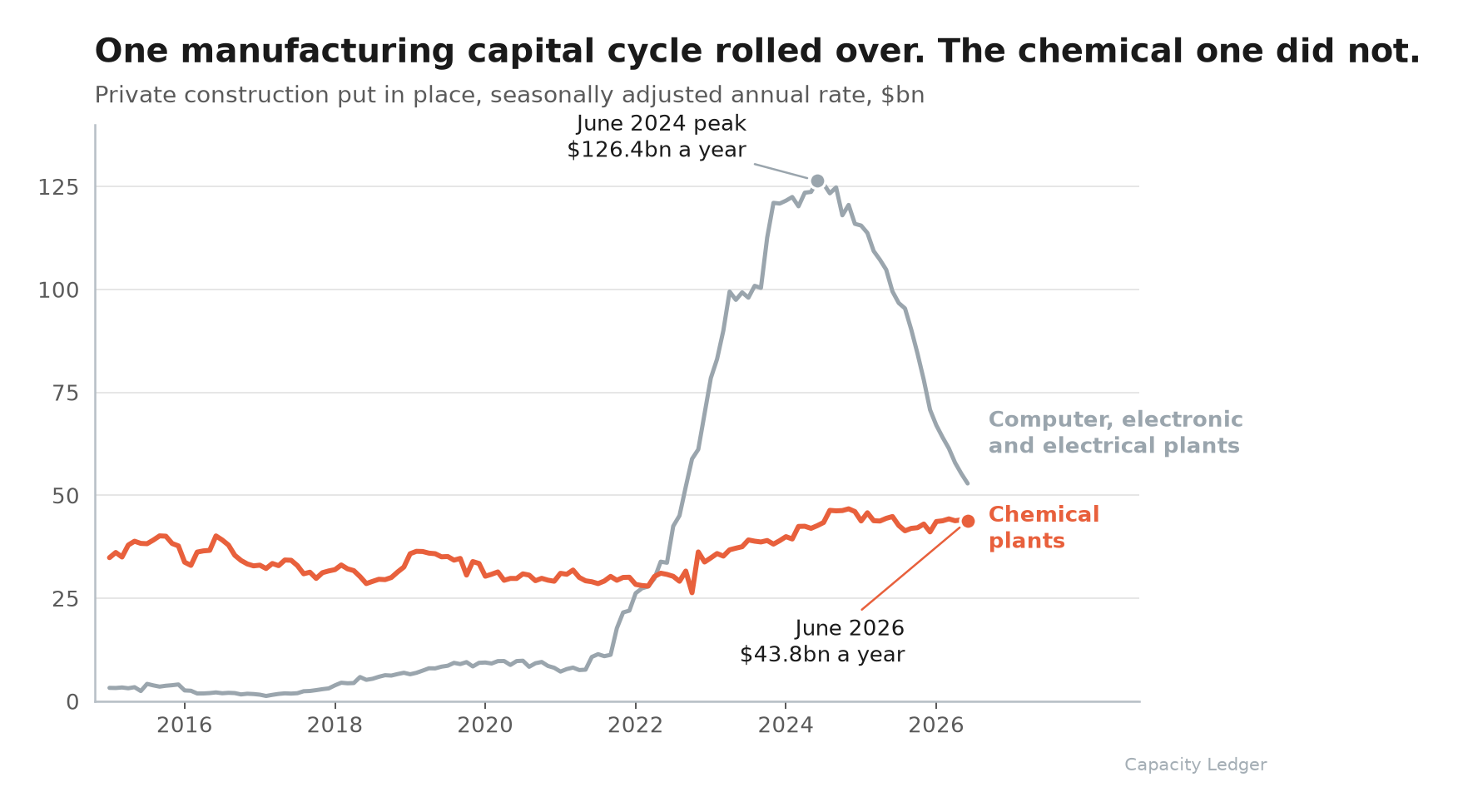
Every producer we have read this earnings season guided capital lower. National spending on chemical plant construction ran $43.8 billion a year in June, six percent off its all-time high, while semiconductor construction fell by more than half.
Every chemical producer we have read since the end of July has said the same thing about capital, in the same direction. Lower.
LyondellBasell spent $270m on capital expenditure in the second quarter against $347m of depreciation and amortization for the same three months, and its release names lower capex as a target of the Cash Improvement Plan rather than an accident of the cycle.
The Census Bureau counts the concrete instead of the intention. Its June figure for private construction put in place on chemical plants came in at $43.8bn a year, 6% below the November 2024 high and inside the same narrow band it has held for eighteen months (chart below).
"Whose money is in that $43.8 billion?"
Two capital cycles, one chart
The comparison sitting right next to chemicals in the same table is the useful one.
Construction of computer, electronic and electrical plants peaked at $126.4bn a year in June 2024 and has since fallen to $52.9bn, down 58% from the peak and 47% on the year. All private manufacturing construction is down 32% from its own September 2024 high.
Chemicals did not grow through any of that. It simply declined to participate in the collapse, and that alone moved its share of every private manufacturing construction dollar from 17.2% in June 2024 to 25.7% in June 2026.
So the answer to why the two stories disagree is a timing question, and the electronics line is the worked example of how it resolves.
Concrete is the last step
A capital decision reaches a job site years after it is taken, and it keeps showing up in this series for years after that.
Eli Lilly's Huntsville plant is the cleanest illustration currently in flight: more than $6bn, announced on December 9, 2025, a synthetic active pharmaceutical ingredient facility for small molecule and peptide medicines, with construction beginning in 2026 and completion slated for 2032. That single project will be inside the Chemical line on this chart through the end of the decade, and nothing anyone says on a 2026 earnings call can pull it back out.
Electronics shows the other end of the same mechanism. Fab decisions taken in 2021 and 2022 spent their way to a mid-2024 peak, and the 58% fall since then is the tail of that same build cycle working itself out.
Which means the June 2026 chemical print is a readout on sanction decisions taken in 2023 and 2024. The capex cuts being announced now arrive in the concrete around 2028 and 2029.
What the category actually holds
Census defines the Chemical category by process, as industries that "transform organic and inorganic raw materials by a chemical process and form products." An API plant qualifies, which is why Lilly's Huntsville campus counts here alongside a cracker or a chlor-alkali line.
That matters more than it used to. We showed on Friday that essentially all of chemical manufacturing's headcount growth since 2019 sits in pharmaceuticals, and the same distortion runs through the construction figures.
The pharmaceutical onshoring wave is holding up a line that gets read as though it were all basic and specialty capacity.
Two other limits worth saying once: every dollar here is nominal, with no construction-cost deflator applied, and June is preliminary with both April and May revised in this release.
Final Thoughts
The practical read for anyone buying on a 2028 or 2029 contract is that the arrival side of the ledger for those years is already poured, or at least already committed, and it is largely not coming from the producers telling you they are shrinking.
Air Liquide is the shape of what does arrive. Over $160m for a large-scale ultra-high-purity gas plant in Arizona, announced July 16, starting up in 2028, built to feed a fab expansion rather than a chemical park.
The gap that all of this year's capital discipline creates is real, and it opens toward 2030. The July figure prints on September 1, and the number to watch is whether that $43bn band finally breaks downward.
Thanks for reading.