 Capacity Ledger
Korea Got the Parts-Per-Billion Step
Indichem went from groundbreaking to ribbon at Gongju in eleven months. The October 27 numbers show the part that takes longer, and why an Indian molecule now gets its last purification inside the customer's own time zone.
A semiconductor-materials plant went up at Gongju, in South Korea's South Chungcheong province, in eleven months flat.
Ground broke on September 29, 2025, and the ribbon was cut late this August.
The company that built it makes its molecules in Gujarat.
Indichem Inc. is the Korean operating entity, held 75:25 by Acutaas Advance Material Limited, a wholly owned subsidiary of Acutaas Chemicals, and by J & Materials Co. Ltd of South Korea.
The JV agreement was signed June 27, 2025, so the whole thing, paperwork to production building, ran about fourteen months. AAML has put KRW 30 billion into it, roughly INR 200 crore.
And the reason it sits in Gongju rather than Ankleshwar is the one genuinely interesting thing about the project.
What Gongju Actually Does
The split is explicit in the company's own framing: synthesise in India, refine and test and qualify in Korea. Naresh Patel, Acutaas chairman and managing director, put it as combining "India's core strengths in complex chemical synthesis with Korea's expertise in ultra-high-purity refining".
Jay Han, who runs Indichem, was blunter. The company is not asking customers to come to India, he said, it is bringing India to Korea.
That is a sourcing statement dressed as a ribbon-cutting quote. The materials here are photoresist, packaging and etching chemistries, where the spec is written in parts per billion and the audit trail matters as much as the molecule. Synthesis is a scale problem and India is good at it. The last purification step, the metrology behind it, and the customer qualification that validates both are a proximity problem.
The site itself is modest and built to grow: 16,513.7 square metres, three buildings (a main production block, a combined headquarters with R&D and a pilot plant, and a warehouse), with land held back for expansion.
There is no public nameplate for it. Nobody has published a tonnage, a litreage or a line count, and we are not going to invent one.
The Clock That Isn't the Construction Clock
Acutaas approved its second-quarter numbers on October 27, and the Gongju disclosure inside them is more useful than the headline.
The plant is on trial runs, and multiple qualification batches have gone to Korean customers.
FY28 is the company's stated ramp-up year for initial products, and management declined to attach any meaningful revenue or profitability to the current one.
Line those dates against the build and the shape is clear (chart below). Construction closed at month eleven.
First qualification batches were out by month twelve, and the ramp year the company itself points at does not open until month eighteen, on April 1, 2027.
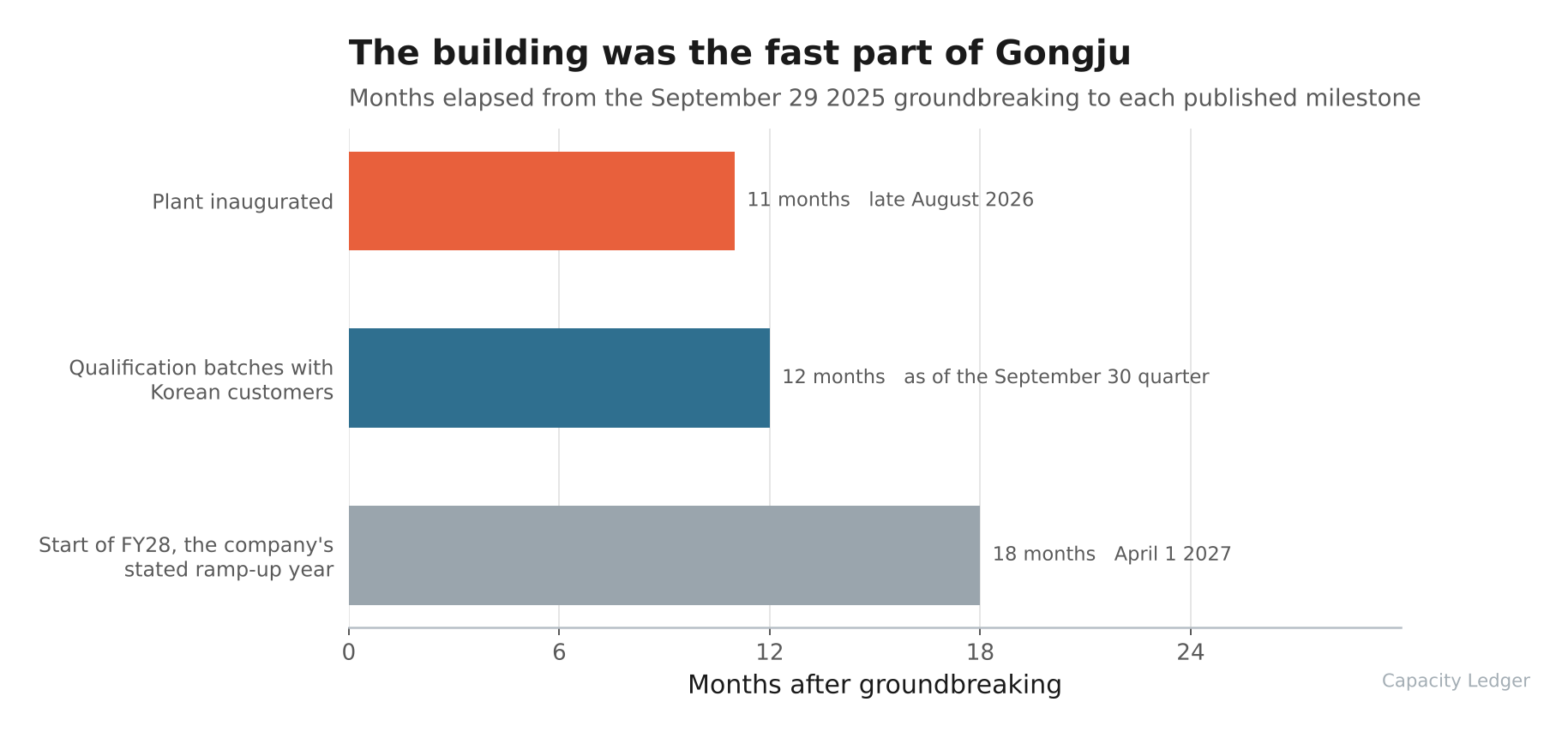
So the eleven months are the part that was under Acutaas's control, and they spent it well. The next eighteen belong to somebody else's incoming-inspection lab.
Okay, so why build the fast thing at all if the slow thing gates it? Because the slow thing runs faster when it is local.
A fab engineer qualifying a new etch chemistry wants to walk the plant, pull a retain, and argue about a COA in the same working day. Put that plant in Gujarat and every one of those loops costs a flight.
What This Means If You Buy to a Spec
The target market here is stated, and it is not India: Korea, Japan and Taiwan. Which makes this a supply-side development for anyone qualifying electronic chemicals in that ecosystem, and worth two things on your side of the table:
- A second source that is already in the queue, not one you have to start. Qualification batches have been submitted since the September quarter. If you are running a dual-source program on a photoresist raw material or an etch component, this one is further along than a plant that opened ten weeks ago usually is.
- A template to ask your other suppliers about. The question is not whether a supplier can make the molecule. It is where they do the last purification step and whose lab signs off on it. Acutaas answered that by building the answer in the customer's country.
The company is also building an electronic-grade chemicals plant back in India, about INR 100 crore of planned capex, roughly a year and a half to complete, production expected in H1 FY29.
That one is the synthesis half getting bigger. The Korean half already exists.
Final Thoughts
Eleven months from groundbreaking to a working plant is genuinely fast, and it is the easiest number in this story to admire and the least important one to act on. The interesting decision was made earlier, when somebody drew the line between the two halves of the process and put the line at a national border instead of a fence inside one site.
Plenty of Indian specialty producers can hit ppb purity. Far fewer have moved the step where a customer's engineer actually checks it to within driving distance of that engineer.
That is a capacity decision even though no tonnage was announced, because in electronic materials the qualification queue is the capacity, and the queue moves at the speed of the shortest trip.
Thanks for reading.