 Capacity Ledger
Kurkumbh Saved Its Biggest Plant for HALS
Clean Science and Technology spent fifteen years inventing catalytic routes to molecules with almost no other producers, and put itself first in the world on five of them. Its fourth and largest unit at Kurkumbh makes hindered amine light stabilizers, the advanced grades cleared trials last week, and first European shipments are due this quarter.
Clean Science and Technology runs sixteen plants at Kurkumbh, in Maharashtra, spread across three units. Together those three sit on about 93,700 square metres.
The company's fourth unit sits on 132,700 by itself.
It went commercial in March 2024, it is the largest facility the group owns, and it was built for hindered amine light stabilizers.
Last week that unit finished product trials on a range of advanced HALS grades. The more interesting part is what the company did to get there.
The Selection Rule
Clean Science writes its own research brief into its investor deck, and the third focus area is the whole strategy in one line: develop products with high demand "which are produced by limited manufacturers globally."
It has been doing that since 2009, when it commercialized an in-house catalytic process for MEHQ and guaiacol. 4-MAP followed in 2011, a vapour-phase route to anisole in 2014, forward integration into BHA in 2018, a process for DCC in 2020, TBHQ in 2022.
In the filing it made on October 31, the company puts itself first in the world on five products:
- MEHQ, the polymerization inhibitor that goes into acrylic acid, acrylic esters and superabsorbent polymer
- BHA, the food and feed antioxidant
- Ascorbyl palmitate, for infant formula, cereal and cosmetics
- 4-MAP, the UV blocker in sunscreen
- Anisole, most of which it consumes itself
Second in the world on TBHQ, guaiacol and DCC. First in India on guaiacol, DCC and HALS.
None of that came from buying a plant. It came from a catalyst group that went from one PhD and 22 scientists in March 2018 to six PhDs and 65-plus scientists this March, working across about fifteen chemistries, at a company carrying no debt.
Then They Went At the UV Stabilizers
HALS is a heavier class of product than anything on that list, and the Kurkumbh plant is sized for it. Managing director Siddharth Sikchi put installed capacity at close to 11,500 tons on the October 31 earnings call.
Grades 770 and 701 came first, in 2023. The filed slate now runs 770, 622, 944, 119, 783, 2020 and NOR HALS for UV stabilization in polymers, plus a Tempo series (4HT, 4OT, 4BT) sold into water treatment and polymerisation inhibition.
The ramp is doing what a ramp is supposed to do. HALS revenue doubled across the first half, half-year volumes came in at 67% of everything the plant shipped in the whole of last financial year, and HALS is now 22% of sales.
That has quietly changed the shape of the company.
The top four legacy products were ~85% of sales in the March 2023 quarter. This quarter they were ~58%.
It has also moved the growth out of the original plants.
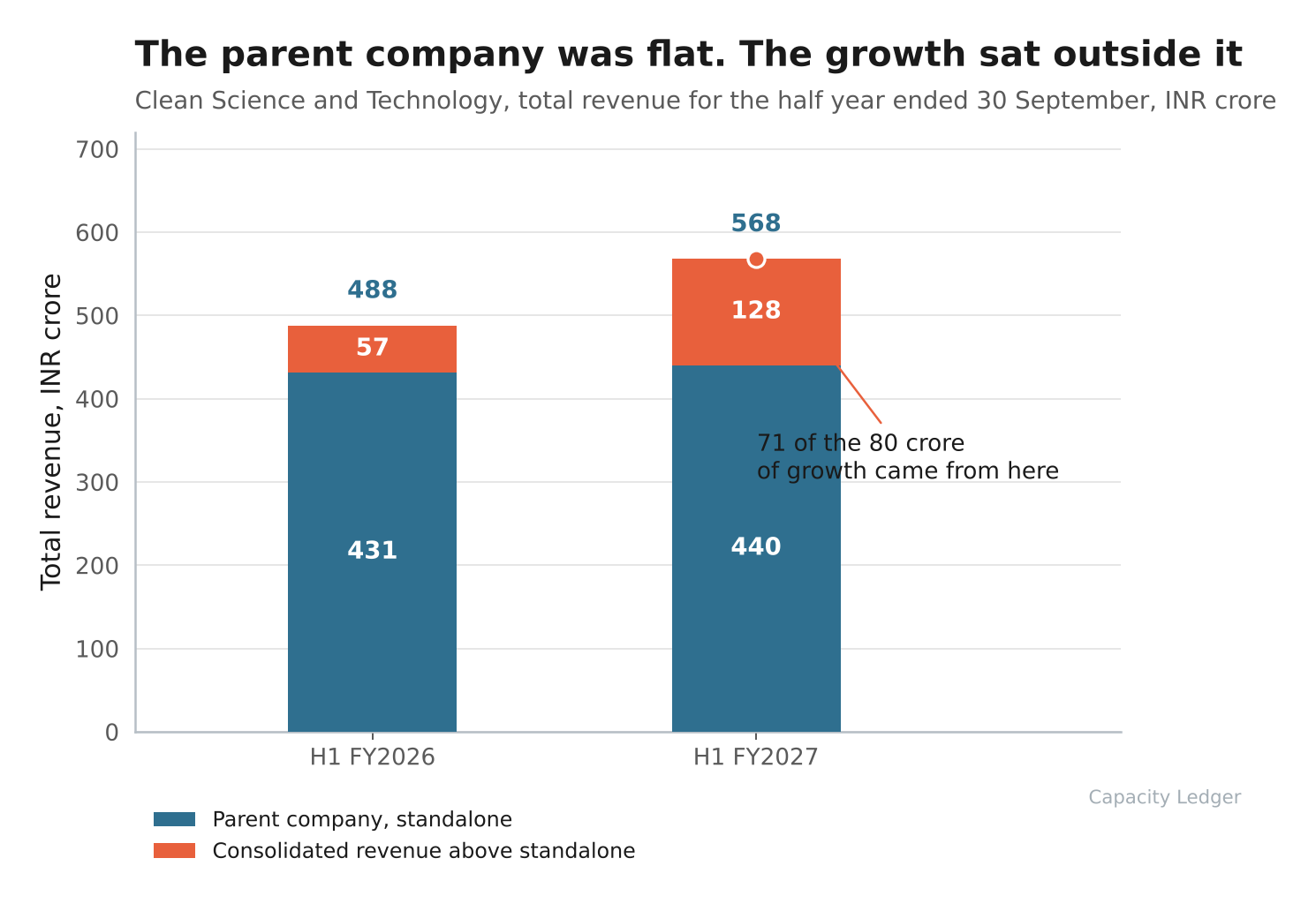
Parent-company revenue for the half was INR 440 crore, up 2%. Consolidated revenue was INR 568 crore, up 16%, so 71 of the 80 crore of growth sat outside the sixteen plants that built the company (chart below).
Utilisation is the honest limit. Sikchi called it "about 30%, 35%", heading for 55% to 60% over the coming few quarters.
There is a lot of plant still unsold.
What It Looks Like From the Buying Side
If you specify HALS into polyolefin, agricultural film or coatings, you already know how short the qualified-supplier list is.
BASF runs what it calls world-scale HALS and NOR HALS production at Lampertheim in Germany and Pontecchio Marconi in Italy, under Tinuvin, Chimassorb and Uvinul. On April 21 it said it is expanding both standard HALS and NOR HALS capacity, citing rising UV radiation, less predictable weather, tighter environmental rules, and Chinese plasticulture. Six days later it raised prices on antioxidants, process stabilizers and light stabilizers across the global portfolio by up to 25%, effective immediately, on top of a March increase.
So the second-source question is live, and Kurkumbh's answer arrives on a near-term clock:
- The advanced grades, developed with Switzerland's Geneus Chem AG, cleared trials and are logged in the October 31 filing as meeting quality and regulatory standards
- Commercial launch is expected in the second half of the fiscal year ending March 2027
- Sikchi said the first material ships to Europe in November or December
- A dedicated 1,000-ton advanced-grade line is targeted to start April or May, taking nameplate to about 12,500 tons
Final Thoughts
The company has not published a tonnage for any individual grade, the plant is a third full, and the dedicated advanced line is two quarters out from running. Treat the qualification window accordingly.
What is worth taking from Kurkumbh is the selection rule rather than the ramp. Pick the molecule with almost no producers, spend a decade building the catalytic route to it, and the market structure does the pricing work for you.
Clean Science did that five times over on obscure intermediates, then pointed the same method at a product class where the incumbents are very large and very few.
The fourth unit is the bet that it travels.
Thanks for reading.