 Capacity Ledger
Nobody Builds a Reactor at Seven and a Half Percent
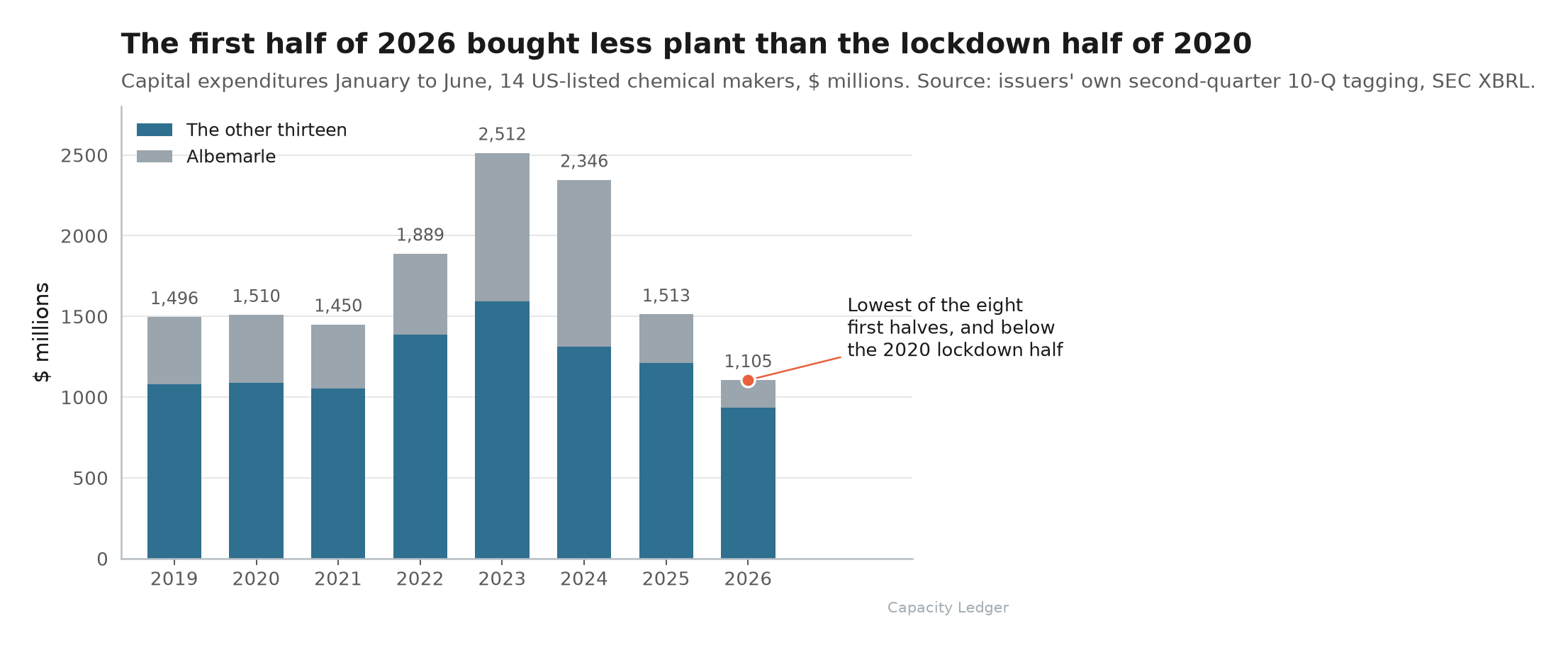
Fourteen US-listed chemical makers spent $1.11 billion on plant between January and June, less than the same fourteen spent in the lockdown half of 2020 and 56 percent below the 2023 peak. On Thursday Minerals Technologies priced the reason: 7.500 percent paper to retire 5.000 percent paper.
Five of the fourteen companies below spent more on plant in the first six months of this year than in the first six months of last year.
The basket still fell 26.9%.
That gap is the whole story: the increases are small and defensive, the cuts are large and concentrated.
What comes out the other side is $1,105.4m of first-half capital spending across fourteen US-listed chemical makers, against $1,509.6m in the lockdown half of 2020 (chart below). Nominal dollars, no deflator, same fourteen companies every year.
"What does a debottleneck have to earn now to clear the coupon that funds it?"
Where the Money Stopped
The obvious objection is lithium, so we put it on the chart rather than in a footnote. Albemarle alone was 44.1% of the basket's first-half spend in 2024 and 15.4% of it this year, a fall from $1,034.6m to $170.4m in two years.
Take Albemarle out entirely and the remaining thirteen still print $935.0m, their own low for the window, down 22.7% on last year and 41.3% off the 2023 peak. The story survives the removal of the company that makes it loudest.
What the cuts have in common is that they are being made by the operators with the most installed base to defend:
- Eastman at $203.0m, down from $413.0m in the first half of 2023.
- Celanese at $128.0m, its lightest first half since 2017 and 47% below 2024.
- Chemours at $93.0m, Olin at $72.7m, Tronox at $112.0m, each of them well inside what they were spending two years ago.
The five that went up are the small end of the basket: NewMarket, LSB, Avient, Innospec, Quaker. Add every one of their increases together and you get $37.0m, against the $94.0m Eastman alone took out.
What Thursday Priced
Minerals Technologies announced the pricing of $400 million of 7.500% senior notes due 2032 on October 1, at par, closing October 13. The use of proceeds is the part worth reading twice: the money redeems all of its outstanding 5.000% senior notes due 2028.
That is 250 basis points of step-up on the same company's own paper.
Six weeks earlier Cabot closed $350 million of 4.950% senior notes due 2029 and used it to retire $250 million of 3.40% notes maturing in September. Call that one 155 basis points.
Two deals do not make a cost-of-capital series, and we would not call it one yet. Both are the most recent occasions on which a US specialty chemicals issuer put in writing what its next dollar costs, and both answers came back above the dollar being replaced.
The Buyer's Version
A 7.500% coupon is the hurdle every brownfield project inside that company now has to clear, and it lands in the same quarter the sector's spending prints an eight-year low. Two things follow for anyone buying into 2027 and 2028:
- The supply you will be negotiating against in 2028 is already decided. Steel ordered this year is what runs then, and the first half of 2026 ordered less of it than any first half since 2019.
- A debottleneck your supplier has been promising for two years is now competing for capital against a bond that pays 7.500 percent to do nothing. Ask when the board approved it, not whether the engineering is done.
The tell is in the quarterly filings, and it is cheap to check. Pull the six-month capital expenditure line out of any supplier's second-quarter 10-Q, compare it to the same line in 2023, and you will know whether the expansion they describe on the call is funded or aspirational.
Final Thoughts
None of this shows up as a closure, and that is exactly why it is easy to miss. Nothing was announced, no WARN notice was filed, no force majeure letter went out.
A board declined to approve the next project, and the only public trace is a smaller number on one line of a cash flow statement.
Capacity that never gets built leaves the same hole in 2029 as capacity that shuts, and it leaves it without a press release. The ledger has to count both.
Thanks for reading.