 Capacity Ledger
Nobody Drilled a Well for This Iodine
Iofina took 393.3 tonnes of crystalline iodine out of other operators' produced water in the first half of 2026, up 29 percent, from eight plants that own no wells. USGS has America's iodine import reliance back under half, and the same company's Kentucky site is the only one Title 40 names by name.
USGS puts the world's iodine supply in three places: the nitrate mines of the Chilean desert, the gas and oil fields of Japan, and the brine wells of northwestern Oklahoma.
One of those three is water somebody else was already paying to get rid of.
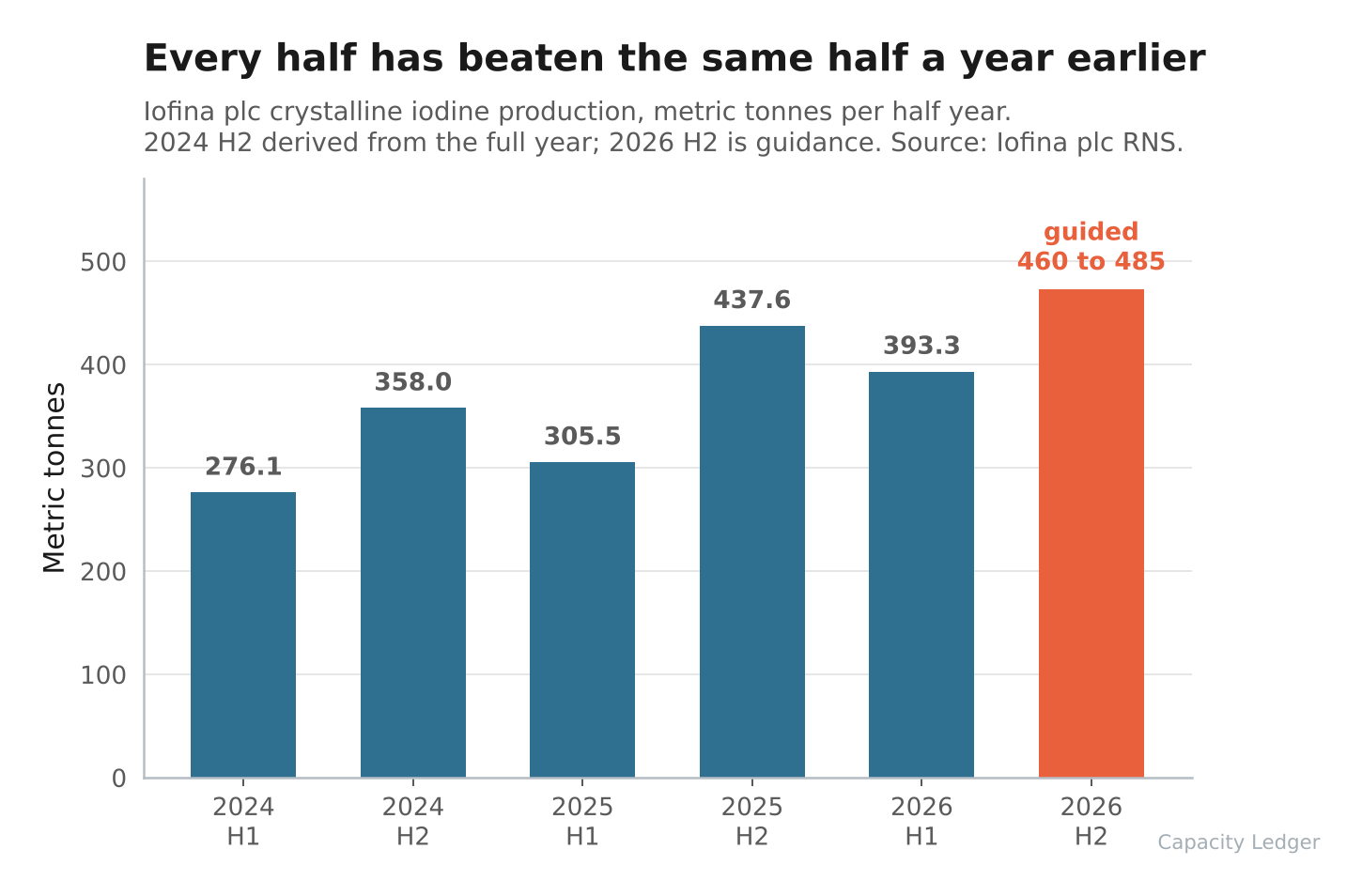
Iofina pulled 393.3 metric tonnes of crystalline iodine out of oilfield produced water in the first half of this year, 29% more than the same half of 2025, across eight plants that do not own a well between them.
"What does a chemical producer look like when its feedstock is another industry's disposal cost?"
Eight Plants on Somebody Else's Water
The arrangement reads in one line: operator lifts the brine → Iofina strips the iodine → operator gets the water back with a smaller disposal bill.
The company calls it a stable source of iodine for itself and "a means to reduce their disposal costs" for the producer on the other side.
The hardware is the WET and IOsorb units, rated to take 5,000 to 100,000 barrels a day, with most of the current fleet running up to 30,000.
Eight are in production, five in northwest Oklahoma and three in central Oklahoma. The brine underneath them is why Oklahoma is on the USGS list: the sandstone that feeds IOCHEM's wells near Vici sits roughly 3 kilometres down and carries 300 to 400 parts per million iodine, mostly as sodium iodide.
Now the output. Every half year has beaten the same half a year earlier, and the second half of 2026 is guided at 460 to 485 MT against the 437.6 that set the company record last year (chart below).
Sales followed: 253 MT moved in the half, up 21%, at an average realised $74.69/kg. Adjusted EBITDA more than doubled to $6.6m on revenue of $31.3m.
Three things are contracted on top of that:
- IO#12, the group's largest facility to date and its first in a new core area, the Permian Basin, worth 170 to 220 MT a year and guided to finish near the end of the third quarter.
- IO#11's second brine source, now flowing, worth another 45 to 60 MT a year.
- IO#13 and IO#14, built concurrently in central Oklahoma with an existing brine partner, operational before the end of the first half of 2027.
The stated destination is 2,000 MT a year, which the company calls nearly 5% of global production. USGS put world production outside the United States at 34,000 tonnes in 2025.
The Producer USGS Won't Name
The federal statistics will not say this out loud. US iodine production is published as W, withheld to avoid disclosing company proprietary data, because three companies produce it, too few to aggregate.
So the Mineral Commodity Summaries do it anonymously. The 2026 edition reads: "One U.S. producer opened an eighth iodine production plant and increased its iodine production by almost 11% during the first 6 months of 2025."
Both halves of that sentence have the same name on them. IO#11 came online in July 2025 as Iofina's eighth IOsorb plant, finished on time and on budget at $5.3m, and H1 2025 production of 305.5 MT was a 10.6% increase on the 276.1 before it.
The line a buyer wants sits a few rows above.
Net import reliance for iodine ran above 50% of apparent consumption in 2024 and below 50% in 2025, the first year back under half since 2023. Of what the country does still import, 88% is Chilean and 11% is Japanese.
The Half of Iofina Nobody Reads
The iodine gets the attention. The derivatives arm has the stranger federal record.
Iofina Chemical runs a site at Covington, Kentucky, operating since 1983 as H&S Chemical and bought by Iofina in 2009. It makes roughly 10 million pounds a year of liquids and solids plus more than 25 metric tonnes a year of specialty gases.
EDDI, the iodine-based feed compound, was its largest-revenue iodine derivative in the half. Non-iodine specialty gas sales were up 34%.
Here is the catch. Open 40 CFR 84.18 and the regulation names the company:
"EPA will allocate 3,000.0 MTEVe of production for export allowances to Iofina Chemical by October 1 of the calendar year prior to the year in which the allowances may be used for calendar years 2026, 2027, 2028, 2029, and 2030."
That provision exists because Iofina asked for it on March 28, 2024, under subsection (e)(5) of the AIM Act, to make HFCs for semiconductor manufacturers outside the United States. EPA agreed, and said why in the final rule: the company produces only HFC-41 at Covington, which carries an exchange value of 92, among the lowest the AIM Act controls.
HFC-41 is one of the two HFCs the fabs use on high-aspect-ratio hole etching, and EPA has found no safe or technically achievable substitute will be available through 2030.
Divide the allowances by that exchange value and the entitlement turns into tonnes. The export carve-out is worth about 32.6 tonnes of HFC-41 a year.
The general-pool production allowances the notice published this morning gives Iofina Chemical for 2027, 1,113.9 MTEVe, are worth about 12.1 (chart below).
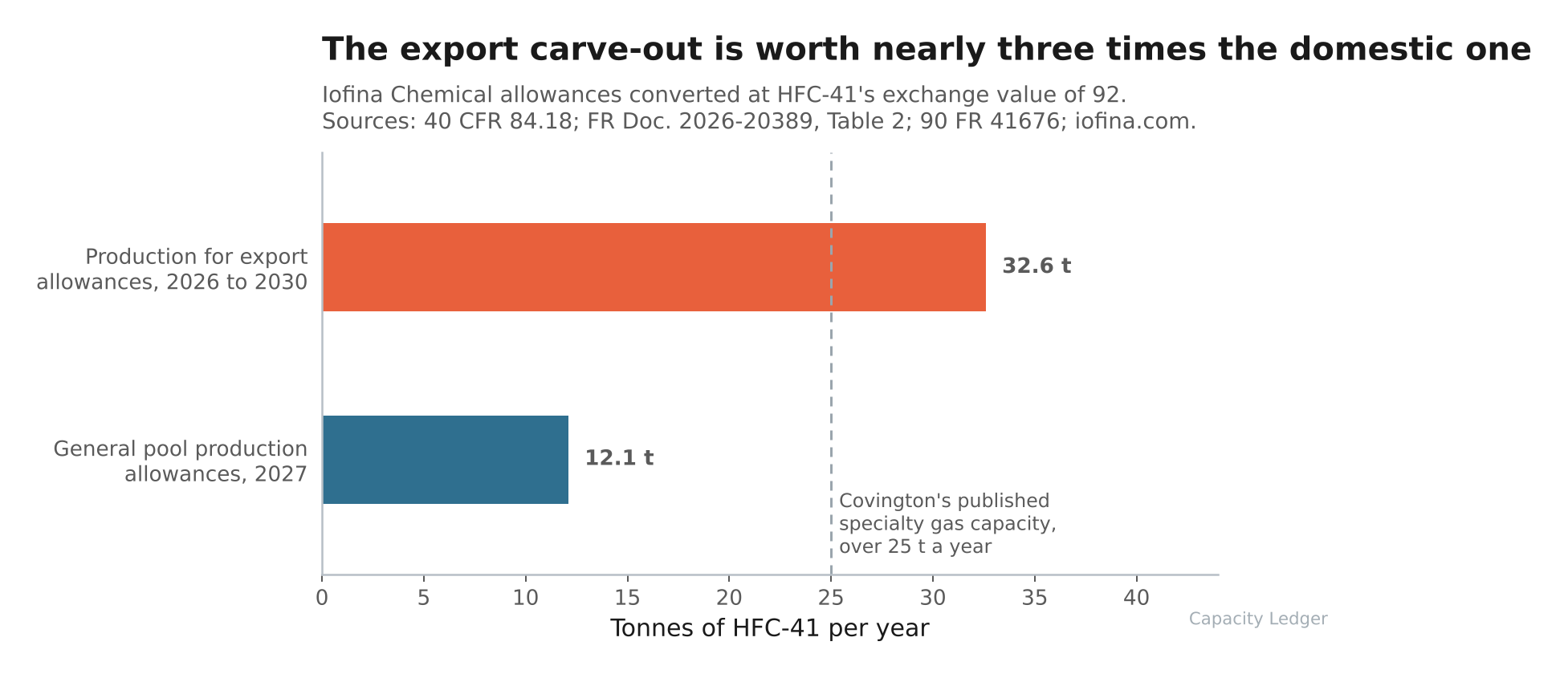
Both numbers land in the same range as the gas capacity the site advertises itself.
The export allowances are set aside before the general pool is allocated at all, cannot be transferred, and must be exported in the year they are made, with each overseas customer certifying the end use in writing.
Final Thoughts
A federal regulation that names one company and sizes the entitlement to roughly one building is rare, and worth understanding. A small halogen house in Kentucky asked for it, with a product slate narrow enough that the Agency could check the whole thing.
The Oklahoma side is the same character in a different costume. Eight plants on a waste stream that was going to be injected anyway, scaled one partner agreement at a time until the national import number moved.
Thanks for reading.