 Capacity Ledger
One Pipeline From a Refinery to a Drug Master File
gChem's Tuscaloosa complex takes a sulfur stream from the refinery next door and turns it into the only DMSO made in the Americas. An $850m agreement this month is why it is worth introducing.
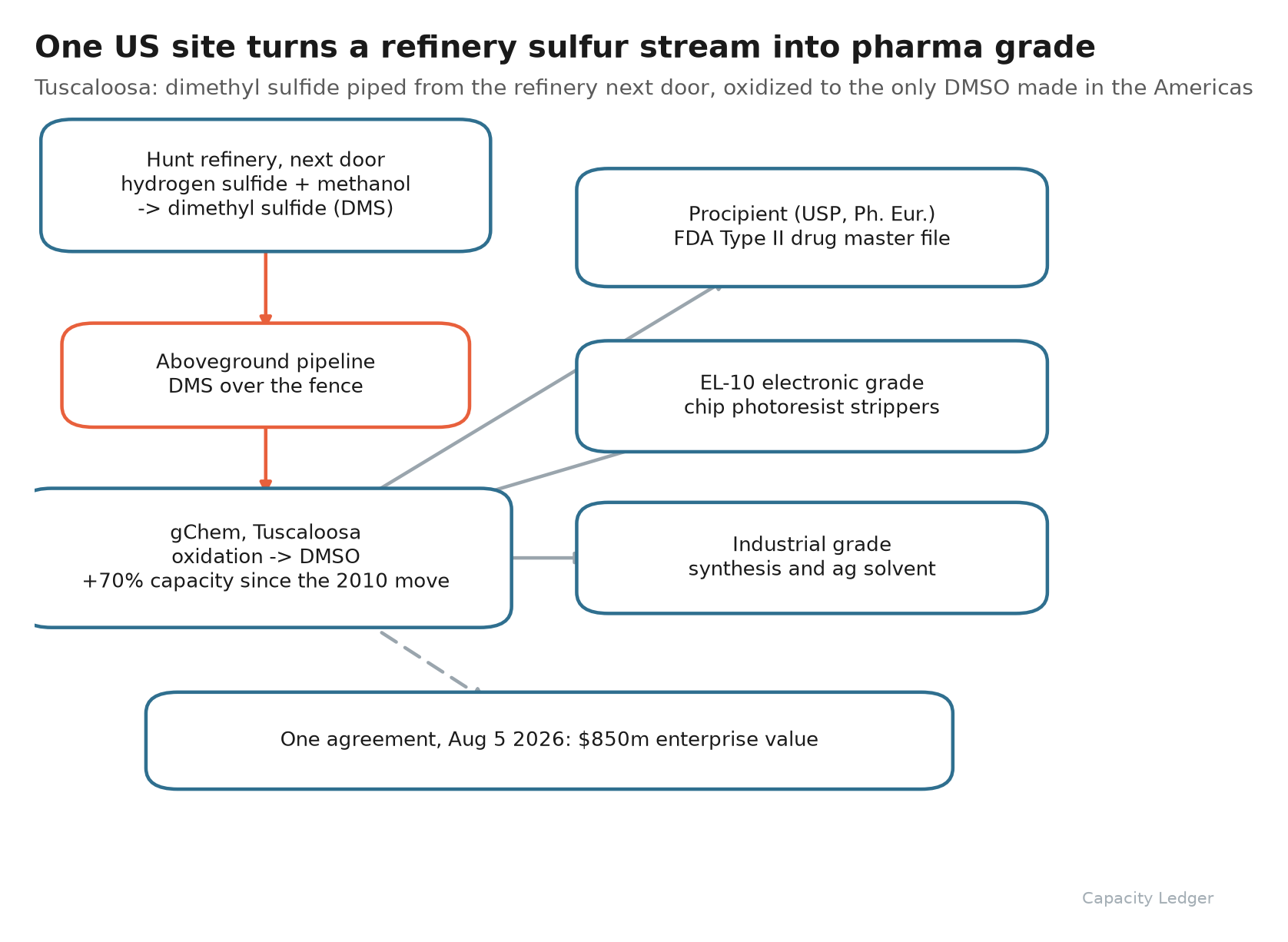
The aboveground pipeline runs a few hundred feet from a Hunt Refining unit in Tuscaloosa, Alabama into a specialty plant on the same fence line, and it carries liquid dimethyl sulfide. On the other side, the sulfide is oxidized to dimethyl sulfoxide, the only DMSO made anywhere in the Americas.
That plant belongs to gChem, the company known as Gaylord Chemical until it rebranded last year.
On Aug 5 2026, ContextLogic Holdings agreed to buy it for an enterprise value of $850m. It is worth introducing the plant that came with the deal.
"What does the industry get by keeping one US DMSO plant standing?"
Where the sulfide comes from
DMSO is made in two steps. Hydrogen sulfide, a sulfur-rich refinery stream, is reacted with methanol over a solid catalyst to give dimethyl sulfide, then the sulfide is oxidized to the sulfoxide. Both steps want to be next to a refinery. gChem's original plant, in Bogalusa, Louisiana, ran a different route entirely, a lignin-based process built on Kraft black liquor from the paper mill it grew up inside. That plant was a Crown Zellerbach chemicals division in the 1960s, and it pioneered the commercial DMSO industry.
In 2010 the company closed Bogalusa and moved the operation to Hunt Refining's Tuscaloosa site so it could take DMS straight off the fence line. The move cost roughly $39m and lifted DMSO capacity 70% in the process.
The pipeline is the point. Chart below.
What comes off the other end
The output splits into grades, and each grade earns its own qualification path.
- Procipient, gChem's Dimethyl Sulfoxide USP / Ph. Eur., maintains an active Type II Drug Master File with the FDA. That is the paperwork a pharma customer wants to see before writing DMSO into a compendial process, and it takes years of consistent batch data to sustain.
- DMSO EL-10, an electronic-grade product with its own dated technical data sheet, feeds semiconductor photoresist strippers and edge-bead removers. DMSO's pull in fabs is partly a straight substitution story for NMP as the industry backs away from reprotoxic solvents; you can watch that pull in every replacement grade a fab qualifies.
- Industrial-grade DMSO goes into pharmaceutical synthesis, agrochemical formulation, polymer processing, and cryopreservation buffers for cell-based therapies. The cell-therapy leg matters. DMSO is the cryoprotectant in almost every clinical stem-cell workflow, and the qualified alternative programs are still years from replacing it at scale.
Three end markets, one plant, one FDA drug master file. That is a lot of qualification on top of one distillation column.
Why one plant matters to you
If you buy DMSO in the United States, your options are one domestic producer or the import book, and the import book is priced against Asian sellers with their own contract calendars. The Aug 5 release calls out the categories the plant serves as "pharmaceuticals, semiconductors, agricultural chemicals, aerospace, and performance chemicals" — the same categories a US customer needs surge coverage in when a container ship goes long or a tariff line shifts.
The vertical integration is the piece a buyer should note. When a plant makes its own feedstock, or takes it by pipeline from a neighbour on a long-term arrangement, the price you see is not the same price you would see out of a merchant supply chain.
It is closer to a cost plus a hurdle, and the hurdle is the plant's own capital return, not a broker's mark.
CEO Frank Roederer signed a five-year employment agreement inside the deal, and the release describes existing management staying in place. Continuity in a specialty operation is a genuinely useful signal.
The people who know why a particular column runs the way it runs are the reason batch data holds up across a Drug Master File.
Final Thoughts
You do not get many US specialty plants that turn a refinery byproduct into an ingredient a drugmaker will trust for the life of a compendial dossier. gChem's Tuscaloosa complex is one of them, and it stayed standing because someone in 2010 was willing to walk away from a paper-mill route and rebuild the process next to the sulfide it needed. The Aug 5 agreement is a change of ownership, not a change of chemistry. The pipeline is still there.
Thanks for reading.