 Capacity Ledger
Rancho Cordova Already Had the Columns
SK pharmteco put more than $200 million behind its American plants on Wednesday, and the one element carrying a date is GMP kilo-scale peptide purification. It lands at the California site whose chromatography group has been training FDA inspectors for years.
Somewhere in SK pharmteco's own white paper on American API supply there is a sentence most CDMO marketing would never think to write. The chromatography and energetic chemistry group at its Rancho Cordova site, it says, "has provided training to FDA inspectors for many years."
Read that again as a buyer. The people who inspect the technique learned part of it on that campus.
On Wednesday the parent company put a five-year number against its American plants: more than $200 million, across development labs, new manufacturing suites, modernized GMP capacity, utilities and logistics, with about 100 long-term jobs attached (chart below). The release carries a Rancho Cordova dateline and names no individual site in the breakdown, so treat the dollars as a US total rather than a site capex.
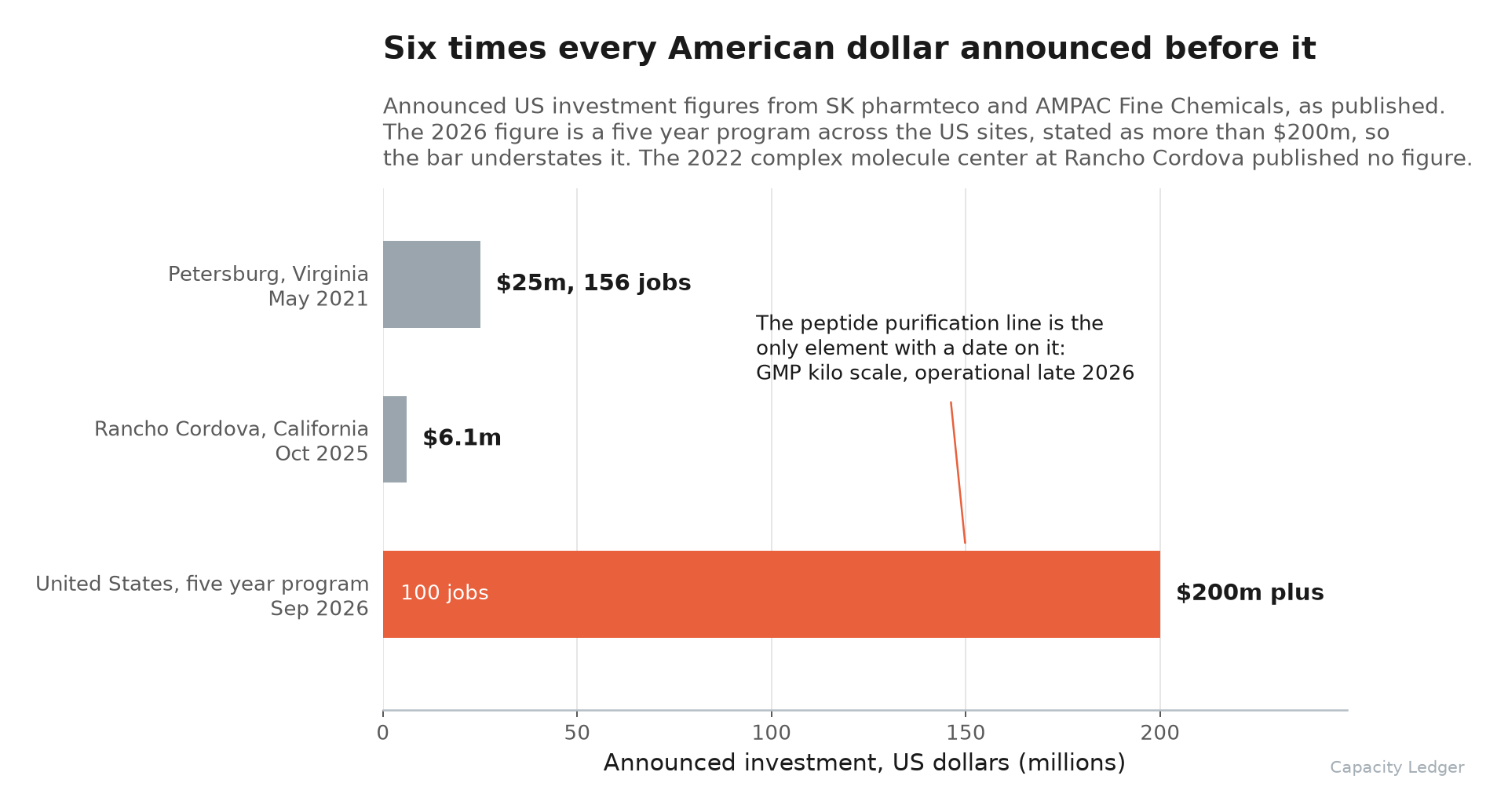
One element in that list has a date on it. GMP kilo-scale peptide purification, with advanced liquid chromatography, operational late 2026.
The Half Of A Peptide Nobody Sells You
Solid-phase synthesis is the part everyone can quote a price on. SK pharmteco's own framing, from an October 2025 release, is that the initial SPPS step is generally accessible and the industry's real problem sits downstream: turning a complex molecule into high-purity batches at volume is unpredictable work, and that is where the bottlenecks and the supply delays live.
Anyone who has tried to get a peptide qualified knows the shape of it. The crude comes off the resin.
Then you spend months finding out whether the separation scales.
That October release is the same line now appearing in Wednesday's announcement, eleven months older and with a bigger number behind it:
- $6.1 million at Rancho Cordova, announced October 23, 2025.
- A lab facility in January 2026.
- A cGMP kilo-scale facility in the second half of 2026.
Wednesday restates the third of those as "late 2026" and folds it into the nine-figure program. SK itself says the California money complements the $260 million small molecule and peptide site it is building at Sejong in South Korea, so peptides are a company-wide push rather than a California one.
Why The Columns Were Already There
Here is what makes the siting interesting rather than routine.
AFC-California sits on a 250-acre campus at Rancho Cordova and is the flagship of the three AMPAC Fine Chemicals plants. By the company's white paper it employs more than 500 high-skilled workers, and the capability list it publishes is unusual for a small-molecule API house:
- Continuous chromatography.
- Highly potent intermediates and API manufacturing.
- Continuous processing.
- Safe implementation of highly energetic chemistries.
Two of those four are exactly what a stubborn peptide purification needs. The site also runs AFC's center of excellence for chromatography and energetic chemistries, which is the group in that inspector-training sentence.
And the campus has been moving toward awkward molecules for a while. The Complex Molecule Chemistry & Engineering Center, announced in August 2022, was built around custom phosphoramidites, UV-sensitive materials and pegylated substrates at gram to kilogram scale.
No dollar figure was ever published for that one, which is why it is absent from the chart.
So the kilo-scale peptide line lands next to the columns, the containment and the people who already run both.
The Other Three American Addresses
Worth knowing who does what, because the $200 million is a US figure and the sites are not interchangeable.
La Porte, Texas, near Houston, runs registered intermediates and APIs with about 50 people, and its stated specialty is performing energetic and hazardous chemistry safely at large scale.
Petersburg, Virginia is the center of excellence for controlled-substance manufacturing and US government API supply, with nearly 150 people. It feeds the Strategic National Stockpile and the Strategic Active Pharmaceutical Ingredient Reserve through a BARDA-funded consortium, and the company has put a new chemistry curriculum into Virginia State University to keep the labor pipeline local. Virginia beat California and Texas for that expansion in May 2021, worth $25 million and 156 jobs; the plant is the old Boehringer Ingelheim site, bought in 2016 and running since 2019.
El Dorado Hills, California is AMPAC Analytical, nearly 40 people doing method development, validation and release testing.
One caveat on those headcounts, since this desk would want it flagged anywhere else: the white paper they come from carries no publication date, and its COVID-19 references put it somewhere around 2021 or 2022. The shape of the footprint is the durable part.
Final Thoughts
American peptide capacity tends to get announced the way tonnage does, in square feet and production trains. The number that actually constrains a program is narrower than that, and it is the one SK pharmteco keeps putting a date against: whether somebody domestic can take your crude peptide and hand back kilograms at the purity your filing claims.
That capability is being added at the one US address whose chromatography group has spent years explaining the technique to the regulator. Our read for anyone qualifying a second source: the small 2025 number is the one that bought the step, and the large 2026 number is the one that will be judged on whether the step arrives.
Late 2026 is the date to hold them to.
Thanks for reading.