 Capacity Ledger
Several Tons of Peptide a Year
Bachem inaugurated the largest plant it has ever built in April and is making commercial GMP product in it now. The only output figure anyone publishes for the site is three words long, and the guidance attached to it says the second half of 2026 has to run at nearly twice the first.
The only output figure Bachem publishes for the biggest plant it has ever built is three words long.
"Around 350 employees will produce several tons of peptides every year."
That sentence went on the record on 23 October 2025, in the release confirming the Swiss regulator had inspected the first phase of Building K at Bubendorf. It is still the whole of the public capacity record for the site.
And it is more than most people building peptide capacity right now will give you.
What Got Inaugurated in April
Building K went up over five years. Construction started in 2021, the regulator walked the first phase in October 2025, and Bachem inaugurated it on 24 April 2026 as the largest project in the company's history and one of the largest peptide plants anywhere.
It is built for industrial-scale peptide and oligonucleotide actives: high-capacity production cells for scalable synthesis, its own energy and cold-storage systems, and a dedicated tank farm sized for large-scale operations.
The half-year statement on 30 July put the plant's status in one line: "Commercial GMP products are already being manufactured here. The facility is being gradually expanded to provide additional capacity."
Two things are true in that sentence at once.
Part of the building is qualified and shipping. The rest of it is still a construction site.
What the Second Half Has to Do
Bachem's first half looks like a company standing still. Group sales came in at CHF 326.4m, up 4.3% and up 7.3% in local currencies.
EBITDA fell 9.0% to CHF 82.8m, and the margin went from 29.1% to 25.4%, which CEO Anne-Kathrin Stoller attributed to Building K's ramp-up costs.
Then the company confirmed full-year guidance of 35% to 40% local-currency sales growth.
Run that against the published halves and you get the shape of what the plant is being asked to carry (chart below). Bachem made CHF 313.0m in the first half of 2025 and CHF 382.1m in the second. It made CHF 326.4m in the first half of this year. The guided range implies a second half between roughly CHF 602m and CHF 637m, which is 1.8 to 1.9 times the first half of the same year.
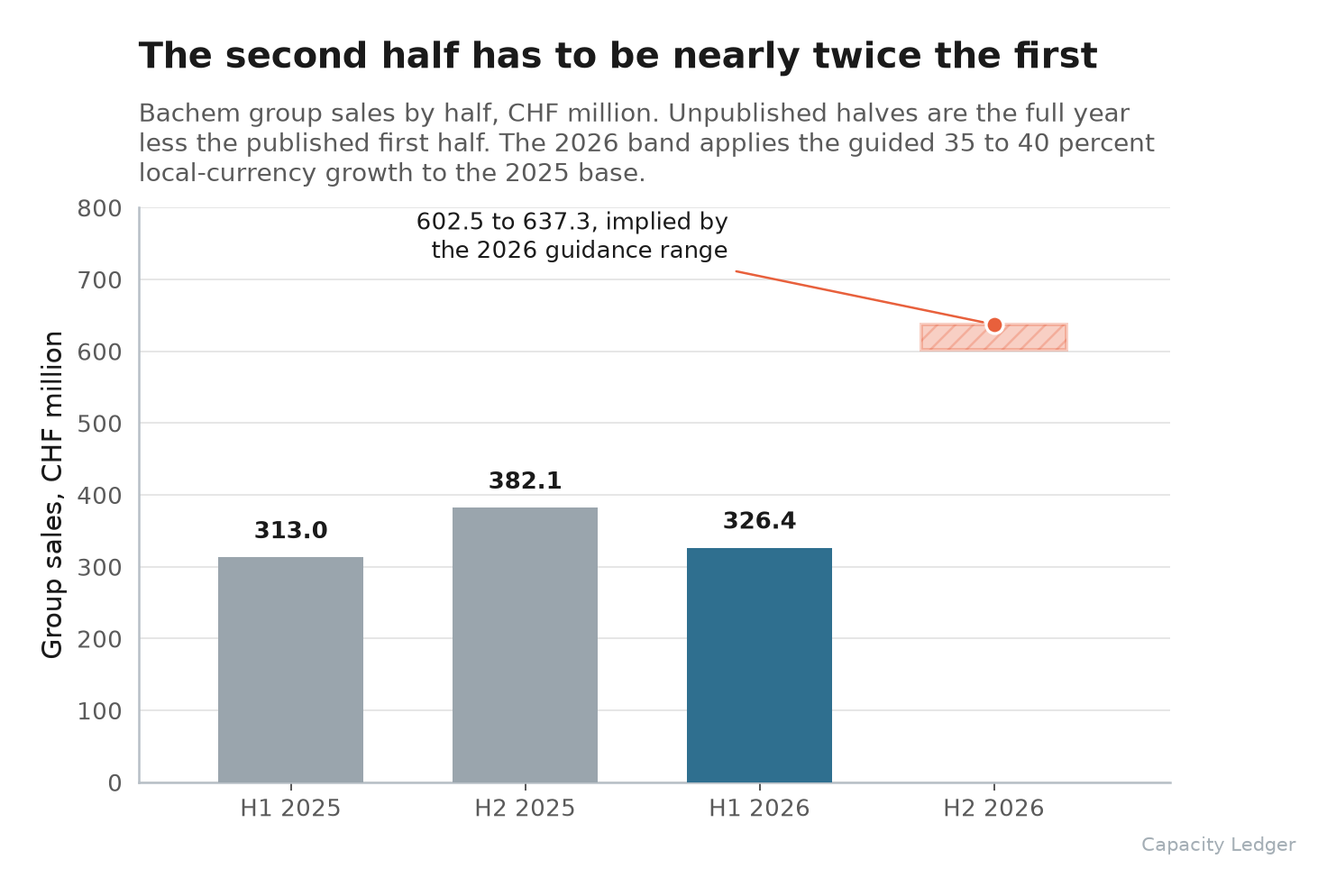
The mix underneath says where it comes from:
- CMC Development (clinical-stage work) grew 35.4% to CHF 167.5m, and is now the largest of the three categories.
- Commercial API fell 21.0% to CHF 133.0m, having been the largest a year ago.
- Research & Specialties grew 24.4% to CHF 25.9m.
A development book growing at that rate against a commercial book that shrank is what a qualification pipeline looks like from outside.
The molecules are in the building. The commercial volumes attach when the campaigns do.
Capital spending is running at the same tempo: CHF 148.4m went out the door in six months, against full-year plans of CHF 350m to 400m, on a company that sold CHF 695.1m in all of 2025.
Nobody Gets a Tonnage for the Next One
On 21 July Bachem said it will put more than CHF 500m into a greenfield plant at Sisslerfeld, in Eiken, its third Swiss site after Bubendorf and Vionnaz. Commercial production is expected in 2030.
There is no capacity figure in that release. Not a tonne, not a reactor volume, not a headcount.
What the release carries instead is the thing this desk almost never gets to read: the plant was announced alongside a signed agreement to supply large volumes of peptides, and that agreement includes pre-payments and long-term commitments. The counterparty is undisclosed by mutual agreement.
Stoller's framing was explicit about the sequencing: "long-term supply agreements are essential to guarantee reliability for our customers and their patients while ensuring disciplined capacity expansion."
Since early July this desk has been writing down the same pattern: additions arrive with a currency symbol and no tonnage, closures arrive with tonnages and no dollars.
Sisslerfeld fits that on the disclosure side and breaks it on the underwriting side, because the money is attached to a customer who has already paid some of it forward.
The US side of the same program is smaller and further along: around USD 250m across 2026 to 2030 to expand Vista, California and modernize Torrance, with an adjacent Vista property already acquired for conversion.
Final Thoughts
If you buy peptide APIs, the announcement is the least useful part of any of this. A press release dated 2030 does nothing for a 2027 campaign, and the CHF 500m at Sisslerfeld buys somebody else's molecules under a contract you will never see.
What is useful is the ramp. Building K is the closest thing the Western peptide chain has to a live test of how fast qualified large-scale capacity actually converts into shipped product, and Bachem has been unusually willing to publish the milestones as they land: the inspection, the first GMP batches, the inauguration, the phase still under construction. Two more prints settle it, the full year in March and whatever the second half actually does.
Several tons a year is a vague number. It is also the only one on our file for a Western large-scale peptide plant, and the company that published it is the one now building the next plant against a contract rather than a forecast.
Thanks for reading.