 Capacity Ledger
Six Times the Price, No Extra Sulfur
Tampa's third-quarter molten sulphur contract settled at a record $705 a long ton, six times where the contract started 2025. US sulfur output over the same stretch has not left a 7% band, because no plant in the country was built to make it.
The USGS sulfur chapter reports domestic employment for the commodity as 2,400 people.
It reported 2,400 in 2024. And in 2023, and 2022, and 2021.
Five consecutive years of a headcount that does not move by a single person, in a commodity whose price has since nearly quadrupled and whose contract has gone up six times.
That row is not sloppy estimating. It is the most honest number in the table.
Nobody Is Employed Making It
In 2025 the US recovered elemental sulfur at 81 plants across 25 states, run by 31 companies, and USGS lists them in descending order of tonnage: petroleum refineries, natural-gas-processing plants, coking plants. Byproduct sulfuric acid came off five nonferrous-metal smelters in four states.
Not one of those is a sulfur plant. Every tonne is a waste stream somebody had to pull out of a hydrocarbon or an ore to sell the thing they actually meant to sell.
So the volume answers to crude runs, sour-gas throughput and smelter maintenance schedules, and to nothing else. USGS says as much in its own forward look, which is that refinery sulfur production should hold "about the same as refining utilization remains high."
Five years of that logic look like the chart below. Output has stayed inside a 7% band while the average unit value went $90.40, $177.80, $58.90, $46.42, and back to $180 a tonne.
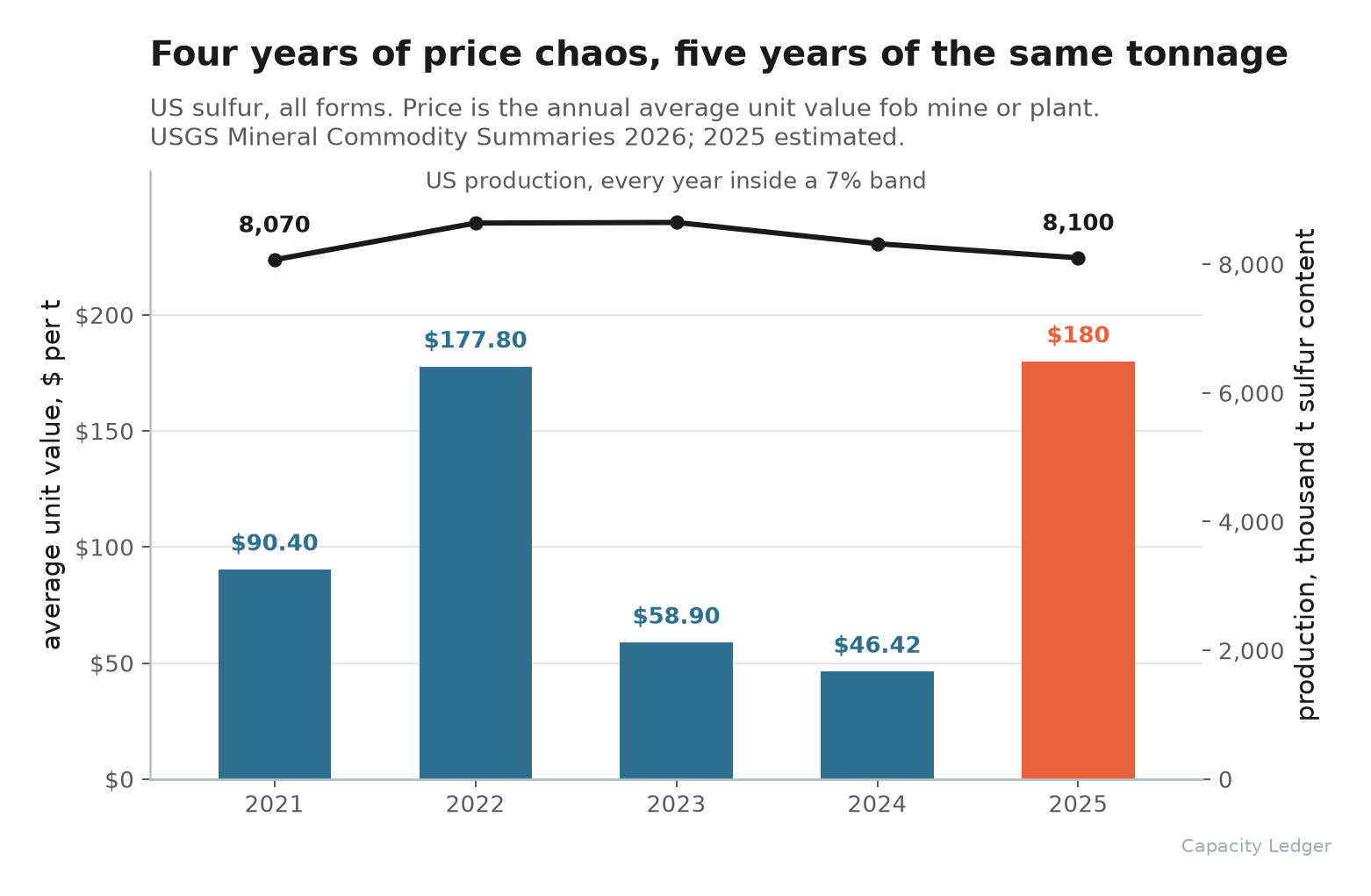
Total 2025 production came in 3% below 2024. That is the supply response to a price that nearly quadrupled.
What Six Times Looks Like
The Tampa contract began 2025 at $116 a long ton. It went to $270 in early April, back to $252 in July, and to $310 by early October.
Then the Strait closed on February 28, and the number stopped behaving.
The second-quarter 2026 settlement cleared the 2008 peak. The third quarter settled at $705/lt, up another $50, and US Gulf spot export cargoes were being assessed at $1,100 to $1,150/t fob in early July.
We logged the $705 on August 5 as a line in Mosaic's cost stack, next to $522/lt realized in the second quarter and a phosphate segment running Faustina completely idled. Worth saying what that number is from the other side of the invoice: it is the price of a molecule that no producer decided to make, sold by refiners who would rather be selling diesel.
Mosaic's CEO called the settlement "considerably below the spot market" and credited "longstanding relationships with Gulf Coast refiners." He is right, and that is the point.
When the supply curve is a straight vertical line, the only thing left to negotiate over is queue position.
It Does Not Stay in Fertilizer
About 90% of the sulfur consumed in this country is consumed as sulfuric acid, and 34% of it arrives as imported sulfur or imported acid. Canada alone is 53% of elemental imports and 54% of acid imports.
That import leg is where a specialty buyer meets this market, and it got thinner this year. China, the world's largest acid exporter, replaced a 700,000 tonne annual export quota with a full ban on April 10, running through this month.
USGS's substitutes line is one sentence and it is worth reading twice: substitutes "are not satisfactory," and some acids can stand in for sulfuric acid in certain applications, "but usually at a higher cost."
So if you buy merchant acid, spent-acid regeneration, or anything sulfonated, your cost line now tracks somebody else's crude slate. The questions that pay this quarter are whether your supplier's tonnes are contract or spot-linked, and whether the refinery behind them is running.
Final Thoughts
We keep two columns here, closures and additions, and sulfur breaks the format.
There is nothing to add. No permit, no FID, no start-up date, no debottleneck, not even a plant to name in a closure notice, and the only real lever on US supply is how hard American refineries are running for reasons that have nothing to do with sulfur.
That is why the employment row never moves. Nobody was ever hired to make the stuff, and nobody is going to be hired now that it costs $705.
Thanks for reading.