The Byproduct That Can't Be Turned Off
EPA's draft risk evaluation for 1,2-dichloropropane published this morning and flags 14 of the 15 conditions of use it assessed, disposal included. Two US plants make the chemical without meaning to, three buy it, and the only lever that moves the volume sits upstream in propylene oxide and epichlorohydrin.
EPA published a draft risk evaluation this morning for a chemical that nobody in the United States sets out to make.
The notice runs at 91 FR 56882, docket EPA-HQ-OPPT-2018-0428, and the preliminary determination is the strong one: 1,2-dichloropropane "does pose unreasonable risk to human health driven primarily by certain COUs."
The underlying draft is blunter. Of the 15 conditions of use EPA assessed, 14 significantly contribute to that determination.
And in the same document, under the heading of what the substance actually is: "It is manufactured primarily as a byproduct."
"What exactly do you restrict, when the producer never decided to produce it?"
This desk was here eight days ago.
On August 27 we counted the December 2019 high-priority cohort at 18 of 20 drafted and named the two with neither a draft nor a final: 1,2-dichloropropane and phosphoric acid triphenyl ester. One of the two just came off the list (chart below).
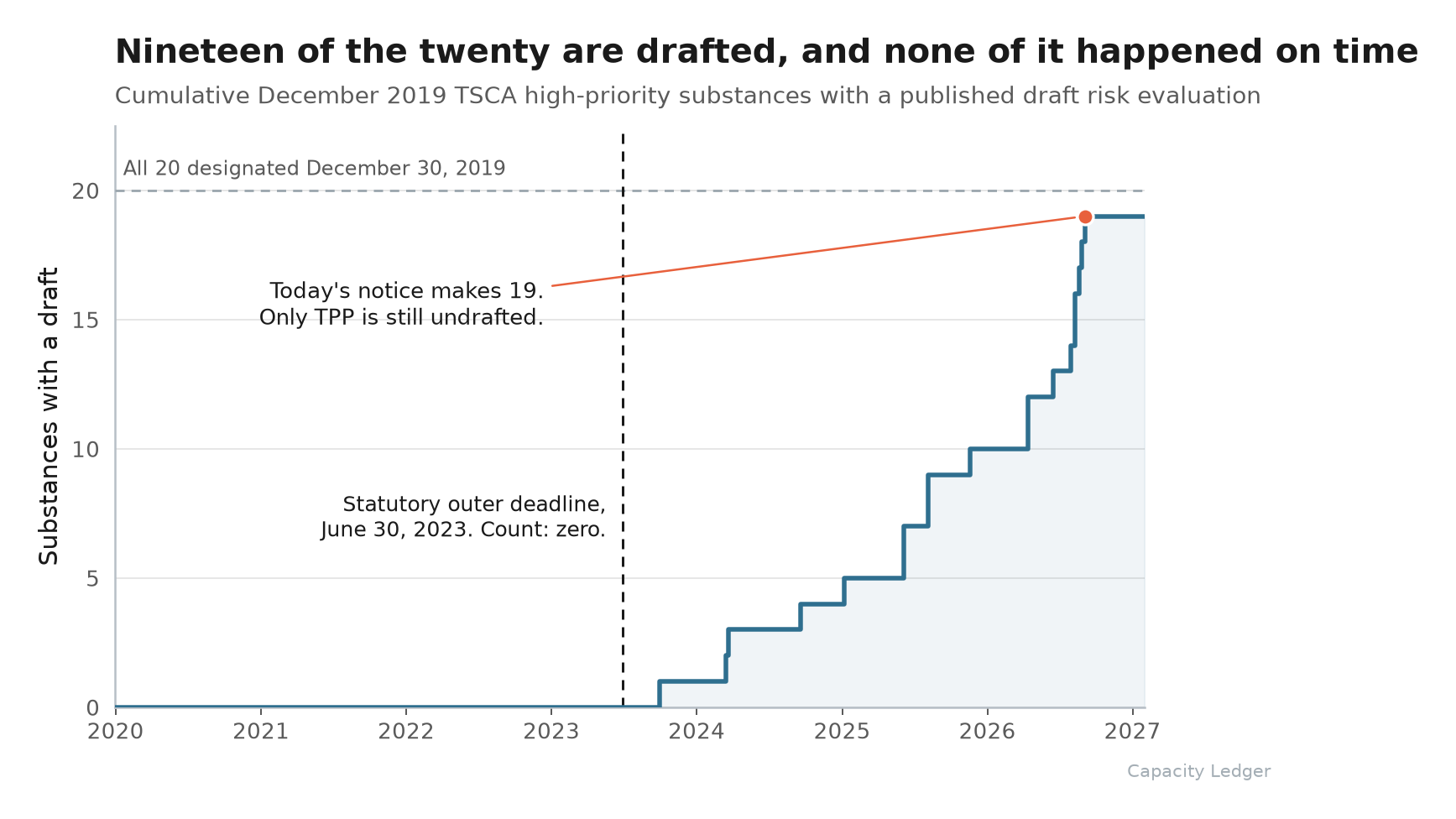
EPA issued the final scope for this one on September 4, 2020. The draft landed September 4, 2026.
Six years to the day, which is either a filing coincidence or somebody's calendar reminder.
Here is what the docket does to the five plants involved.

The rest of this brief is for subscribers.
The capacity math, the trade-flow read, and what it means for the products you buy.
$50 a month, or $400 a year.
Already a subscriber? Sign in