 Capacity Ledger
The Chemical Increase Nobody Gave Back
Three of the seven chemical producer price indexes BLS publishes are below their May peak, and the other four printed series highs in the same August release. The three that fell make the inputs. The four at records formulate them. September's print lands Thursday, and Brent has already gone back to $114.
Three of the seven chemical price indexes the Bureau of Labor Statistics publishes sit below where they stood in May. The other four printed the highest number their series has ever carried.
Same release. Same month. August 2026.
The three that fell are the three that make what other chemical plants buy: basic chemicals, resins and fibers, agricultural chemicals. The four at series highs are the four that formulate: paints and coatings, soaps and cleaners, other chemical preparations, and pharmaceuticals.
So the spike travelled all the way up the chain. The giveback has not travelled back down it.
"If my supplier's input index is five percent off its peak, why is my price still setting records?"
Three down, four up
Take the three that rolled over first, measured from the May peak to August (chart below):
- Basic chemical manufacturing, NAICS 3251: -5.3%
- Resin, synthetic rubber and fibers, 3252: -7.1%
- Pesticide, fertilizer and other agricultural chemicals, 3253: -5.3%
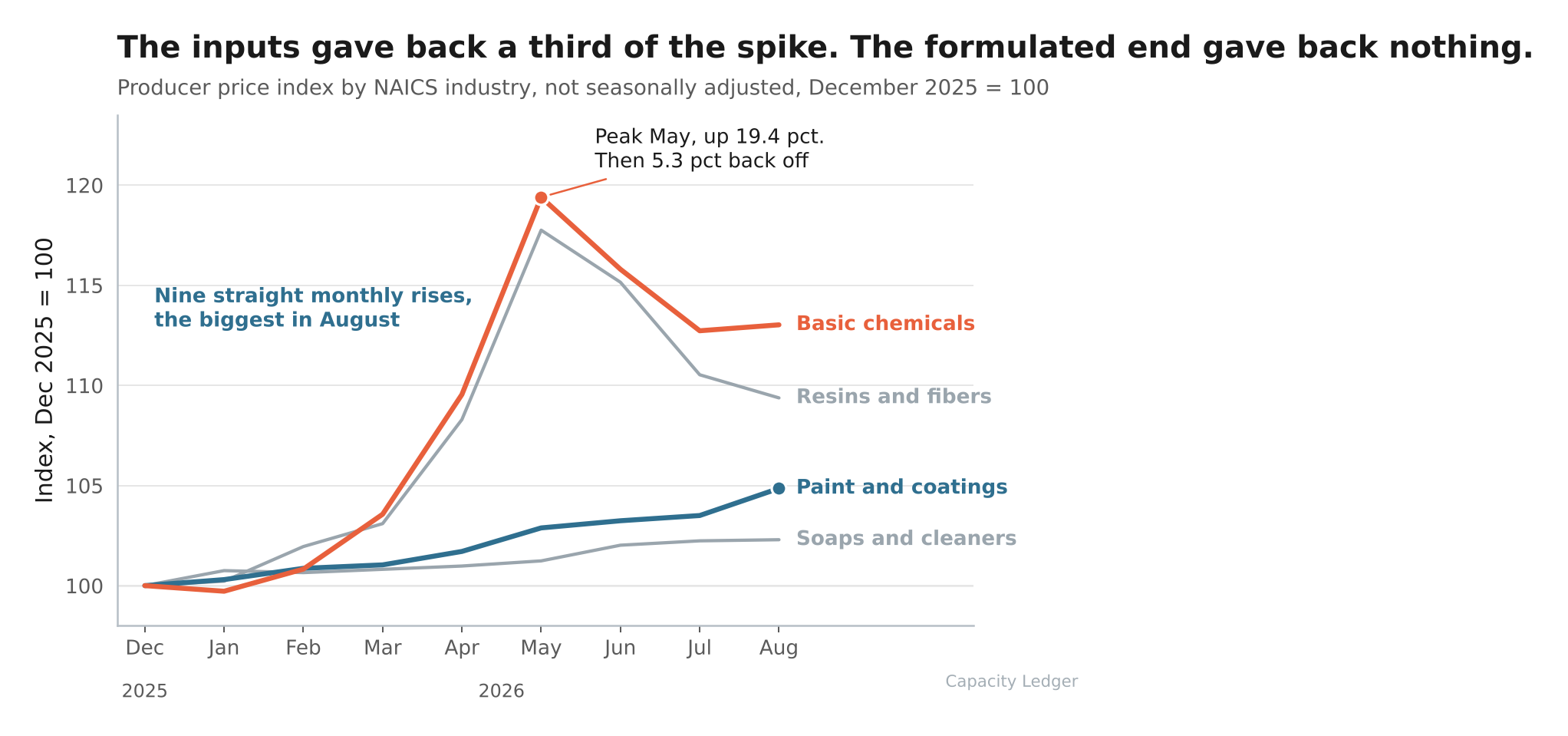
Over the same three months, the formulated end went the other way.
Paint, coating and adhesive +1.9%. Soap, cleaners and toilet preparations +1.0%. Other chemical product and preparation +1.2%.
Paint and coatings is the one to look at twice. It has now risen for nine consecutive months, December through August, and the largest single month of that run is August, at +1.31%.
That is three months after its own feedstock index peaked.
Soaps and other preparations each ran six straight months up into August.
To be fair about the fourth record: pharmaceuticals printed a series high too, on a move of +0.04% in the month and +0.8% since December.
That index ratchets, and nobody should read it as evidence of anything.
Three plus four is all of NAICS 325. There is no eighth subsector where the missing giveback is hiding.
May was the month everything turned
Basic chemicals rose 9.0% in May alone, to 493.961, the highest that index has printed since the series began in December 1984. From December it was up 13.0% at the peak.
EIA's October Short-Term Energy Outlook, published on the sixth, dates the physical side to the same month. Crude oil production shut-ins "averaged 4.8 million b/d in September, down from 5.8 million b/d in August and down from 10.9 million b/d at the peak in May."
Two different agencies, two different datasets, one month.
What they do not agree on is what happened next.
EIA's barrels kept coming back through the summer. Four of the seven chemical indexes never acknowledged that the barrels had.
Thursday is the next print
September's PPI lands Thursday, October 15, at 8:30 a.m. ET. It is the first print that will carry what crude did in September, and crude did this:
- Brent averaged $114.16/b in September against $91.08 in August. Up 25.3% in a month.
- EIA's own account puts the daily high at $131/b on September 15, after attacks on Saudi Arabia's East-West pipeline, which had been moving more than 5.0 million b/d to Yanbu.
- The four daily prints EIA has published for October, through the sixth, average $125.32.
EIA then raised its fourth-quarter Brent forecast to $105/b, $14/b above the September outlook, and put 2027 at $84/b.
Read that against the chart. The first wave peaked in the input indexes in May and had given back about a third of itself by August while your formulated price gave back none of it.
The second wave is already in the crude data and has not reached a single chemical index yet.
Final Thoughts
None of this tells you a supplier is gouging. A formulator buying on a quarterly or annual contract genuinely was paying May prices in July, and the nine-month climb in coatings is partly that lag arriving on schedule.
It does tell you the lag has only run in one direction so far. That asymmetry is the number to put on the table, because the 2027 numbers you are negotiating now get priced off an input cost EIA expects to fall $21/b between this quarter and next year.
Your counterparty can pull the same two series. Both are public, both are free, and one of them updates on Thursday.
Thanks for reading.