 Capacity Ledger
The Grade That Outlived Two Reactor Programs
A graphite grade built for a South African reactor program that lost its funding in 2010 spent this year becoming a commercial product line. On August 3, X-energy agreed to put up to $8 million into doubling the line that makes it, at a carbon plant in the French Alps, and the first reactors it feeds go up at a Dow chemical site in Texas.
On February 18, 2010, the South African government published a short media statement about a reactor company. PBMR's government funding allocation "comes to an end on 31 March 2010, and no further funds have been allocated to the company going forward."
The money had carried two conditions: attract an investor other than the state, and secure a customer for the product. The statement records that the company "has been unable to do" either.
Management was told to consider retrenchments as part of its "rationalisation process."
That is how a reactor program ends. Normally it takes the materials qualified for it down with it.
This one didn't.
"What is actually scarce when a reactor program finally finds a customer?"
On August 3, X-energy and SGL Carbon signed a binding agreement to double European production capacity for NBG-18, the medium-grain isotropic graphite originally developed for that South African pebble bed program and later carried into the Department of Energy's Next Generation Nuclear Plant project. X-energy is putting up to $8 million of milestone-based payments into new facilities and equipment upgrades at SGL's site in Chedde, in Haute-Savoie. The target is a line that can turn out billets for up to eight Xe-100 reactors a year, with European NBG-18 capacity doubled by 2030.
The Reactor Core Is a Coal Tar Product
Inside an Xe-100, NBG-18 does two jobs at once: it moderates neutrons and it holds the pebble bed core up. The block has to do both for decades, hot.
What it is made from will be familiar to anyone who has ever bought carbon. NBG-18 is a pitch coke based graphite, which is how the peer-reviewed microstructural work on the NGNP candidate grades identifies it. Pitch coke comes from coal tar pitch, the dark residue left over from the distillation of coal tar, and coal tar is what a coke oven makes when it isn't making coke. Koppers, which sells the stuff, puts it plainly: carbon pitch is "the main product derived from coal tar distillation."
Binder pitch goes into the mix as well. SGL's own account of how it makes graphite runs: coke milled and mixed with binder pitch, shaped, then carbonized "in an oxygen free environment at about 1000°C", then graphitized "at roughly 3000°C" to turn the amorphous carbon into ordered graphite.
Three days ago this desk wrote about Koppers shutting the Stickney coal tar still outside Chicago and moving US pitch and creosote supply onto a Danish plant. Follow that chain forward instead of backward and it ends here: coke oven, tar, pitch, coke again, billet, reactor core.
Eleven Years Before the First Order
SGL and X-energy have been working on qualifying NBG-18 together since 2015.
For most of that stretch there was no commercial order behind the work. The first one landed on January 15, 2026: a ten-year supplier framework agreement, an initial three-year award worth over $100 million, and production of NBG-18 commencing at Chedde. SGL also reserved capacity for the twelve-unit Cascade Advanced Energy Facility in Washington State, with graphite for that project due to start in the second half of this year.
Eleven years of qualification, then four years to double the plant (chart below).
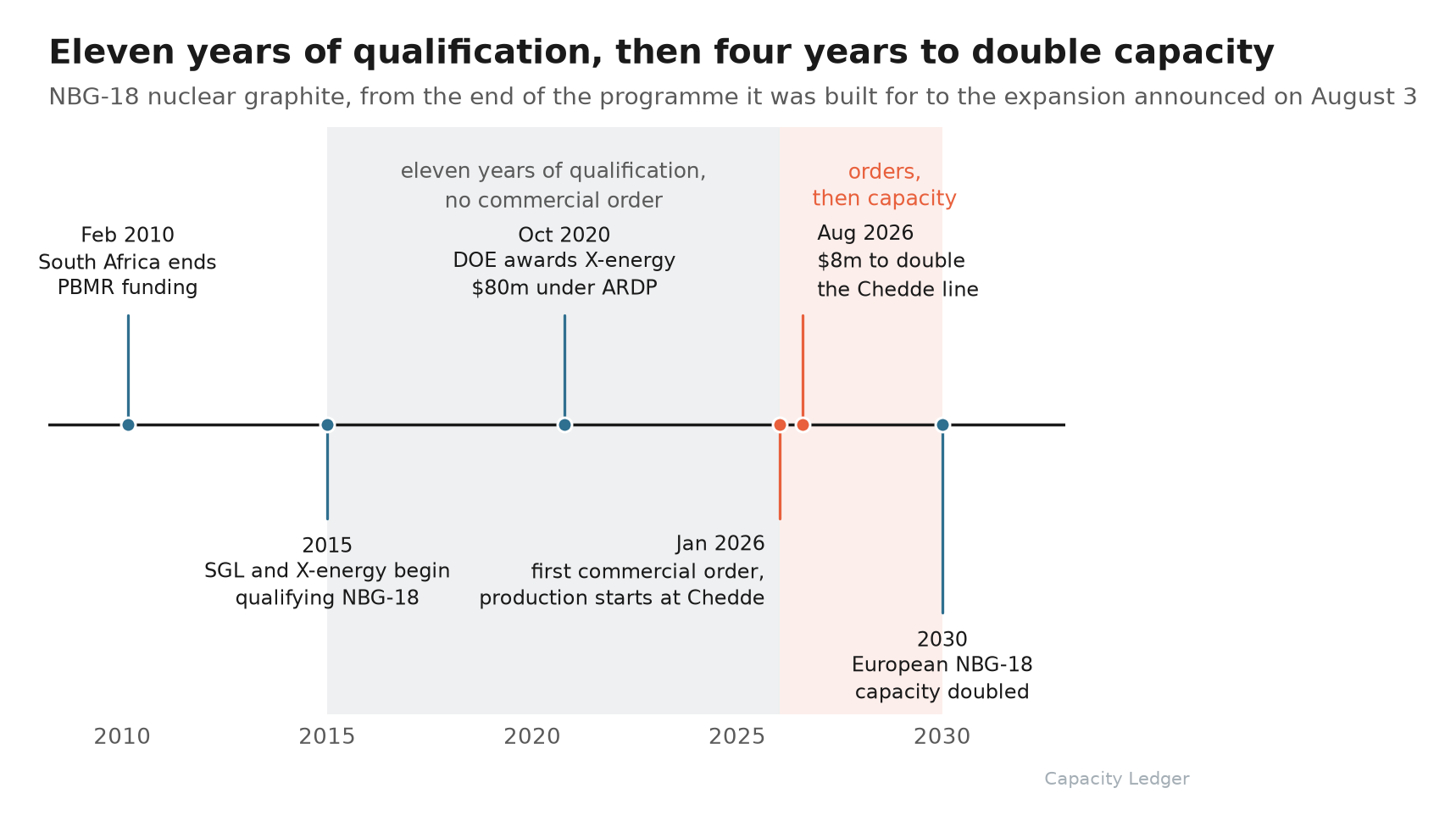
That ratio is the whole story of this material. The furnace was never the hard part. What the August 3 money buys is comparatively ordinary:
- New facilities and equipment upgrades at Chedde, paid against milestones rather than up front.
- Expanded US capacity for machining billets into finished graphite blocks, which is the step that turns a French billet into an American reactor component.
- A prototyping campaign already finished this year, with the first NBG-18 blocks made at Chedde under the award shipped to SGL's US sites for machining.
X-energy's chief executive, J. Clay Sell, was direct about why the money moved: "Commercializing new nuclear at scale rests first and foremost on our ability to significantly expand the nuclear supply chain."
The First Reactor Sits in a Chemical Plant
Here is the part that makes this a specialty chemicals story rather than an energy one.
X-energy's first commercial deployment is Long Mott Generating Station in Calhoun County, Texas. The applicant, Long Mott Energy LLC, is a wholly owned Dow subsidiary, and the NRC docket describes a four-module plant at 800 MWth / 320 MWe. A single Xe-100 makes 80 MW of electricity or 200 MW of process heat, on a sixty-year design life. DOE's own description of the project is that the reactors will "replace aging power and steam assets on the Seadrift site and support the manufacturing of more than 4 billion pounds of chemical products a year."
The regulatory clock is close to done. The application was docketed in May 2025, the environmental assessment and finding of no significant impact were completed on May 18, 2026, and the NRC schedule targets a final safety evaluation in November.
So a Gulf Coast chemical site's steam and power, four billion pounds a year of product behind it, now depend partly on the throughput of a carbon plant in Haute-Savoie. That is the shape of every thin chain this desk covers: one qualified source, a long lead time, and a customer with nowhere else to go.
Final Thoughts
The desk spends most of its time on the removal side, counting plants that stop. The addition side is thinner and usually arrives as a dollar figure with no tonnage attached to it, which is why we keep saying that an announcement is not capacity.
This one is worth holding up for the opposite reason. Nothing about the Chedde expansion is large: eight million dollars is a rounding error next to the reactors it enables.
What made the material scarce was the eleven years of qualification data standing behind it, and that work was done through two cancelled programs by people with no order to show for it.
Qualification is the capacity. The furnace is just where you put it.
Thanks for reading.