The Grades That Still Need the Surfactant
Syensqo stopped making C6O4 at Spinetta Marengo 64 days before its permit required it, and says nearly all of the site's fluoropolymers are now polymerized without a fluorosurfactant. The one percent that is not is the hydrogen and semiconductor grade set, and it is being made from inventory.
Syensqo stopped producing C6O4 at Spinetta Marengo on Wednesday, 64 days before the deadline written into the site's own permit.
C6O4 was the last fluorosurfactant the Alessandria plant used to polymerize fluoropolymers. The work that replaced it started in 2019, the public commitment to finish by 2026 came in 2022, and the renewed environmental authorisation presented to the town on 17 September turned the commitment into a date: production had to stop by the end of December.
So the clean version of this story is a European fluoropolymer site taking a PFAS processing aid out of its own reactors, ahead of schedule, and saying so in writing.
Where it gets interesting is the residue.
"Which grades still need the surfactant, and what happens to them when the inventory runs out?"
Nearly 100% of the company's fluoropolymers are now made without a PFAS processing aid. The rest is about 1% of the site's production volume (chart below), and the company is specific about what sits inside that one percent: highly specialized fluoropolymers for hydrogen and semiconductor uses that still need more research and qualification.
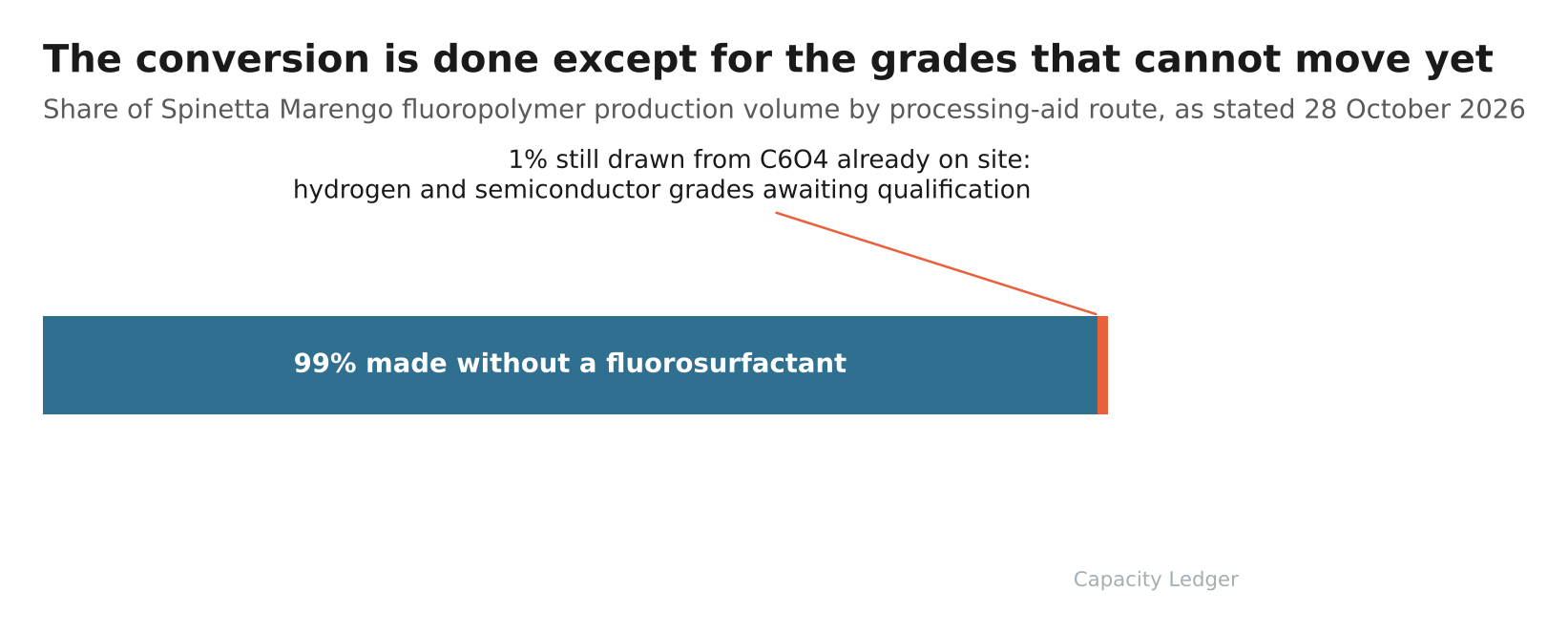
Those grades keep running on C6O4 already on site. No new production of the aid, existing stock, best available emissions-reduction technology on the stacks while the stock lasts.
A finite input behind a permanent prohibition.
The Process Changed and the Plant Kept Running
Nothing here takes a tonne of fluoropolymer nameplate out of Europe, and that is worth saying plainly, because almost everything else in this desk's fluoropolymer file this year has been the subtractive kind of story. AGC's Hillhouse exit in July. The PFA antidumping and countervailing cases through August and September. The PTFE import book in October, after Germany stopped sending what it used to send. The PVDF exclusion order the Commission put partly back under review this week.
This one is a process change inside a plant that is still making product.
Which is why it is easy to file under compliance news and move on.
The reason not to is that a polymerization aid sits inside the recipe rather than beside it. A recipe change is a qualification event for the people downstream.

The rest of this brief is for subscribers.
The capacity math, the trade-flow read, and what it means for the products you buy.
$50 a month, or $400 a year.
Already a subscriber? Sign in