 Capacity Ledger
The Last Cell Room Is Still in EPA's Mercury Count
EPA published its triennial mercury inventory on November 6 and led the release with four declines. The report's own use table carries two increases, and the heavier of them is the chlor-alkali cathode line: 376,459 pounds in 2024, up 17,225 on 2021, twenty-five times the mercury that went into every mercury-added product made in the country. The plant that holds it stopped in May 2025, and nobody in America is currently able to take the metal.
Four reported activities in the entire United States put elemental mercury into a manufacturing process in 2024.
One is a weld head. One is a porosity test. One is a bath for measuring the density of tungsten bars and checking respirators.
The fourth is a chlor-alkali cell room. Between them the four carry 376,325 pounds of elemental mercury, and the instruments are not what is holding it.
EPA published the third triennial mercury inventory on November 6 and the Federal Register notice of availability ran yesterday. The data is calendar-year 2024, filed by companies directly under 40 CFR part 713, deadline July 1, 2025. The release led with four declines: 48% less mercury in products made here, 58% less in products sold here, 56% less elemental mercury manufactured, 99% less mercury compound imported.
All four are real. All four are also small.
"What happens to a hundred and seventy tonnes of cathode mercury when the cell room it circulates in stops?"
The Same Table Carries Two Increases
Page 17 lists them with no commentary at all.
Mercury sold in the United States rose 41,291 lbs, about 76%. Mercury used in a manufacturing process rose again, and page 40 puts that one at 17,225 lbs, about 5%.
Set the four categories side by side across the three reporting years EPA now has and the proportions do the arguing (chart below).
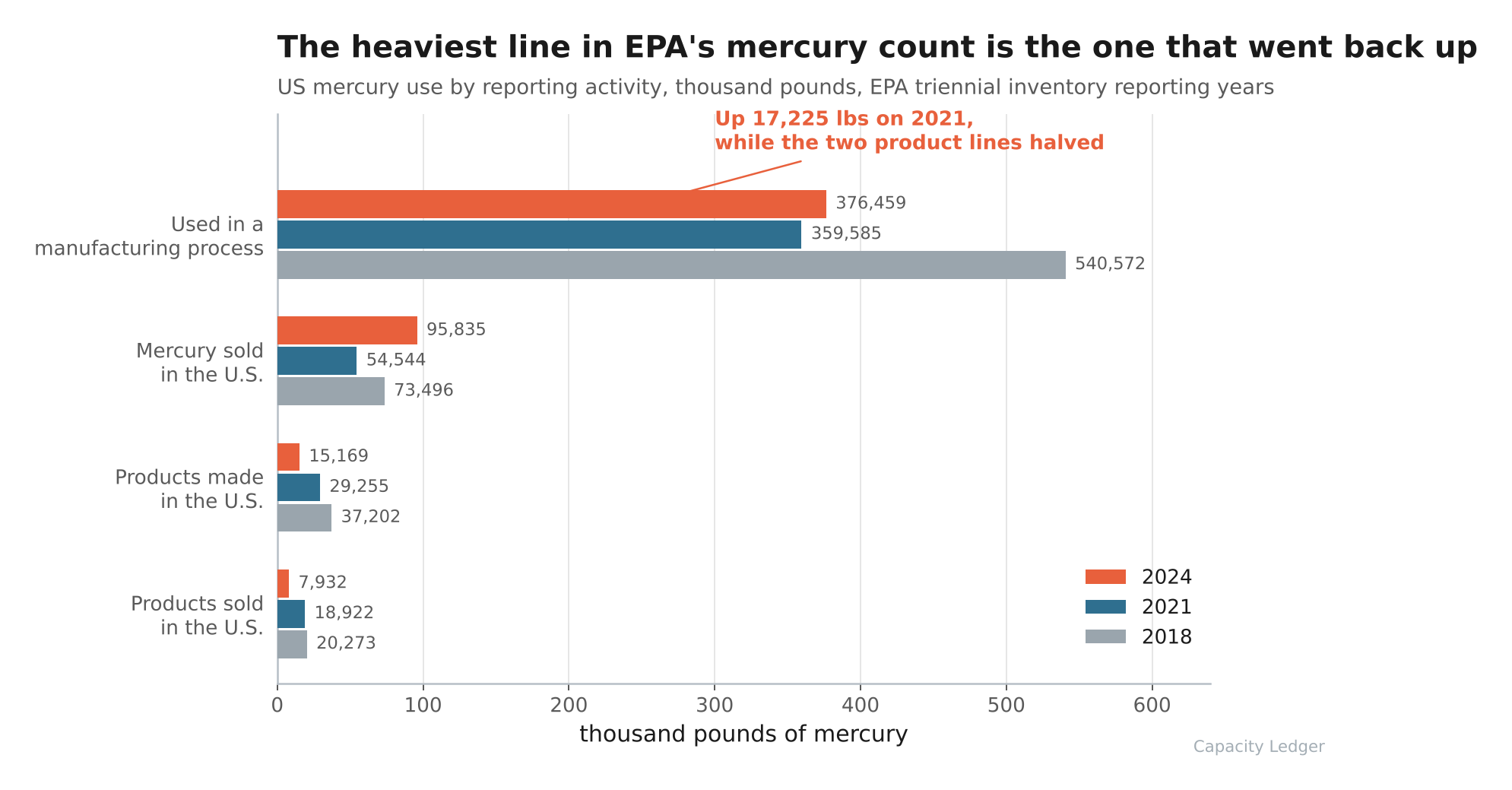
The manufacturing-process line is 376,459 lbs for 2024. Products made in the United States, the category that fell 48% and got the headline, is 15,169.
24.8 times heavier.
EPA plots these four categories once, in Figure 4, on a log axis, which is the one scale on which that ratio disappears.
One aside for anyone who reconciles tables. Table 5's 2024 total column prints 375,459 for that row while its own components (376,325 elemental plus 134 in compounds) and Table 2 both give 376,459, a thousand-pound slip in the line that matters most.
Continuous Use Means It Just Sits There
The report says the bulk of the 376,325 lbs was "in continuous use." USGS says the same thing from the other direction: almost all the mercury in that process is reused, and mercury-cell chlor-alkali plants are the leading manufacturing processes that use it.
So the number is a stock sitting in cells, reported as use. It goes to zero when the cells are drained.
Which is what happened eighteen months ago.
Natrium Stopped in May 2025
EPA's 2022 NESHAP amendment gave existing mercury-cell chlor-alkali plants three years to eliminate mercury emissions, with a compliance date of May 6, 2025. By then the source category under 40 CFR part 63 subpart IIIII contained exactly one operating facility, Westlake in West Virginia, after the second converted in late 2020.
The numbers EPA attached to that lone unit in the rulemaking:
- Built in 1958, and one of the smaller mercury-cell units the country ever had, under 75,000 tons of chlorine a year. Against Westlake's 6.7 billion lbs of chlorine capacity that is about 2%.
- Roughly 125 lbs a year of mercury air emissions, which is what the rule was written to end.
- No mercury recovery facilities still operating anywhere in the US, a line EPA put in the 2022 rule and has not revised.
Westlake's 2025 10-K closes it out in one sentence: the company ceased operations of the mercury cell production unit at Natrium in May 2025 and expects to keep incurring decommissioning and demolition costs through 2026.
The inventory published last week is a census of a cell room that had already stopped.
Nobody Can Take the Metal
Here is the part a capacity desk should care about. 170.7 tonnes of elemental mercury has to leave that building, and the routes out are closed in sequence:
- Export has been illegal since 2013 under the Mercury Export Ban Act, with five mercury compounds added in 2020. USGS records zero exports of the metal in every year from 2021 through 2025.
- Commercial disposal does not exist. EPA's own words in this report: "There is currently no commercial capacity for disposal of high-concentration mercury hazardous waste."
- Federal long-term storage is still a contract. DOE awarded a Texas company a five-year deal on November 21, 2024 to construct a facility holding as much as 7,000 tons, and EPA says plainly that no such facility is currently available.
Eight recycling facilities run by six companies are authorized by DOE to hold mercury temporarily until that site opens. Temporary storage is the whole market.
Final Thoughts
The United States registered a Minamata exemption to run mercury in chlor-alkali production out to 2030, five years past the Annex B date. It will finish the decade without needing it, and the process that forced the registration is already off.
None of it shows up in the official count until the 2027 reporting year, which is a full cycle of lag on the largest single move the series has ever had. Last week's report says 376,459 pounds. The next one, on this line, should say close to nothing.
A count taken every three years tells you where the mercury was. The cell room tells you where it is.
Thanks for reading.