 Capacity Ledger
The Pacific Rim Chemical Index Fell Without Its Parts
BLS says goods coming in from the Pacific Rim cost 7.0 percent more than a year ago. Chemicals from the same origin group are down 3.57 percent, which is a steeper fall than basic chemicals, resins or other chemical products managed, and two of those three went up.
Eight days ago BLS put out the September import and export price numbers, and the line everyone quoted was the top one: imports up 1.1% on the month and 8.1% over the year, the largest twelve months since the year ended July 2022.
Further down the same release is the table sorted by where the goods came from. Everything arriving from the Pacific Rim, up 7.0% over those twelve months.
Now go one more level in, to chemicals from the Pacific Rim.
Down 3.57%.
"Which of those two numbers is the one a chemical buyer should be arguing about?"
Neither, and the chart below is why.
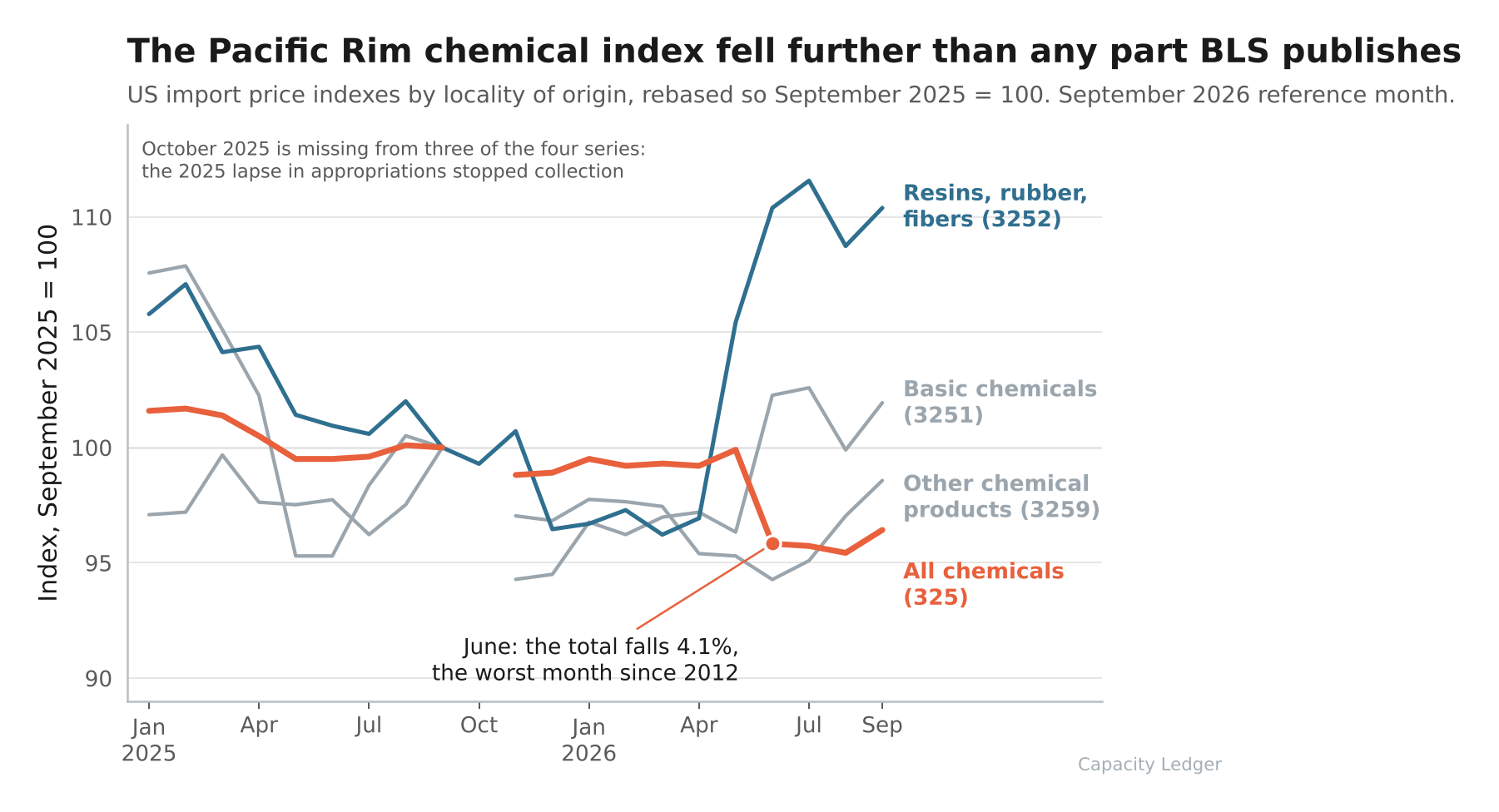
BLS publishes three four-digit chemical industries underneath that Pacific Rim total. Over the same twelve months to September, basic chemicals rose 1.94%, resins and synthetic rubber and fibers rose 10.39%, and other chemical products slipped 1.43%.
The total fell further than every one of them.
The Month That Did It
Almost all of the gap opened in June.
Pacific Rim chemicals went 100.6 to 96.5 that month, a drop of 4.08%. Run every consecutive-month change in the series back to June 2012, 169 of them, and nothing comes close: the next worst is -2.67% in January 2016.
Here is what the same origin group was doing in that same June:
- Basic chemicals, up 6.16%.
- Resins, rubber and fibers, up 4.70%.
- Other chemical products, down 1.07%.
- All goods from the Pacific Rim, dead flat at 0.00%, 105.8 to 105.8.
So the record month in the total is not visible anywhere in the published pieces of the total.
Two of the five four-digit industries BLS prices under chemical manufacturing are withheld for this origin: pesticides and fertilizers, and pharmaceuticals. Whatever happened in June is sitting in those, in the weights, or in both, and the weights for locality indexes are not something BLS publishes. We are not going to pretend to close that gap. The useful part is knowing it is there before you quote the number at someone.
Japan Is Already Inside That Number
The Handbook is blunt about the overlap: "Regions are not mutually exclusive." Japan and China are both inside the Pacific Rim group, and both have their own chemical index.
Japan's is up 8.28% over the twelve months. China's is up 1.29%. The group that contains them is down 3.57%.
Japan's did almost all of that in one month too. March to April 2026, 89.2 to 98.9, a rise of 10.87% that is comfortably the largest month in that series since it began in 2012, with the runner-up at +3.96% in July 2023.
And the obvious explanation does not hold. A currency move would have lifted everything Japan ships here, and Japan's all-goods index moved +0.58% that month.
Whatever repriced in April was chemicals.
What the Index Is Actually Measuring
Worth being precise about, because it changes what the number is good for.
Import prices are collected f.o.b. the foreign port, and they exclude duty.
BLS's own methodology says so, and gives the example: a foreign firm that eats half of a 10 percent tariff shows up as roughly a 5 percent decline in the index.
So what the series measures is pass-through, at the foreign seller's own gate:
- It will not tell you your delivered cost, because freight, insurance and duty are all outside it.
- It will tell you what your supplier changed at their own gate, in dollars, which is the half of the tariff conversation that usually goes unmeasured.
- It converts at the average daily exchange rate of the month before the reference month, so a currency move reaches the index a month late.
A resin buyer sourcing out of Asia has exactly one number in that release worth having.
Pacific Rim resins, rubber and fibers ran +14.72% from March to September alone.
Final Thoughts
None of this is a capacity event. Nothing came off a nameplate, and the September file is eight days old with the October print due November 17.
What it settles is which series to key an escalator to.
The origin aggregates get quoted because they sit at the top of the release and they are easy to find, and for chemicals the Pacific Rim one spent the last year falling further than every piece of itself anybody can see. Four digits down costs you one extra lookup in a free flat file, and over those twelve months the distance between the total and the resin line was 13.96 points.
Thanks for reading.