 Capacity Ledger
The Plant Yara Bought Instead of Building
On June 30 Yara walked away from the ammonia assets inside Air Products' Louisiana complex because the returns did not clear its bar. Two days later it paid $1.3 billion for a Texas City plant that is still in commissioning, and priced per annual tonne that was the cheapest capacity on its list.
Two days is not much time to change your mind about a billion dollars.
On June 30 Yara told the market it would not buy the ammonia assets inside Air Products' Louisiana Clean Energy Complex. The reason was stated flatly: the project's expected financial returns did not meet Yara's investment criteria.
Air Products cancelled the whole complex the same day and booked a pre-tax charge of approximately $2.9 billion.
On July 2 Yara agreed to pay $1.3 billion for the Gulf Coast Ammonia plant in Texas City.
Same company, same chemistry, same coast, forty-eight hours apart. The difference is that one of them exists.
"What does a tonne of capacity actually cost right now?"
What $1.3 Billion Actually Bought
Gulf Coast Ammonia is a single-train plant rated at 1.3 million tonnes a year, sitting on land Eastman owns inside the Texas City industrial park. Air Products supplies the hydrogen and nitrogen under a long-term contract and keeps the pipeline.
It was scheduled to open in 2023. Yara's own release describes it on July 2, 2026 as "currently in commissioning," with full production and stable operations anticipated by the end of this year.
So Yara bought a plant that is still finding its rate. Close enough, evidently, to beat everything else on the list.
Here is the part worth writing down. When the financing closed in January 2020, Gulf Coast Ammonia's own investment was announced at $600 million, alongside a separate $500 million from Air Products for the reformer, the air separation unit, the utilities and thirty miles of pipeline.
Yara paid more for the ammonia plant on its own than the entire complex was budgeted to cost.
The Board Yara Was Looking At
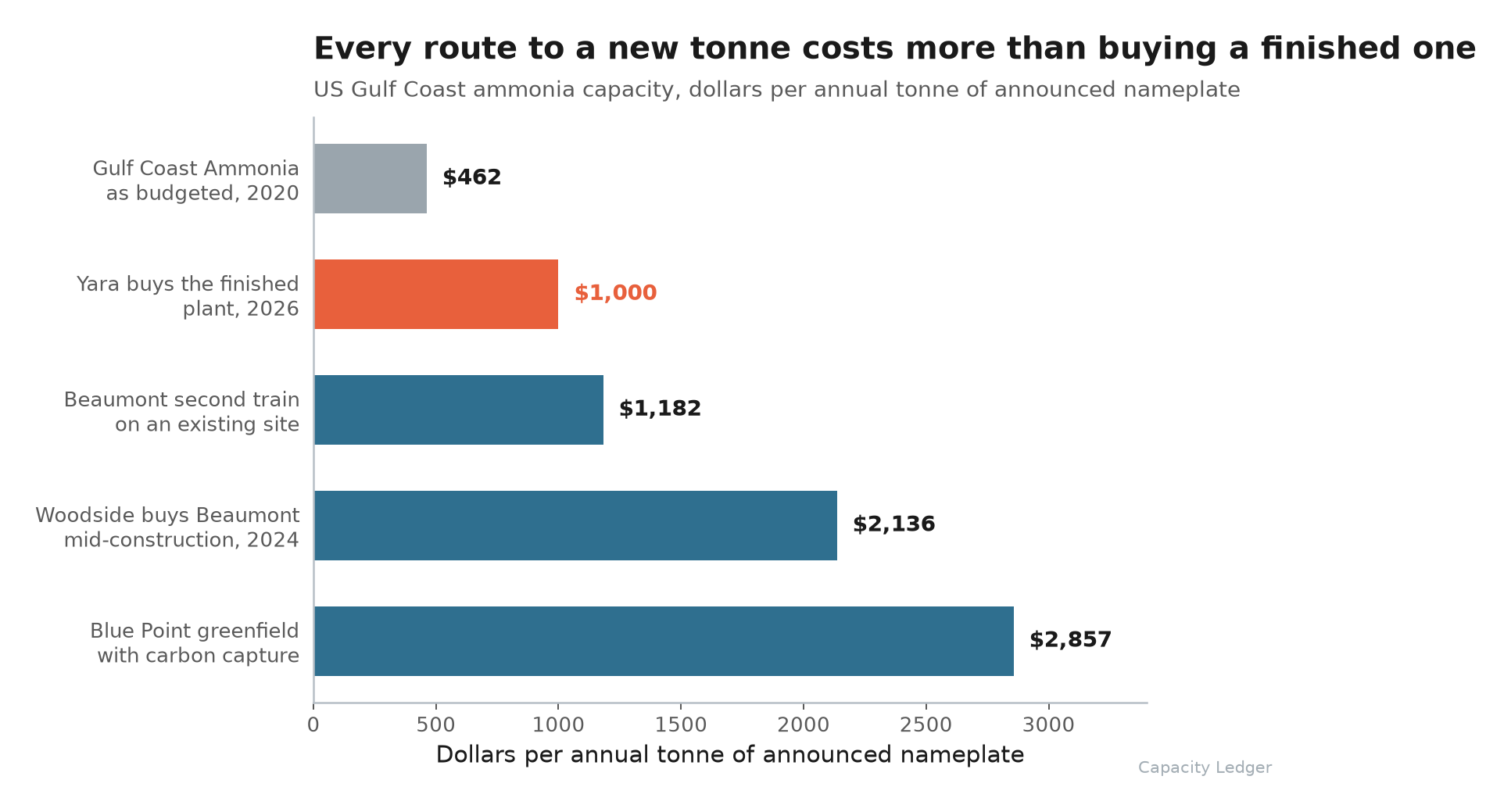
Divide announced consideration by announced nameplate and every recent US Gulf Coast ammonia decision lands on one axis (chart above).
- $462 per annual tonne: Gulf Coast Ammonia as budgeted in 2020, before the schedule went sideways.
- $1,000: what Yara just paid for that same plant, commissioning and all.
- $1,182: the midpoint of Woodside's $1.2bn to $1.4bn range for a second 1.1 Mt train at Beaumont, on a site that already has one.
- $2,136: what Woodside paid OCI in August 2024 for the first Beaumont train, mid-construction.
- $2,857: the CF Industries, JERA and Mitsui joint venture at Blue Point, $4 billion for 1.4 Mt of autothermal reforming with carbon capture, production expected in 2029.
The bottom two entries buy carbon capture equipment a conventional steam-reforming plant does not have, so the comparison is a bit of an oversimplification for time. The ranking survives it.
The cheapest tonne anyone can still act on is one somebody else already paid to build.
Yara said so itself on June 30, in the flattest available language: it would reallocate the capital toward US ammonia opportunities with more competitive returns. Two days later we learned which ones.
Why This Sits in a Specialty Chemicals Brief
Ammonia is the front of a chain most of this readership buys somewhere further down. Nitric acid, acrylonitrile, caprolactam, aniline into MDI, and the merchant CO2 that comes off the reformer as a byproduct and turns up in your gas contract every autumn.
The arithmetic is the more portable part.
Every capital committee in the industry is running this same comparison, and when replacement cost sits two to three times above the price of a commissioned asset, the addition column fills with transactions instead of construction.
Ownership moves. The tonne count does not.
That is what this morning's July tally showed on the addition side, before we had priced any of it: six entries, five of them dollar figures with no capacity attached to them at all.
Final Thoughts
None of this makes Texas City new capacity. The plant was announced in 2020, and it will make the same 1.3 million tonnes under a Norwegian flag that it would have made under a private-equity one.
What the transaction does is put a price on the thing this desk keeps counting. For most of the last decade a buyer could assume that persistent tightness eventually pulls new plants into the world.
At $2,857 a tonne for a greenfield against $1,000 for a finished one, that assumption now has a much longer fuse.
Watch the Beaumont second train. Woodside has said it wants to be ready for a decision this year, and at $1,182 a tonne it is the cheapest new-build route anyone in the US Gulf has attached a number to.
If that one slips, the only ammonia capacity arriving on this coast for years is capacity that is already standing.
Thanks for reading.