 Capacity Ledger
The Price List Ends Before the Rhine Does
Contargo's low-water surcharge runs from 40 euros a box to 1,075. On two of the four gauges it is keyed to, October's river went past the bottom of the published list, and on none of the four was there a single morning the carrier owed you carriage.
"If the river goes below the bottom of the price list, what do you pay?"
Contargo publishes its low-water surcharge as a step table, which is the honest way to do it.
Pick the gauge that governs your terminal, read the level at 5 a.m., find the band, pay the number. Full containers only, per box rather than per TEU.
The tables run a long way. Kaub goes from 40 euros per laden 20-foot container at 150 centimetres down to 1,075 euros in the deepest band, nearly twenty-seven times the top of its own schedule, and the carrier attributes the step up from earlier low-water years to the rise in ship charter costs.
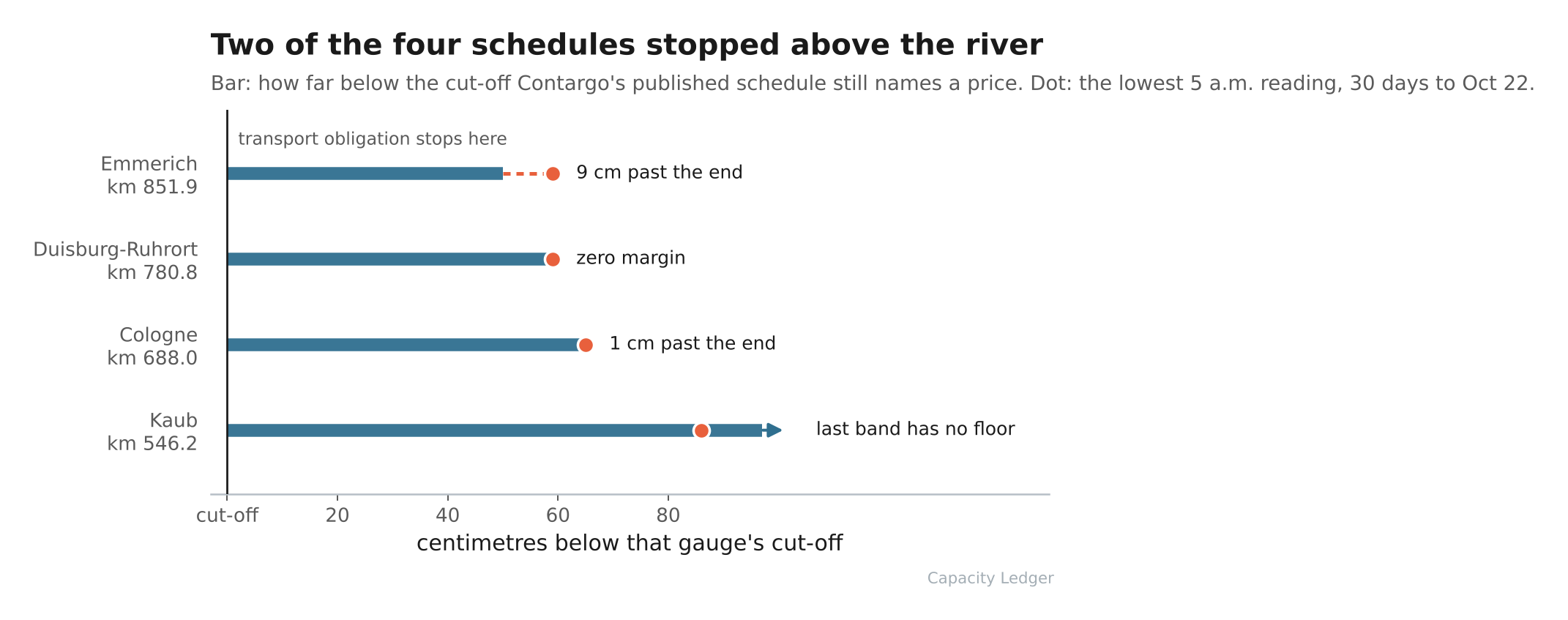
Three of those four tables have a last line (chart below).
Four Gauges, Four Cut-Offs
The schedule is keyed to four WSV stations, and each one governs a stretch of terminals:
- Emmerich at Rhine km 851.9, the Dutch border crossing.
- Duisburg-Ruhrort at km 780.8, everything from south-east of Wesel down to Neuss.
- Cologne at km 688, the Koblenz-to-Cologne run.
- Kaub at km 546.2, which gates every terminal south of Koblenz, meaning the Upper Rhine and the drummed and bagged freight that moves up it in boxes rather than tank barges.
Each gauge also carries a cut-off where Contargo's transport obligation stops: 30 centimetres at Emmerich, 180 at Duisburg-Ruhrort, 105 at Cologne, 80 at Kaub.
Below that the carrier is still selling you a move. It is no longer promising one.
Okay, so the useful question is how far past that cut-off the published price actually reaches, and whether the river stayed inside it.
Where October Went
We pulled all four gauges off the WSV PEGELONLINE feed this morning: 11,465 readings at fifteen-minute spacing, September 22 to October 22, parameter W.
Not one of them reached a cut-off. Zero of 11,465, on all four stations, for thirty straight days.
The best single reading of the month was still 58 centimetres under the line at Kaub and 25 under it at Duisburg-Ruhrort.
The decisive reading is the morning one, and we can show that rather than assume it. Contargo's own posted levels for today read Emmerich -11, Ruhrort 145, Köln 64, Kaub 19, and the desk's 05:00 readings for October 22 are -11, 145, 64 and 19.
Same river, same clock, to the centimetre.
Run thirty of those mornings against the bottom of each table and the gap opens:
- Emmerich priced down to -20 centimetres. Its lowest morning was -29, and 7 of the 30 fell past the end of the list.
- Cologne priced down to 41. Its lowest morning was 40. One centimetre, one day.
- Duisburg-Ruhrort priced down to 121. Its lowest morning was 121 exactly, which is zero margin and a coin flip, since the 6 a.m. reading that day was 120.
- Kaub never ran out, and the reason is a drafting choice rather than a hydrological one.
What Kaub Has That Nobody Else Does
Kaub's deepest band is written "from 40 cm". No lower bound.
Everything from 40 centimetres down to the -6 the gauge printed at 02:45 on October 1 falls in one band at 1,075 euros a box.
That open end is worth something to a buyer, and only one of the four tables has it. At Kaub you have a ceiling.
At Emmerich, on seven mornings in a month, you had a published schedule that stopped nine centimetres above the water and an invoice that had to come from somewhere else.
Today's numbers, straight off the gauge and the table: 1,075 euros per laden 20-foot box on the Upper Rhine, 685 at Cologne, 445 at Duisburg-Ruhrort, 345 at Emmerich. The 40-foot column is higher in every case.
Two things worth putting in writing with your forwarder before the next low-water season:
- Which reading governs. "5 a.m." resolves differently in CET and CEST, and this month it was the difference between Duisburg-Ruhrort being on the table and off it.
- What happens past the last band. The tables that end do not say. Have that negotiation on a 54-centimetre day, while the table still has an answer.
Final Thoughts
None of this is a capacity event. No plant came off line for it, nobody declared anything, and the river has actually recovered a little since the first of the month.
What it does is put a number on a cost that usually arrives as a line item nobody models. The gauge is a free API, the schedule is a public web page, and between them you can price your own box a day ahead of the invoice and know, on the bad mornings, when the published answer runs out.
Thanks for reading.