 Capacity Ledger
Twenty-Eight-Dollar Gas Is Back in Europe
EIA's Tuesday outlook spent its gas section cutting the US winter forecast to $2.87 an MMBtu. Further down the same page it reports that Europe's benchmark averaged $28.51 in October and East Asia's $28.59, the highest international gas prices since December 2022. The ratio a European plant runs against a Gulf Coast one went from three to one in February to nine and a half to one in October.
The November Short-Term Energy Outlook came out Tuesday. EIA closed the modelling the Thursday before, on November 5, and spent most of the natural gas section on a forecast: Henry Hub averaging $2.87 per MMBtu from November through March, 16% below what the same agency said a month ago and 36% below last winter.
The number that should stop you sits further down the same page, and it has already happened.
Europe's benchmark, the Dutch Title Transfer Facility, averaged $28.51/MMBtu on near-month futures in October. In February it averaged $11.27.
East Asia did the same thing, the Japan-Korea Marker going $10.82 to $28.59.
Henry Hub spent those same eight months walking the other way, $3.62 in February to $2.99 in October.
"What does a nine-to-one energy gap do to a plant that already decided to close under a three-to-one one?"
The Split Is Eight Months Old
The level is a 2022 level. The cause is this year's (chart below).
EIA dates the move and does not hedge it: international prices "have risen to the highest levels since December 2022," and the clock starts "since the U.S.-Iran conflict began on February 28." Tanker strikes and other logistical disruptions still hold LNG exports through the Strait of Hormuz well below pre-war levels.
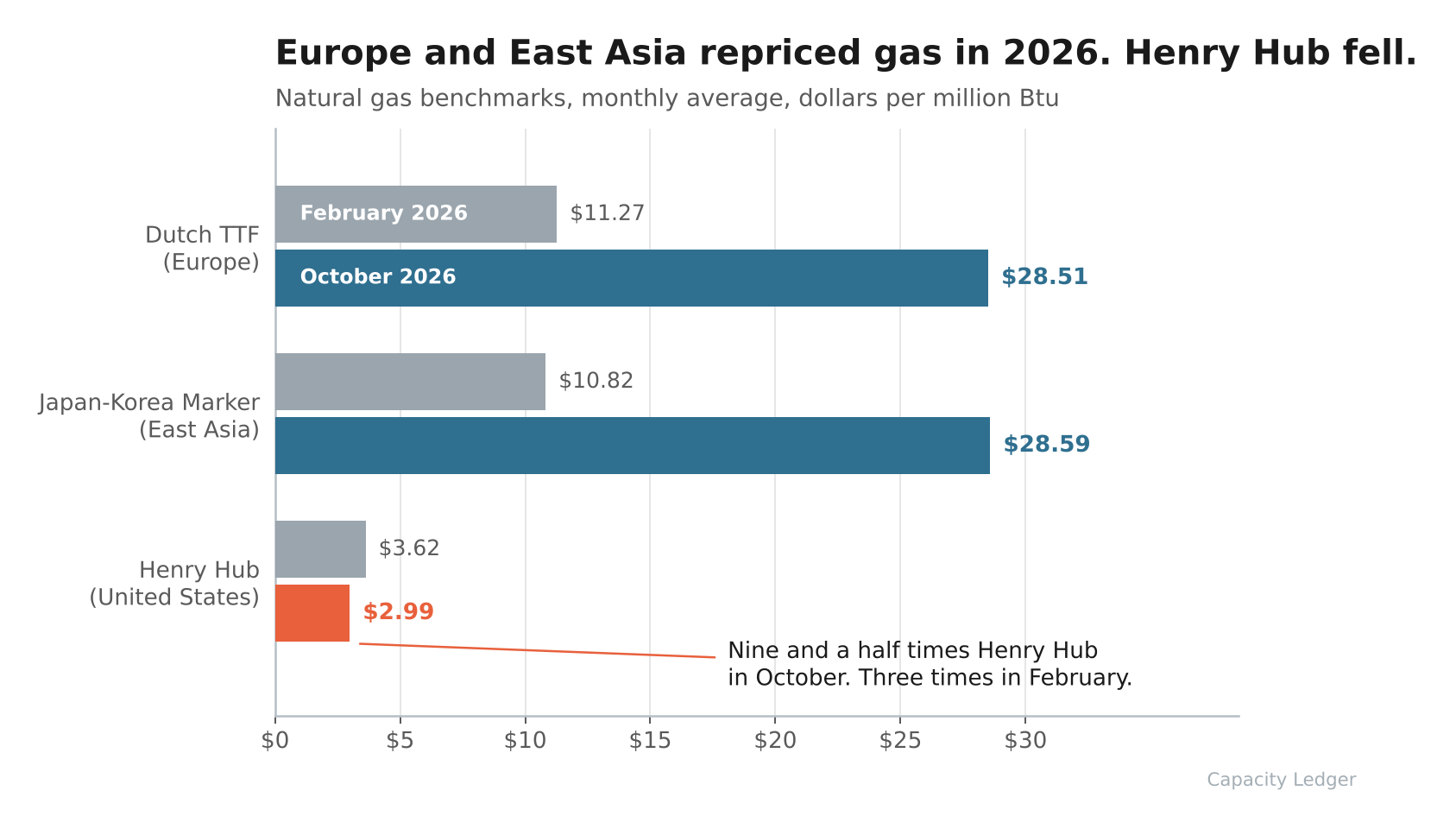
Divide the two benchmarks and you get what a European competitor is looking at:
- February 2026: TTF at 3.1 times Henry Hub, a $7.65 spread per MMBtu.
- October 2026: TTF at 9.5 times Henry Hub, a $25.52 spread.
That division is ours. Nobody publishes the ratio, and EIA publishes no downloadable monthly TTF series at all, which is why the chart carries the two months the agency names and nothing in between.
Neither Number Is What a Plant Pays
Worth saying once and plainly: a hub price is not a delivered industrial price, and any European producer still running has hedges, legacy contracts and some national relief scheme sitting between it and the spot screen.
What a hub sets is the margin. It prices the next molecule, and the next molecule is the one that decides whether the reactor runs this quarter.
Europe has been answering that question for four years by leaving it off. Cefic's count, reported in January, has announced European closures rising from 2.9 Mt of capacity in 2022 to 17.2 Mt by 2025, around 9% of the continent's total production capacity and 20,000 direct jobs.
In half of those cases the companies gave energy cost competitiveness as the primary reason.
That tally was assembled when the gap was three to one.
Cologne Is the Tell
On September 29 Westlake said it would close its Cologne PVC plant, 165,000 tonnes a year, with operations ceasing in the first quarter of 2027. The release named three causes: "weak demand, elevated energy costs and increased import pressure from Asia." The charge runs about $205 million pre-tax, roughly $110m of it landing in 2026, and the volume moves to Westlake's other German sites including what the release calls "the recently acquired Wilhelmshaven site."
October's print landed five weeks later.
So watch the second decisions through the first quarter:
- The hedge books that roll at year-end. A producer that survived 2026 on a strike price set in 2025 has to re-strike it against an October screen.
- Any US import line where a European plant is the marginal supplier. A supplier carrying $25 more per MMBtu than your domestic one stops bidding for volume and starts bidding only for the grades nobody else makes.
- The announcements that stop short of closure. "Reduced operating rates" and "footprint optimisation" are where this shows up a quarter before a WARN notice does.
Final Thoughts
Both ends of this chart are weather and tankers, and both can move. EIA's own winter number dropped 16% in a single month, which tells you how much conviction to attach to the forecast half.
The ratio is the durable part. It was already three to one in February, before February 28 changed anything, and three to one was enough to retire 9% of European capacity and 20,000 jobs over four years.
Whatever nine and a half settles back toward, the sorting it is doing right now is happening at plants that had already run the math at a third of the gap.
Thanks for reading.