 Capacity Ledger
Twenty-Five Thousand Square Feet That Make Nothing
RTI International cut the ribbon last Thursday on a $14 million expansion of the only privately owned industrial pilot laboratory in North Carolina, and the Department of Energy put $5.5 million into two projects there the day before. The building has no nameplate and will never sell you a tonne. Five companies have ever used it, and a few dozen say they would like to.
Five companies have ever run a process through RTI International's pilot plant in Research Triangle Park. It opened in 2013.
Two of them are in the building right now.
A few dozen more have told RTI they would like a turn, which is why on September 10 the institute cut a ribbon on a $14 million expansion of the thing, and why a US Department of Energy award worth $5.5 million landed on two projects inside it the day before.
"What actually decides whether a new molecule ever gets a nameplate?"
Not the money for the plant. The capacity events this desk logs every week get financed at fifty to two hundred million dollars a throw and nobody blinks.
The step in front of them costs a rounding error, and in an entire state there is one place to do it.
What Got Built
Read the two RTI announcements against each other and you get a better picture than either gives alone.
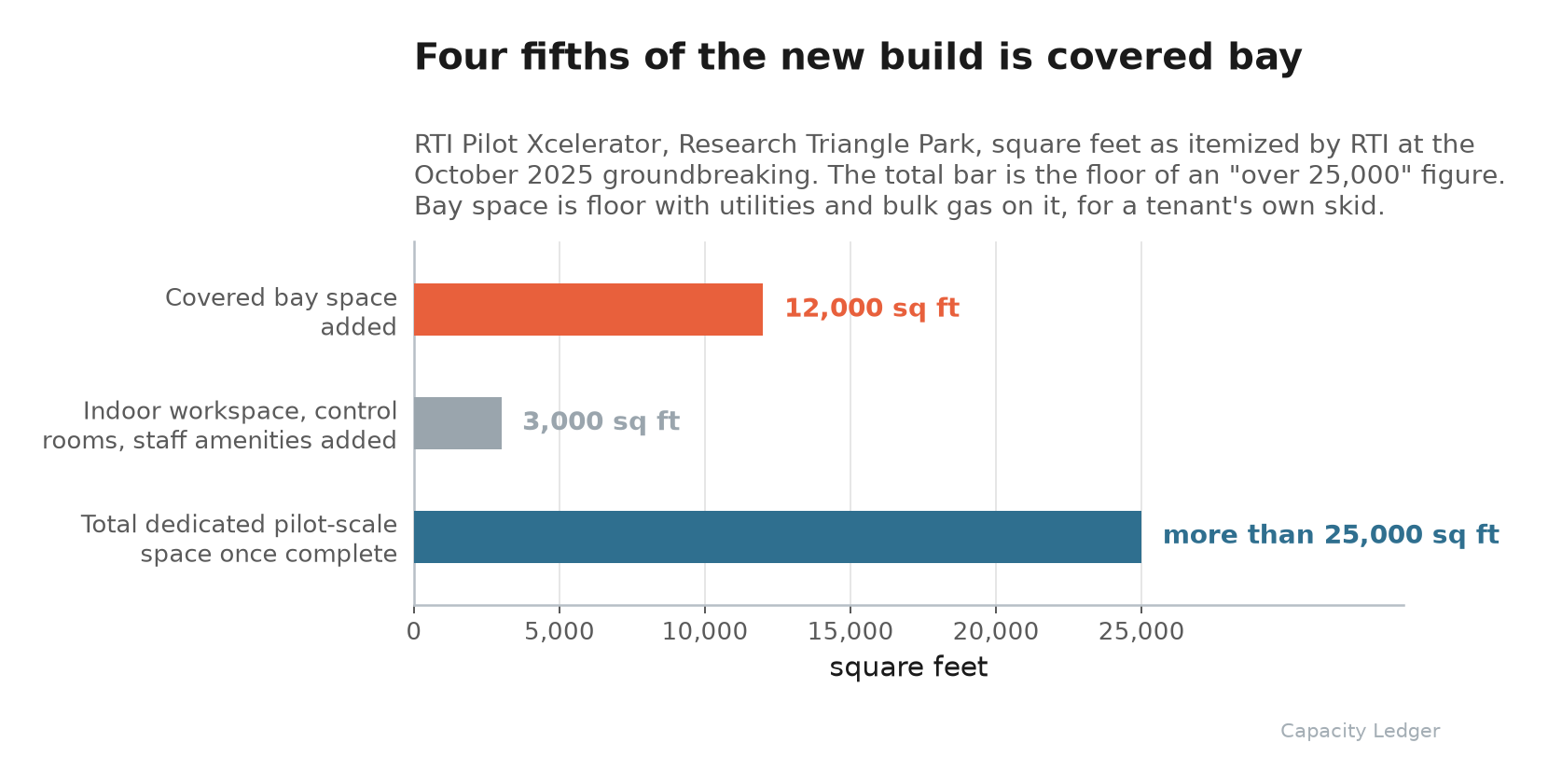
The September 10 opening release calls it a 25,000-square-foot expansion that doubles RTI's commercialization infrastructure. The October 2025 groundbreaking, eleven months earlier, is the one that itemizes: 12,000 square feet of covered bay space, 3,000 square feet of indoor workspace, control rooms and staff amenities, and total dedicated pilot-scale space landing somewhere above 25,000 square feet when it was done (chart below).
So four fifths of the itemized new build is bay. Empty, covered floor.
That is the correct thing to build, and it is worth being precise about what it means.
What RTI sells is floor: permitted, utility-connected, gas-supplied area a tenant bolts their own skid into, plus the instrumentation and the people who know how to read it. The groundbreaking lists the specification plainly:
- configurable bays sized for process skids
- dedicated control rooms for real-time monitoring
- full utility connections and bulk gas supply
- a solar field going in next door for behind-the-meter demonstrations
Nobody publishes a throughput figure for the place, and we are not going to estimate one. The unit of capacity here is not tonnes per year. It is how many innovators can be in the building at the same time, which is the number the program director, Sameer Parvathikar, actually reached for when the ribbon was cut: RTI has "more than doubled our footprint and the capacity to simultaneously host innovators and entrepreneurs here."
Twice a handful. In North Carolina, that is the whole supply.
Who Is Actually In There
The tenant list reads like a slate of molecules that do not have a US plant yet, and every one of them has to survive this building before anyone draws a P&ID for one that does.
Syzygy Plasmonics is running a greenhouse-gas-reforming process that takes CO2 and methane to low-carbon aviation fuel. CarbonBridge is doing methane to methanol biologically.
Aether Fuels is on waste carbon to SAF, and Lydian Labs is combining captured CO2, water and renewable electricity into the same product by a different route.
Then the DOE money, announced September 9 and split across two projects RTI will run in the new space.
One takes olivine, an ordinary rock, and pulls out materials for steelmaking, hydrogen fuel, soil amendments and construction, with Gunnadoo Consulting and Thar Energy on the team. The other is an anaerobic digestion route for used cardboard into recovered fibre and biogas, run with NC State's forest biorefineries department, and its stated targets are the most honest numbers in the whole announcement: 100 continuous days of operation, at least 1,000 kg of cardboard.
A thousand kilograms, run continuously, is the scale at which an industrial process earns the right to be taken seriously, because continuous operation is where the interesting failures live.
Fouling, catalyst life, a solids handling step that works beautifully for six hours and plugs on day nine. None of that shows up on a bench.
RTI's own vice president of engineering and advanced technology, David Dausch, put the barrier in one line: access to pilot-scale infrastructure "can be one of the biggest barriers to commercialization."
Final Thoughts
We spend most of our week counting tonnes that are going away. The closure file is long and it is not getting shorter, and the honest reason the addition side stays thin is not that nobody has ideas. It is that between a flask and a 40,000-tonne plant there is a step nobody wants to own, because it produces no product, carries no nameplate, and shows up on a balance sheet as a cost with a long tail.
So a nonprofit owns it, and one state's entire merchant supply of it is a bay you could park a few trucks in. That got twice as big last Thursday, which is genuinely good news and also tells you how small the number was.
If you are a sourcing manager wondering why the interesting new molecule your R&D group keeps asking about is still four years out, this is usually where it is. Waiting for floor space.
Thanks for reading.