 Capacity Ledger
Two Countries Ship Nine Tenths of Your Ethyl Acetate
INEOS mothballed Europe's largest ethyl acetate line on September 22, and the American drum barely felt it, because Britain had already fallen to 1.1 percent of the US import book. Mexico and South Africa carry 90.5 percent of what's left, the tightest that book has been in seven years, and the largest domestic plant spent this spring in Chapter 11.
INEOS rates the ethyl acetate line at Hull at 200,000 tonnes a year.
America's entire annual ethyl acetate import book is 39,945 tonnes.
One European plant, five times everything the United States buys from the rest of the world put together. INEOS mothballed it on September 22 along with the acetic acid and acetic anhydride units beside it, and the honest read on what that does to your drum price is close to nothing.
Britain was 1.1% of the book last year.
"If the plant that just went quiet was never in your book, who is in it?"
The Book Is Two Lanes
Mexico and South Africa, and it has been those two for as long as the series runs (chart below).
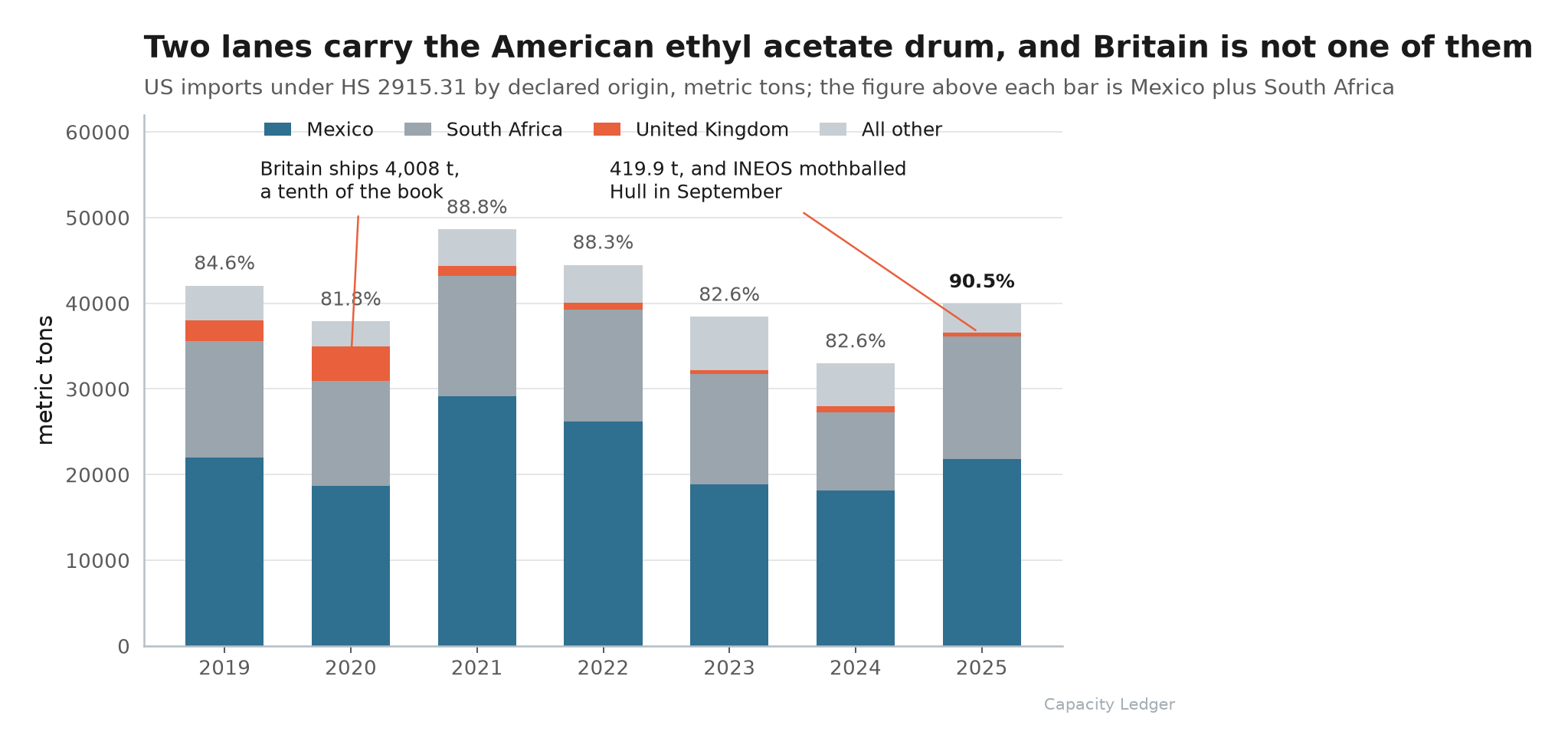
Mexico declared 21,792.7 t into the US in 2025 and South Africa 14,349.9 t. Together that is 90.5% of the year's 39,945.3 t, the highest concentration in the seven years we pulled, against a low of 81.8% in 2020.
Everyone else divides 3,382.8 t. India took 4.0%, Brazil 2.6%, Britain 1.1%, Korea and China under a point each.
All of Europe, every EU member plus the UK, came to 488,426 kg, or 1.22% of the book.
Worth knowing about the two lanes you actually depend on:
- The South African volume comes out of Sasol's Secunda solvents complex, Unit 590, which makes ethyl acetate by dehydrogenating its own ethanol rather than from acetic acid. Different feedstock, different cost curve, no exposure at all to the gas-versus-methanol economics that shut Hull.
- Secunda's own 2025 air licence lists Unit 590 as running "Intermittent" where the solvent units next to it are listed "Continuous." The licence publishes the production-rate table with the numbers blank, so nobody outside Sasol has a nameplate to work with.
- Mexico's lane is the bigger one and the more opaque. The desk could not verify from public sources which Mexican site or sites fill it, which is its own answer about how much of this you can diligence.
Britain Left Before INEOS Did
The UK lane peaked in this series at 4,008.1 t in 2020, a tenth of that year's book. By 2023 it was 461.5 t. Last year, 419.9 t.
Call that 0.21% of Hull's published nameplate. American buyers walked away from that plant years before the gas bill closed it.
Now, the lane was rebuilding on its way out the door. January through June 2026 brought 577.6 t from Britain, 2.9 times the same months of 2025 and already more than the whole of last year.
So the sliver of Hull that America had started buying again is exactly the sliver that stopped in September.
The Domestic Answer Went Through Chapter 11
The obvious hedge against a two-country import book is a domestic plant, and the largest one in the country spent 2026 being sold for parts.
Viridis Chemical ran the ethyl acetate plant at Columbus, Nebraska, making the solvent from corn ethanol instead of coal or methane derivatives, work the EPA gave a Green Chemistry Challenge Award in October 2024. ICIS put the line at 52,000 t/y from the end of 2022, by a distance the biggest in the US.
The company spent 2025 moving it to a BioUrja site near Peoria, Illinois, and the move is what killed it.
Payments to the construction contractor hit roughly $21.5m against a $14.9m contract, 44.3% over, inside a project budgeted at $26.7m all-in. The ethyl acetate-to-ethanol spread contracted 26% in the second half of 2025 while that was happening.
Viridis and four affiliates filed Chapter 11 on March 8, 2026 in the Southern District of Texas, case 26-90393, and ran a fast section 363 sale of the stalled Peoria plant. The court signed off on the liquidation plan after the assets went.
The Nebraska plant had never really carried the load anyway. Court filings describe it running in "limited operations" after its 2019 completion because the adjacent ADM ethanol plant could not supply input of sufficient quality.
Final Thoughts
The pricing news right now is friendly. H1 2026 import volume ran 7.8% above H1 2025 and the average declared unit value fell 24.0%, from $1.130/kg to $0.859/kg, which is the same weak spread that bankrupted the domestic producer showing up on your side of the invoice.
The exposure is the shape of the book, not the level of the price. Ninety percent of a solvent that goes into your coatings, your adhesives, your pharma washes and your printing inks arrives from two countries, one of which publishes nothing about the plant and the other of which the desk cannot even locate.
Hull was the headline this month. Secunda and whatever is behind the Mexican border are the numbers.
Thanks for reading.