 Capacity Ledger
Two Thirds of Your Furfural Rides on a Cane Harvest
Half of every tonne of furfural the US imported since 2015 came from South Africa and another sixth from the Dominican Republic, both of them byproducts of sugar milling. The 2026 book is running 29 percent behind last year.
In July the United States imported 59.9 tonnes of furfural.
Fifty-five of them came from Austria.
Both numbers are real. That is what a supply book looks like when the molecule is a byproduct of somebody else's harvest, and the harvest was somewhere else that month.
"If two thirds of a chemical arrives as a sugar-mill byproduct, who actually sets your delivery schedule?"
Where the Tonnes Come From
We pulled every reported US import of HS 2932.12 from UN Comtrade this morning, 2015 through 2025, and summed the partner detail rather than the reported world row (that row is missing outright for three of the eleven years, so it cannot be trusted as a denominator).
Eleven years, 192,674 tonnes. South Africa alone is 94,904 t, or 49.3% of every tonne.
Add the Dominican Republic's 33,705 t and the two of them carry 66.8% of the book (chart below).
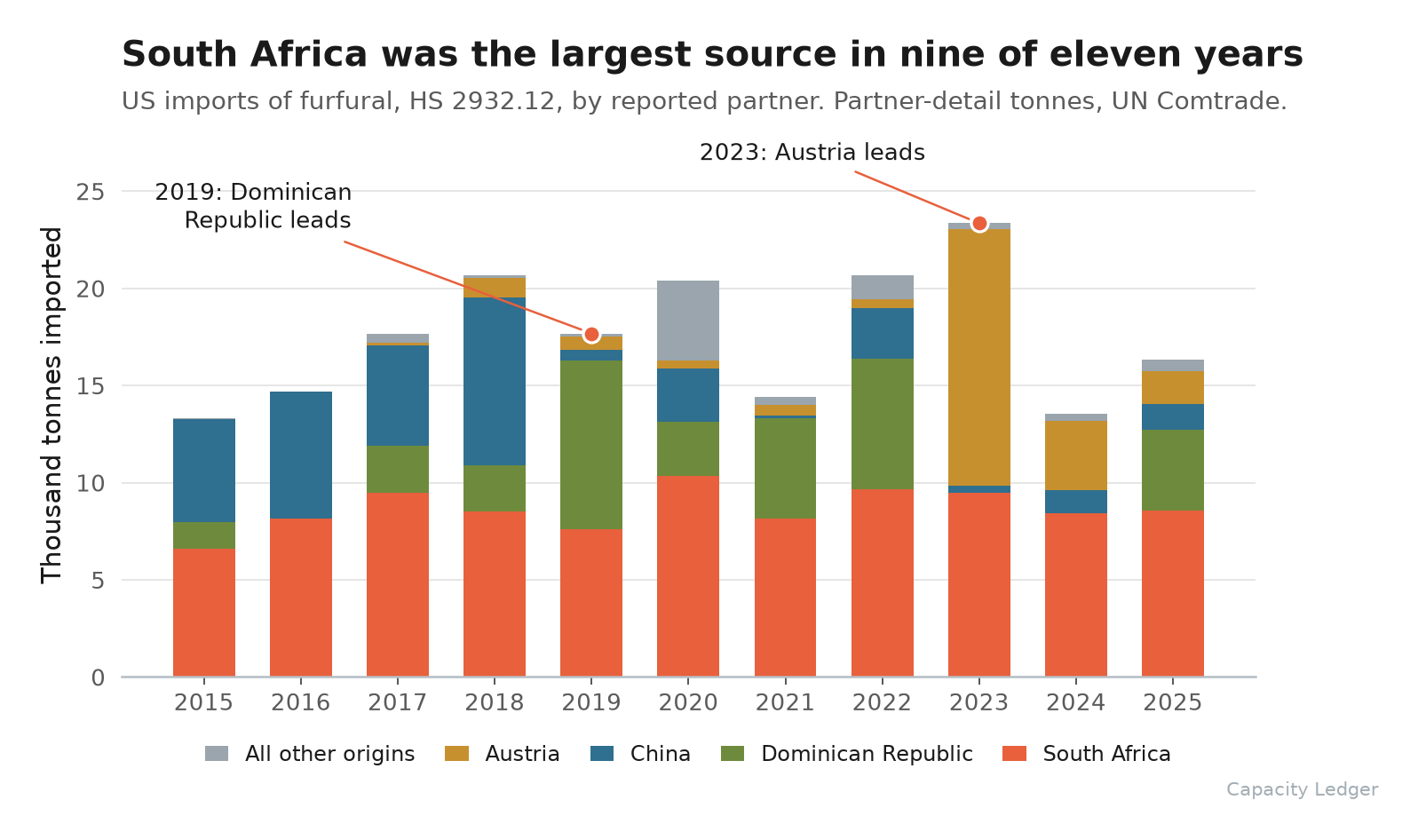
China, which is the world's largest furfural producer by a wide margin, supplied 17.9% across the same window, and in four of the last five years it shipped under 1,400 t.
South Africa was the largest single source in nine of the eleven years. The exceptions are 2019, when the Dominican Republic took the top slot, and 2023, when Austria did on a single anomalous 13,208 t.
Both of the big two are cane. Central Romana's plant at La Romana is described by its own exclusive distributor as the world's largest furfural facility, with a mean annual output of 40,000 t made from sugarcane bagasse. Illovo's Sezela complex on the KwaZulu-Natal coast runs furfural and its derivatives, furfuryl alcohol and diacetyl among them, off the same feedstock. The trade data is country-level and we are not going to pretend otherwise, though at these tonnages there is not much ambiguity about which sites are shipping.
Why It Arrives in Lumps
Pentosan-rich residue is not produced on your schedule. It is produced when cane is crushed, and the two hemispheres do not crush at the same time.
So the monthly series does not look like a chemical with a nameplate.
It looks like this: February 2026 landed 2,461 t, of which the Dominican Republic sent 1,560 and South Africa 901. One month later, March took 125 t and neither origin appears at all.
Now, a buyer reading a three-month moving average off this line will get a number that never happened. The tonnes come in parcels, the parcels come off a crop, and the gap between two parcels is not a demand signal.
The 2026 Book
Seven months against seven months, with August not yet reported on this line:
- January to July 2025: 8,948.8 t
- January to July 2026: 6,364.2 t
That is -28.9%. Recent Comtrade months do revise, so treat the July figure as provisional, though the shape of the year is already well past revision range.
Here is the part worth writing down. The cane held.
South Africa shipped 4,105 t in the first seven months of 2026 against 3,521 t a year earlier, which is up 17%. Everything else fell off:
- Austria: 1,471 t → 357 t
- Dominican Republic: 2,622 t → 1,739 t
- China: 727 t → 160 t
So the origin most people would call the fragile one is the origin carrying the year, and the European and Chinese tonnes that used to pad the book are the ones that went missing. If you buy furfuryl alcohol or foundry resin, your 2026 exposure to a single cane region went up while your total volume went down.
Final Thoughts
Furfural is the rare industrial chemical whose supply curve is set by agronomy rather than by a capacity decision in a boardroom.
Nobody debottlenecks a cane crop. Nobody restarts one early because the spot price moved.
Which is why the useful question here is whether your next parcel is on a boat, and whose crushing season it came out of.
That is a schedule question, and on this line the schedule is the risk.
Thanks for reading.