 Capacity Ledger
Two Thirds of Your Silica Lands at a Dollar Thirty Eight
Evonik told its silica customers in January 2025 that it would keep imported product available domestically. Its Maryland WARN filing dates the Havre de Grace wind-down to a window that is open right now, and the import book says the tonnes did arrive: 92,979 of them in seven months, up 4.6 percent, with the dollars flat. Two thirds of that weight is Chinese material at $1.38 a kilogram, and the grades a specialty buyer wants come from three countries carrying 13 percent of the weight and a third of the dollars.
If you buy silica in North America, your supplier already told you how this was going to work.
Evonik's January 2025 release closing two North American silica plants carries one sentence that is really a supply commitment. Emmanuel Auer, who runs the Smart Effects business line, said the company was "committed to maintaining the adequate and timely domestic availability of imported products."
Imported products. In the closure announcement.
Waterford, New York made fumed silica with 24 people, and Evonik said production there would end in mid-2025. Havre de Grace, Maryland makes precipitated silica and calcium silicate for toothpaste, food and animal feed, and that one was given mid-2026.
This desk covered Evonik's closure list on September 28, off the BASF approach, and used the January release for the two silica sites.
We never pulled the Maryland filing and we never built the import book. Both are here.
The filing dates the wind-down
Evonik Corporation's WARN notice sits on the Maryland Department of Labor register, field by field:
- Notice date March 25, 2026, NAICS 325180
- Evonik Corporation, 701 Fountain Street, Havre De Grace
- Susquehanna region, 34 employees
- Effective June 30 to December 31, 2026
- Type: plant closure
That window is open right now.
Note the headcount. Evonik's own release counted 42 production personnel in January 2025, and the filing fourteen months later counts 34.
We don't know which eight moved in between, and we aren't going to guess at it.
The tonnes showed up. The dollars didn't.
Everything those two sites make, and everything that would replace it, lands on one tariff line: HS 2811.22, silicon dioxide.
US imports on that line ran 92,979 tonnes across the first seven months of 2026, against 88,894 in the same months of 2025. Up 4.6 percent.
The dollars went nowhere. $205.9m against $205.5m, a gap of about $331,000 on a two hundred million dollar book.
So the average kilogram got cheaper, $2.31 down to $2.21.
Which is the point at which the average stops being worth anything.
"Does the average import price on this line describe anything a specialty buyer actually pays?"
One code, two businesses
Well, no, and the shape of the book says so without much help (chart below).
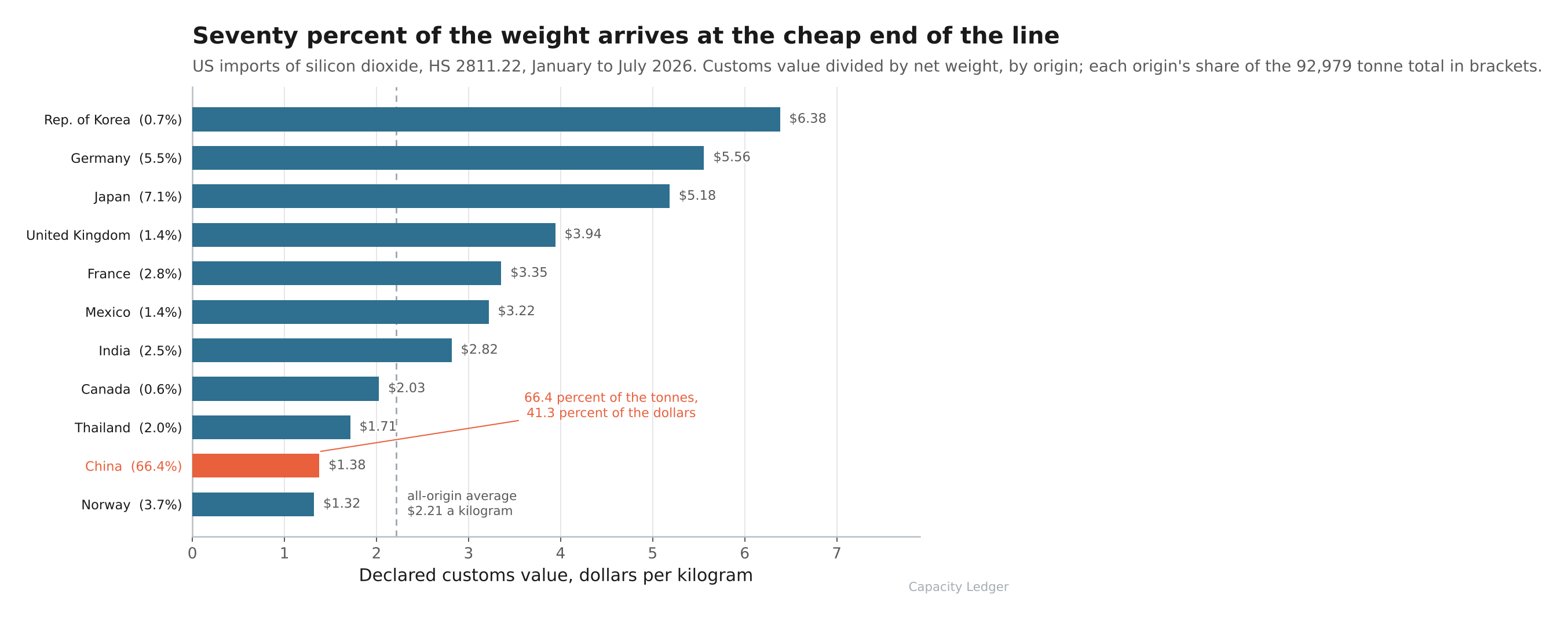
China shipped 61,711 tonnes in those seven months. That is 66.4 percent of the weight at a declared $1.38 a kilogram, and 41.3 percent of the dollars.
Add Norway at $1.32 and two origins carry 70 percent of everything that crossed the border on this code.
Now look at the top of the chart. Germany at $5.56, Japan at $5.18, Korea at $6.38.
Those three together are 13.3 percent of the weight and 32.5 percent of the value.
That is the grade split, drawn in price because the tariff line will not draw it for you. Microsilica and bulk silica gel at the bottom, surface-treated fumed grades at the top, one six-digit code over all of it.
Japan is the number that moved
The whole book gained 4,085 tonnes year on year. Japan gained 2,700 of them.
Japanese arrivals went from 3,924 tonnes to 6,624, up 68.8 percent, which is two thirds of the entire increase on the line.
Germany added 5.4 percent. Nobody else of any size moved like that.
Evonik has a fumed silica plant in Japan. Nippon Aerosil, at Yokkaichi, a fifty-fifty venture with what is now Mitsubishi Materials, making the stuff since November 1966.
Comtrade reports origin, weight and customs value. It does not report the producer, the grade or the buyer, so we will put those two facts next to each other and stop there.
What is left on this side of the water
Cabot still makes fumed silica at Midland, Michigan, beside Dow, on chlorosilane that arrives by pipeline. Michigan's air permit file is blunt about the size of it: "about 18 million lbs/yr of amorphous fumed silica."
That is 8,165 tonnes a year.
The Germany plus Japan plus Korea slice of the import book ran 12,374 tonnes in seven months. Call it one and a half times Midland's entire permitted year, delivered between January and July.
Final Thoughts
Evonik's commitment was honest and the tonnage shows up. Nothing on this line is short, and we would not call this a supply story.
What moved is where the price gets set. A buyer benchmarking against a published average on 2811.22 is benchmarking against Chinese tonnage at a dollar thirty eight that they are never going to buy, while the grade they do buy now comes from three countries carrying 13 percent of the weight and a third of the dollars.
The code was never built to tell those apart. For most of the last decade it didn't have to.
Thanks for reading.