 Capacity Ledger
What a Toll Blender Buys First
ReAgent has blended chemicals in Cheshire since 1977 and never operated outside the UK. Last month it opened 25,000 square feet in Winston-Salem, and the equipment it bought first says more about how the formulation layer actually works than any capacity table does.
A company has been blending chemicals in Cheshire since 1977, and for nearly fifty years it never operated anywhere else.
Last month it opened a plant in Winston-Salem.
ReAgent USA is 25,000 square feet in Forsyth County, North Carolina, doing toll blending and high-grade aqueous solutions. North Carolina announced it in September 2025 at $4.8 million of capital investment over five years and 30 jobs paying an average above $59,000; the figure reported at the August launch was $6 million.
Set against the file this desk keeps, none of that registers. No 8-K, no WARN notice, no permit fight, no force majeure letter.
A chemical plant opened in North Carolina and every database we watch stayed quiet.
"What does a company actually have to buy to start blending chemicals in a country it has never operated in?"
The Twenty Percent
ReAgent's own account of the build is the most useful thing about it. The company describes taking a "strategic 80/20 approach": working out which 20% of the equipment would make 80% of the products, then buying only that.
What made the cut:
- Blending for high and low viscosity formulations across a range of batch sizes
- Custom labelling and packaging
- A water plant producing deionised, demineralised and distilled water, synthetic seawater, and several ASTM grades
The water plant is the entry worth sitting with. In Runcorn the company runs HDPE tanks to 20,000 L for acids, alkalis and low-hazard blends and stainless to 22,500 L for high-flashpoint flammables, with the vessels on load cells for dosing, and every HDPE tank fed with water conforming to USP water for injection.
Purified water is a raw material nobody ships across an ocean. So a blender opening in a new country builds the water first, and the mixing tanks are the easy part.
Everything else on that list is a batch size and a label. Which is, honestly, most of the job.
Down Here, Capacity Is a Certificate
The Runcorn operation holds four ISO certifications: 9001 and 14001 on quality and environment, 45001 on health and safety since 2022, and ISO 13485:2016 since 2019, the quality-management standard written for medical devices, which the company ties directly to in vitro diagnostic reagents.
For a sourcing lead qualifying a blend house, 13485 is the capacity number. A blender that holds it can quote IVD work, and one that doesn't can't, whatever the tank volumes say.
That is the part of this industry that never charts. Upstream you can count reactors, nameplate tonnes and utilisation. In the formulation layer the binding constraint is a document set: certificates of analysis, certificates of conformity, an audit you passed, a grade of water you can prove. Ellis Keifer at Greater Winston-Salem said the company was looking for proximity to manufacturing, life sciences and pharmaceutical clusters, and that is a sentence about who is close enough to audit you.
Why the Ledger Never Sees It
We built a lot of this desk's early-warning method on WARN notices, on the argument that a state filing beats the press release by about sixty days. The statute has a floor written into it.
Federal WARN reaches employers of 100 or more people. A plant closing has to produce an employment loss of 50 or more at a single site inside 30 days before anyone owes notice, and a mass layoff needs 33% of the site plus that same 50.
So run the establishment base against those two numbers (chart below).
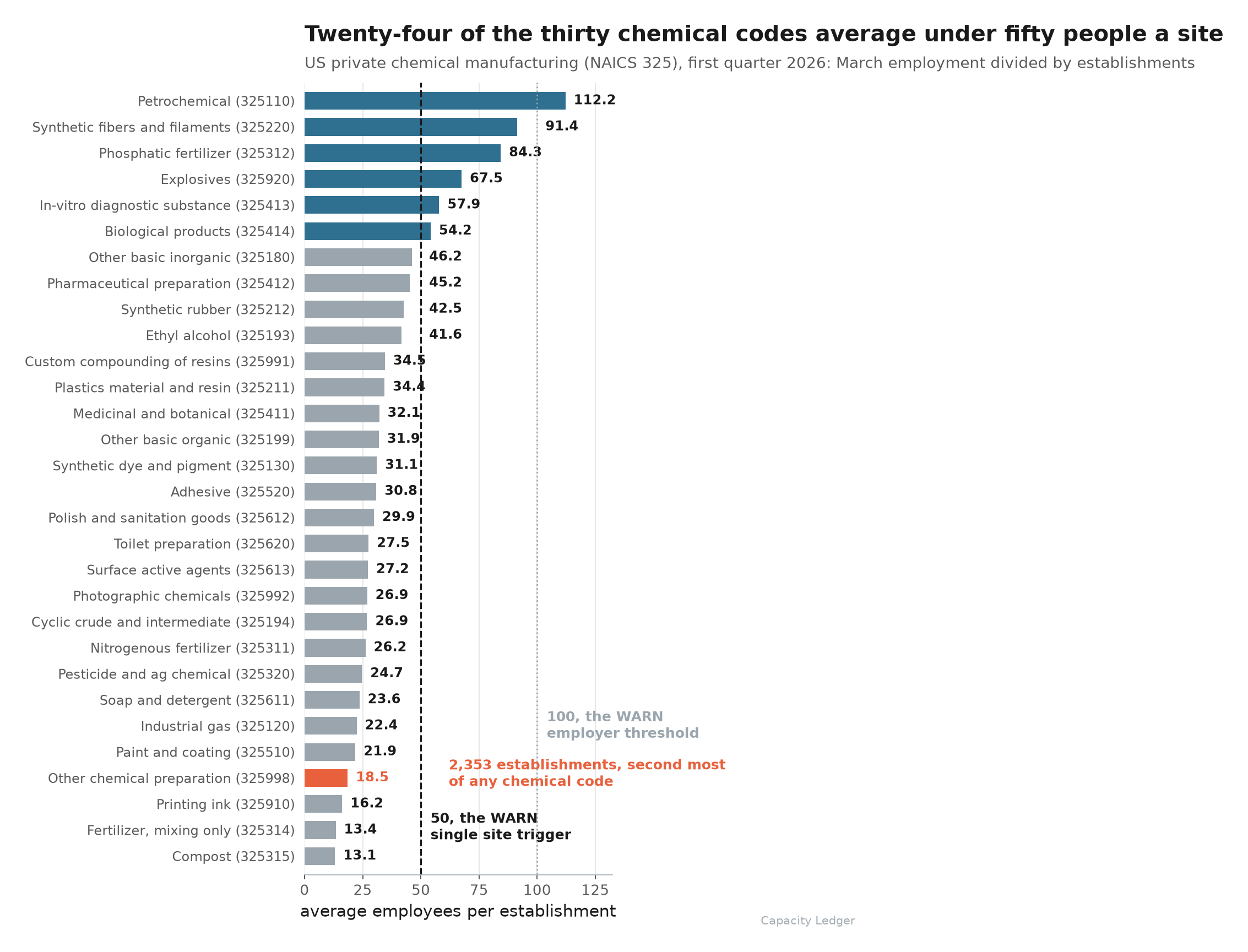
Of the thirty six-digit industries inside NAICS 325, 24 average fewer than 50 employees per establishment. Exactly one, petrochemical manufacturing at 112.2, averages above the employer threshold.
On August 31 we ran this same BLS series as a time series: 26,248 chemical establishments in the first quarter, up 662 on the year, employing 4,108 fewer people, and an average site down from 48.4 people in 2014 to 34.1 now. The cross-section is the other half of that story.
325998, the residual code that carries contract preparation work, runs 2,353 establishments at 18.5 people each. That is the second-largest address count of any chemical code in the country and the fourth-smallest average site in it.
An establishment of that size cannot generate a federal WARN notice on its own arithmetic. Neither can it generate one on the way in, because nothing files a notice for opening.
Final Thoughts
At its announced 30 jobs, Winston-Salem will run well above the 18.5-person average of 325998, which is a strange thing to be able to say about a 30-person plant. It is also the point. The company is family-run, took a King's Award for Enterprise in the international trade category last year as one of 197 British firms honoured, planned this site for 2017, got interrupted by its own growth and then by a pandemic, and opened it in 2026 anyway.
Our file counts what large companies remove, because removal is what files paperwork. The layer underneath adds capacity in 25,000-square-foot increments and tells almost nobody.
If your next qualification headache is a grade of water, a batch size, or a label nobody in your plant wants to run, that layer is where the answer lives, and it is bigger than the closure count makes it look.
Thanks for reading.