 Capacity Ledger
What Aarti Built Instead of a Chlorotoluene Chain
Aarti Industries commissioned the first three units of Zone IV at Jhagadia on September 7. Six weeks earlier the company had told its analysts the site was 97 percent erected, which tells you what a commissioning date is actually made of.
On the last day of July, an analyst asked Aarti Industries what was wrong with a plant in Gujarat that had slipped half a year.
The answer was 97%.
That is how much of the equipment was erected across the delayed blocks of Zone IV at Jhagadia. Piping stood at 85%.
Every vessel, every column, every pump was bolted down, and the site could not make a kilo of anything.
"What is actually left when a plant is ninety-seven percent built?"
Pipe and insulation, mostly. On September 7 the answer arrived in the form of a commissioning notice: calcium chloride, PEDA and part of the multipurpose plant, all live.
The Last Fifteen Percent Is People
Suyog Kotecha, the CEO, was unusually plain about the cause on that call. He put the delay at three to six months, called it "a pure product execution challenge", and located it in the March to May window.
The gating item was labour. Piping and final insulation, in his words, require a "huge amount of manpower", and Jhagadia did not have it: he named an LPG issue, then elections, then the monsoon.
Anyone who has watched a turnaround slip knows the shape of this. Steel arrives on a purchase order and a pipefitter does not.
What makes the July call worth reading is the last line of that answer. Aarti said it was back to full manpower on the site, and that commissioning would land inside the fiscal year.
Six weeks later it did.
Five Blocks Where One Chain Was
The more interesting decision at Jhagadia was made about eighteen months before any of this.
Zone IV started life as a chlorotoluene project. Chlorotoluene is a perfectly good chain, feeding agrochemical and pharmaceutical intermediates, and Aarti had been fielding analyst questions about it since 2024.
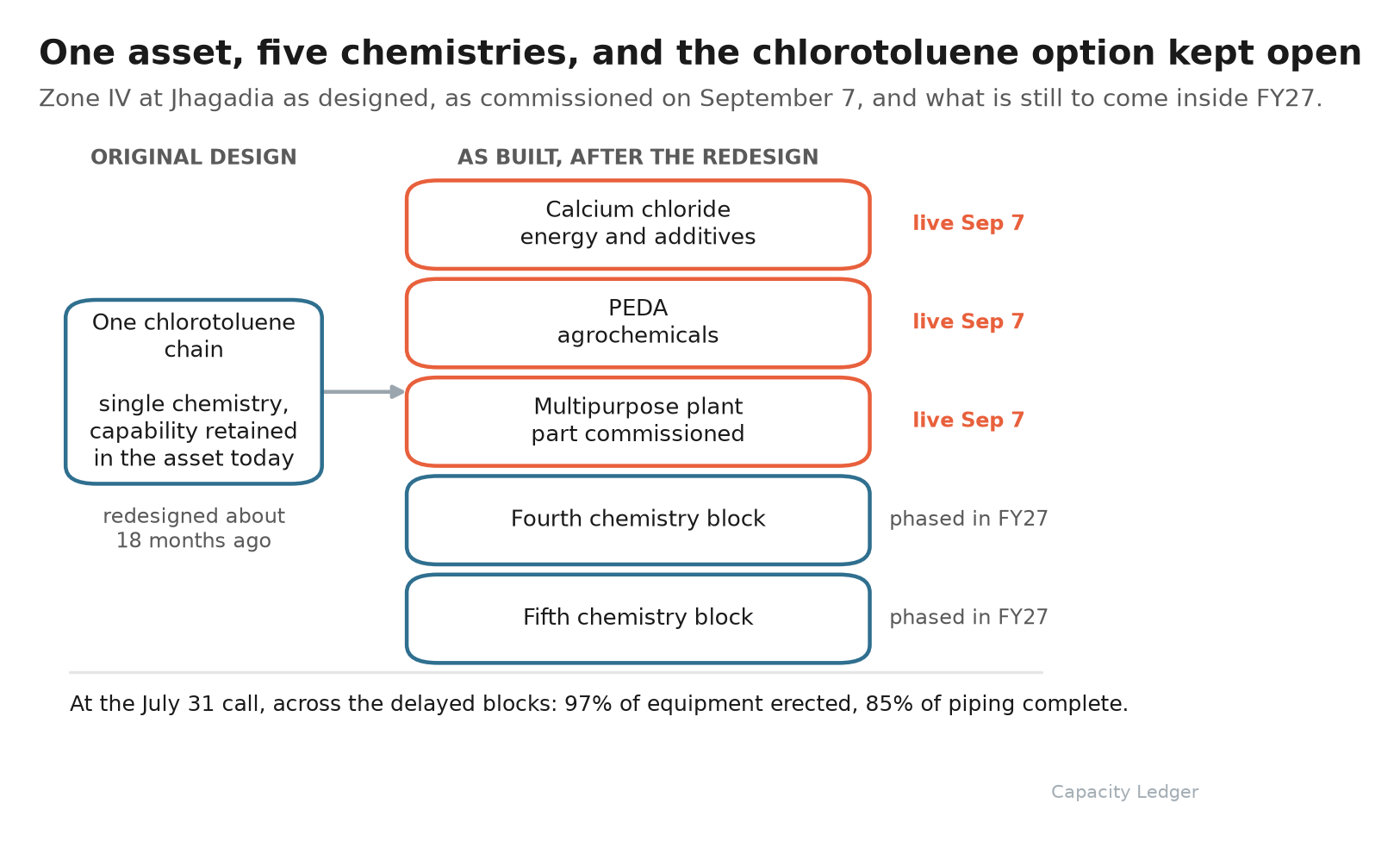
Then the company redesigned the asset around five chemistry blocks capable of running different chemistries, keeping the ability to make the whole chlorotoluene chain if it ever wants to (chart below).
That is a different kind of capital decision than a nameplate. A dedicated chain gives you tonnage in one product and a demand bet you cannot unwind.
A block that can be re-piped for the next molecule gives you optionality, at the cost of never being the lowest-cost producer of any single one.
The end-market spread tells you it was deliberate. Kotecha described the starting product mix as agro, pharma, coatings and polymers, and said Zone IV "will not be heavy towards one particular end market."
Calcium chloride, the first unit out, goes to oilfield and energy applications. PEDA goes to agrochemicals.
The multipurpose plant exists precisely to take chemistries from pilot to commercial scale without a new asset each time.
Five blocks, four end markets, one site.
What a Sourcing Manager Can Do With It Today
Nothing yet, and that is the part worth diarising.
Aarti's own account of the qualification sequence is specific: target customers are identified for most of these products, and the pilot-plant qualification is already done. The commercial batch is the gate.
Customers "will also ask for a commercial batch qualification", Kotecha said, and "that will happen only when the assets are commissioned."
So September 7 starts a clock rather than ending one. First commercial batch, then requalification against that batch, then a supply agreement.
The scale of what is coming is on the record too. Aarti expects 5 to 10 products out of this platform inside FY27, and 25 to 30 by FY28, several of which it says will be made in India for the first time.
For a buyer holding a China-only line on a niche intermediate, that last clause is the whole story. A second qualified source does not exist until someone builds the asset, and the asset does not exist until someone pipes it.
Both of those have now happened for three units of five.
Final Thoughts
The capacity databases will record September 7, 2026 as the date Zone IV came online, and they will be right in the way a calendar is right.
The useful record is the July transcript. A 97% complete plant, a 15% piping gap, a labour market that went sideways for three months, and a management team that told its analysts all of it before the good news arrived.
Aarti has guided FY27 capex to Rs 700 to 800 crore, with about Rs 180 crore deployed by the end of June, and says capital intensity drops significantly from next year. Zone IV is the last big block of a long build.
Which means the interesting question about Jhagadia has moved.
It is no longer whether the plant gets finished. It is how fast five chemistry blocks can be qualified into supply chains that were not asking for an Indian source two years ago.
Thanks for reading.