 Capacity Ledger
What Haldia Had to Build Before It Could Build Phenol
Adperma started India's first east-coast phenol plant on October 14, at 345,000 tonnes a year of phenol and 215,000 of acetone. Getting there took a cumene unit and the country's first on-purpose propylene plant, and at nameplate the benzene draw is 2.2 times what the site's own benzene unit makes.
For most of this century, the benzene made at Haldia has mostly left the country.
HPL's own product page puts it in seven words. The site runs 132 KTPA of benzene off the raw pyrolysis gasoline fraction, Lurgi technology, better than 99.9 percent pure, and "Benzene is mostly exported to Asian Markets."
On October 14 that stopped being the plan.
The Plant That Opened on the Fourteenth
Adperma Private Limited, a step-down subsidiary of Haldia Petrochemicals and formerly named Adplus Chemicals and Polymers, inaugurated a phenol and acetone complex inside the Haldia fence that day. Rs 6,000 crore, about $627m, for 345,000 tonnes a year of phenol and 215,000 of acetone.
West Bengal's chief minister Suvendu Adhikari inaugurated it and called it a historic day. Purnendu Chatterjee, chairman of The Chatterjee Group, and HPL managing director and chief executive Navanit Narayan both spoke.
Two claims in the coverage are worth separating.
First on the east coast holds without qualification. No phenol plant stood on that coastline before this one.
On size, the new plate is level with the biggest already running: Deepak Phenolics tells its own shareholders it runs 345 KTPA of phenol and 210 KTPA of acetone at Dahej. What the word integrated is carrying, then, is everything upstream of the oxidiser.
Adperma is not a new vehicle, either. It is the entity that took HPL's butene-1 plant in 2019.
The Two Units Nobody Put in the Headline
A phenol plant does not buy phenol feed.
It buys benzene and propylene, alkylates one with the other to make cumene, oxidises the cumene and cleaves the hydroperoxide. Phenol and acetone come out of the same cleavage step.
So Haldia licensed three technologies from Lummus in November 2023, not one:
- Lummus/Versalis cumene technology, the liquid-phase zeolite alkylation the two have co-licensed since 2007.
- Lummus/Versalis phenol technology, the oxidation and cleavage end.
- Olefins conversion technology, OCT, which makes propylene by reacting ethylene with C4 or C5 olefins over a metathesis catalyst.
That third one is the interesting line item.
Lummus calls OCT the only commercially demonstrated metathesis route to propylene, and the unit at Haldia is India's first on-purpose propylene plant. Everywhere else in the country, propylene arrives as whatever the cracker or the refinery happens to make.
Worth noting on the licensor: HPL acquired a 57% majority stake in the Lummus Technology business from McDermott in 2020. The buyer of the licence owns most of the licensor.
Where the Benzene Comes From
Run the cumene route at its molar weights and the feed bill falls out of the nameplate with no estimating at all. Every tonne of phenol carries 830 kilos of benzene and 447 kilos of propylene into the reactor, and real yields run under theoretical, so those are floors.
At 345,000 tonnes a year that is 286,000 tonnes of benzene and 154,000 tonnes of propylene (chart below).
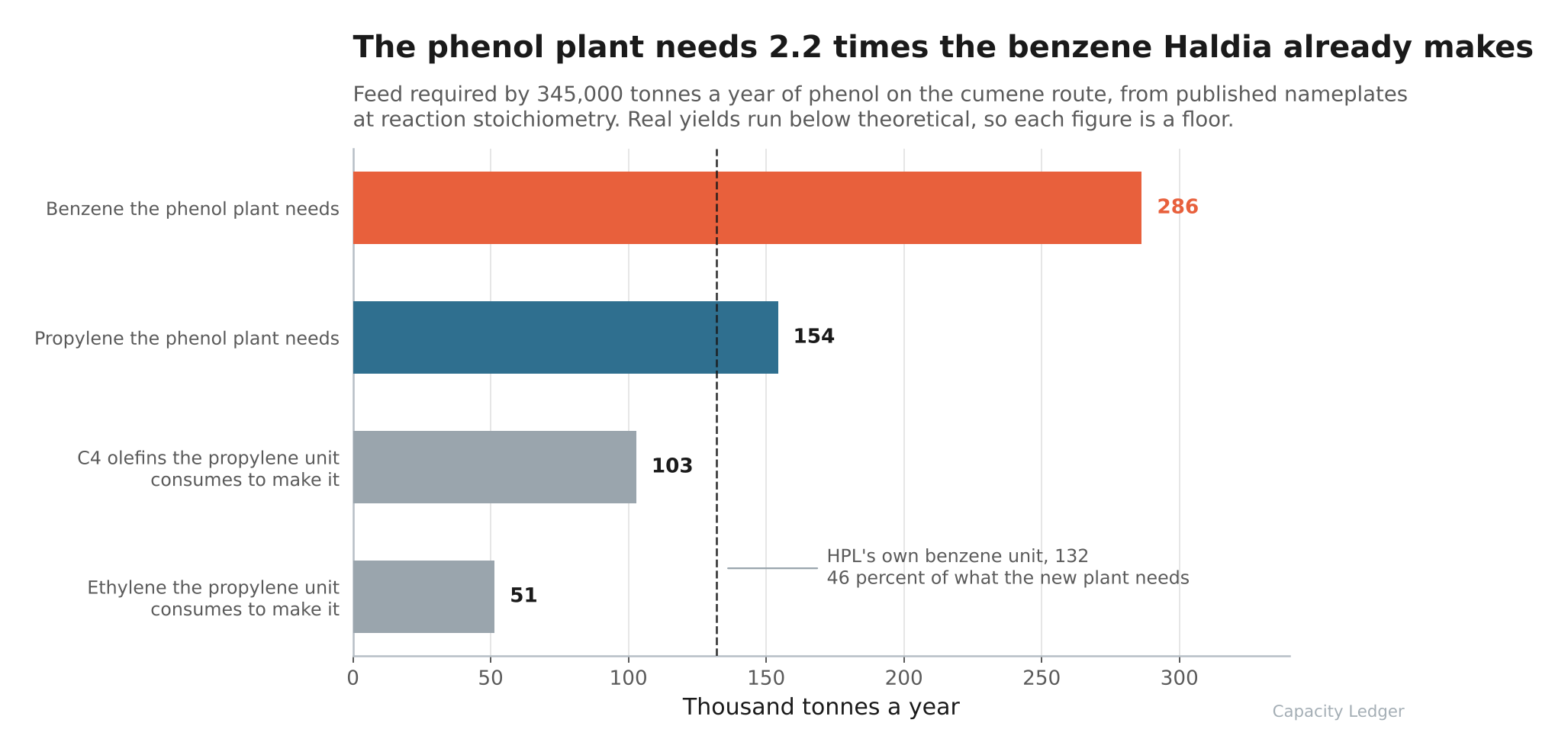
Set the benzene requirement against the site's own benzene unit and you get 46%. The new plant at rate needs 2.2 times what Haldia has been making and mostly shipping out.
The propylene half is where the OCT unit earns its capital. Metathesis is one ethylene plus one butene into two propylenes, so covering 154,000 tonnes means:
- About 51,000 tonnes a year of ethylene, 7.3% of the site's 700 KTPA ethylene plate, turned into propylene instead of polyethylene.
- About 103,000 tonnes a year of C4 olefins off the same cracker.
Neither the cumene unit nor the propylene unit has a published tonnage anywhere we could find this week, which is the one hole in an otherwise unusually open project record.
Put the output against the import book and the scale lands.
India brought in 240,487 tonnes of phenol in 2024 under HS 2907.11. One plant's nameplate is 143% of that.
The 45,000 Tonnes Added in a Boardroom
The plates moved once during construction, and the way they moved tells you how little discretion anyone had.
Piling started January 3, 2024 on a Rs 3,000 crore project rated at 300 KTPA phenol and 185 KTPA acetone, targeting Q1 2026. On November 14, 2024, Navanit Narayan and Lummus chief business officer Romain Lemoine signed a licence amendment taking phenol to 345 KTPA.
The acetone went to 215. It had to.
Cleavage gives one acetone for every phenol, which at their molar weights is 617 kilos of acetone per tonne.
Run that on the old plate and you get 185,139 against a published 185,000. Run it on the new one and you get 212,910 against a published 215,000.
Both within a rounding error of the chemistry. Nobody sat in that room choosing an acetone number.
Final Thoughts
Integration is the word in every line written about this plant, and it usually means nothing. Here it has an arithmetic behind it that a buyer can check: a cumene unit built to feed the oxidiser, a metathesis unit built to feed the cumene unit, and a benzene stream that stops being an export.
That benzene stream covers less than half the draw, which is the honest read on the chart above. The rest arrives the way everything else at Haldia does, through the dedicated feedstock pipelines HPL runs up to the jetty.
What is unusual is the order of construction.
Most projects buy the feed and build the product. This one built the feed first, including a propylene route nobody in the country had tried, and left the tonnage of both feed units unpublished while naming the product plate to the thousand.
A buyer in eastern India can now source phenol from 125 kilometres outside Kolkata. Getting that address onto the map took three units, and only one of them makes phenol.
Thanks for reading.