 Capacity Ledger
What Happens to a Capacitor When the Film Has Four Thousand Layers
Peak Nano said this morning it is expanding US capacitor film production twentyfold at Macedonia, Ohio, on a new Davis-Standard cast line rated at up to three million pounds a year. The context: America imported $232.6m of finished film capacitors last year from fifty origins, and a third of that came from Japan.
Eight microns thick, with up to 4,096 layers stacked inside it.
That is the build on Peak Nano's NanoPlex HDC capacitor film, and this morning the company said it is going to make twenty times more of it.
The release is dated Nov. 10, 2026 out of Macedonia, Ohio. $20 million into equipment, facilities and staffing, a new Davis-Standard cast film line rated at up to 3 million pounds a year, full production in Q1 2028.
The previous Davis-Standard line went in during 2022, and another expansion is already penciled for 2027.
The hiring is the part that tells you the schedule is real.
More than 15 openings for extrusion and inspection technicians, across all three shifts including weekend hours, with a job fair on Saturday, Nov. 21 at the company's Valley View site.
"What does a buyer actually get from a dielectric film coextruded in Ohio?"
What Four Thousand Layers Buys You
The datasheet answers in the units a design engineer argues in. Two grades, both specified on 8 micron film:
- 4125: dielectric constant 4.7, dissipation factor 1.0% at 1 kHz and 25C per ASTM D150, breakdown strength 790 V/micron under oil per ASTM D149.
- 3125: dielectric constant 3.7, dissipation factor 0.5%, breakdown strength 820 V/micron.
- Both rated to 105C without de-rating, against the 85C the company's own comparison line gives for typical BOPP.
- Up to 4x the energy storage per unit volume of conventional film, in 620 mm rolls running 500 to 5,000 m, at 8 and 12 micron.
And the four thousand layers do real electrical work. The granted patent behind the product describes interfaces between adjoining dielectric layers that delocalize the charge build-up in the layers, which is the whole trick: you are using the boundaries, not the bulk.
Where the Finished Part Comes From
Film capacitors move through customs as HS 853225, fixed capacitors with a dielectric of paper or plastics. The US bought $232.6m of them in 2025, from 50 reporting origins.
Japan was $77.0m of that, 33.1%, the largest single source by a wide margin. In 2013 Japan was $19.0m and 10.9% (chart below).
China went the other direction over the same twelve years, from 27.6% to 18.8%, and 2021 is the year the two lines crossed. So the concentration a sourcing manager is carrying today built up on the Japanese side of the board while the trade conversation was about the Chinese side.
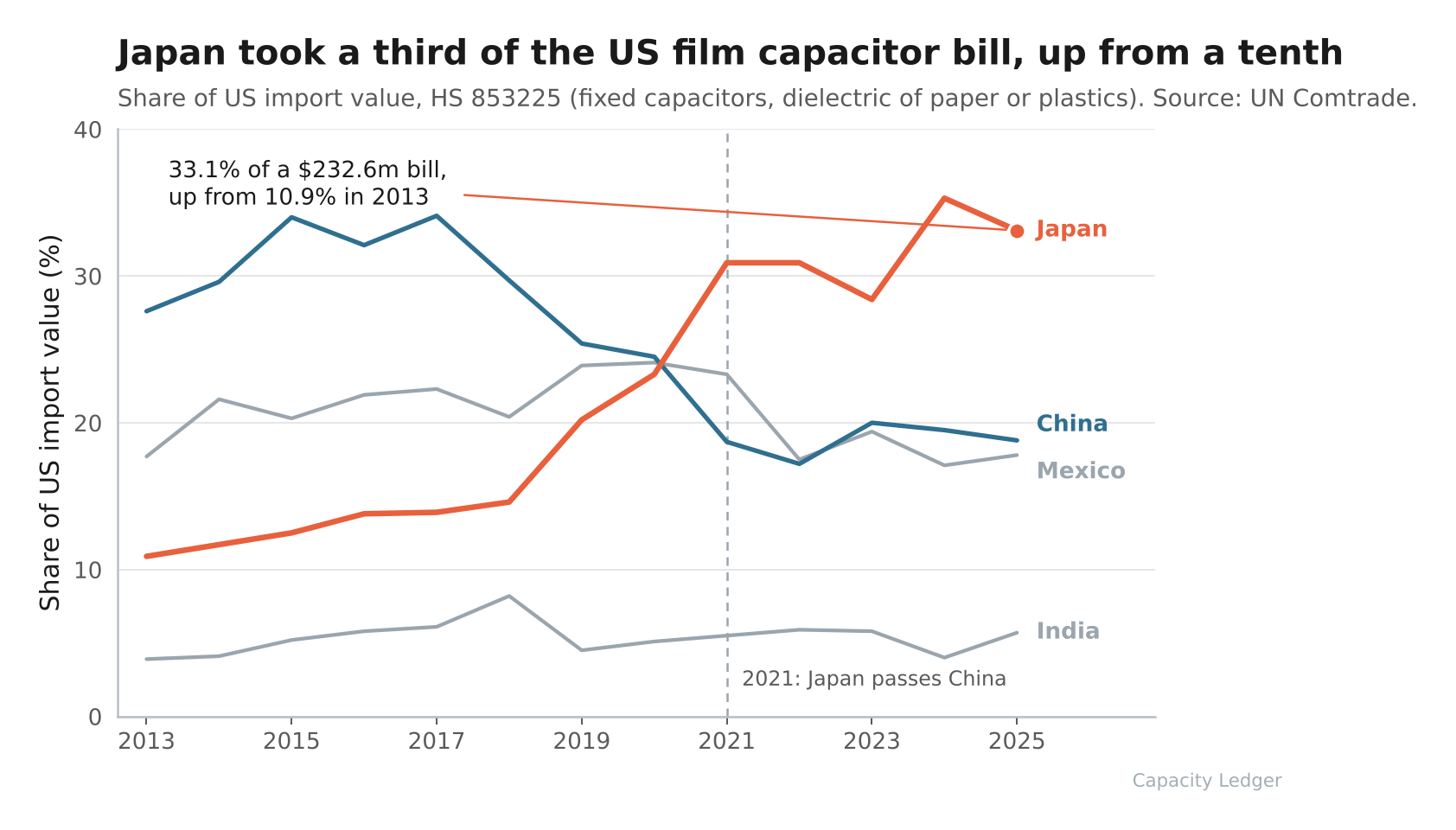
One honest caveat on that series: HS 853225 is the finished capacitor, one step downstream of the film. Capacitor-grade dielectric film has no code of its own, so the part is the best public proxy for where the chain sits.
The Patent Still Says PolymerPlus
Pull the document and the corporate history falls out of it.
US12427754B2, "Multicomponent layered dielectric film with surface modification", granted Sept. 30, 2025 on a priority date of July 19, 2018. The assignee on the face of it is PolymerPlus LLC, and the inventors are Deepak Langhe and Michael Ponting.
Ponting is Peak Nano's chief science officer, and he co-founded PolymerPlus before Peak Nanosystems acquired it in April 2020, a deal that carried exclusive licenses on Case Western Reserve University technology.
The citation list says the same thing from a different angle. Among the patents cited against it: one assigned to Case Western Reserve University, and one assigned to the Secretary of the Navy.
Seven years from that priority filing to a granted claim, and the line that makes the film at volume is going in now.
Final Thoughts
Do the arithmetic the release leaves to you.
Three million pounds divided by a twentyfold step puts current output somewhere near 150,000 pounds a year. That is a pilot line with customers on it.
That is the honest size of this. It is also why Q1 2028 is the date worth writing down, because a qualification cycle on a dielectric is long, and the people who start theirs when the line is still being built are the ones who get a second source out of it.
The film came out of a Case Western lab, still sits under the PolymerPlus name on its own patent, and now gets a production line in the same corner of Ohio. The grid and the data centers will decide whether three million pounds a year reads as ambitious or modest.
Thanks for reading.