 Capacity Ledger
What Loads at Seventeen Centimetres?
The Kaub gauge printed 17 centimetres this afternoon, the level the forecasts had for Saturday. Germany's waterways administration publishes a load factor down to 40 centimetres and no further, so here is what the number actually measures and which part of it reaches your invoice.
Three wire stories this week gave three different numbers for the same stretch of the same river.
25 centimetres on Friday. 24 on Monday. 21 overnight into Tuesday, described as the lowest since records began in 1880. All three were reporting Kaub, and all three were roughly right.
The desk pulls that gauge itself. At half past three this afternoon, local time, it read 17 centimetres, which is the level the same forecasts had pencilled in for Saturday.
"How much water is actually under a chemical barge at seventeen centimetres?"
Seventeen Centimetres of Gauge
The Kaub reading is a height above a local datum fixed in 1951 at 67.66 m above sea level, and that datum sits nowhere near the riverbed. The station's own reference says so in as many words: the gauge level does not directly correspond to the actual depth of the river.
Fairway depth comes from the reading plus two published constants, an ideal channel depth of 1.90 m and an equivalent water level (GlW) of 0.78 m:
gauge + 1.90 m - 0.78 m
At 17 cm, that is 1.29 m of navigable water. At the 0.24 m of October 2018, the figure that has anchored every Rhine story written since, it was 1.36 m.
So the record fell by seven centimetres of gauge and seven centimetres of water. Around 5% of the column.
Worth holding onto when the next headline lands, because the wires are quoting the gauge and calling it a clearance. Those are both real numbers and they are not the same number.
The Loading Table Runs Out Above the River
Now, five percent understates it badly in the other direction, because loadable tonnes do not move linearly with depth. The last centimetres are the expensive ones.
Germany's federal waterways administration publishes a load factor for the 40 to 50 cm band: around 20% of normal volume. Operators put current loading at 20% to 30%.
Below 40 cm there is no published figure at all. The official guidance stops above where the river is.
What that leaves buyers reading instead:
- A tanker barge rated at roughly 1,200 t crosses Kaub with about 460 t.
- Rotterdam freight went from about EUR 45/t in June to close to EUR 150 in July, per Dutch trade reporting.
- Diesel from Rotterdam to Karlsruhe is the most expensive since Bloomberg began compiling the series in 2009.
The Number That Bills You Is a Duration
Kaub last read above 35 cm on the morning of 27 July. That is 223.5 hours ago, and below 35 the station's guidance is that only specially designed vessels move at all (chart below).
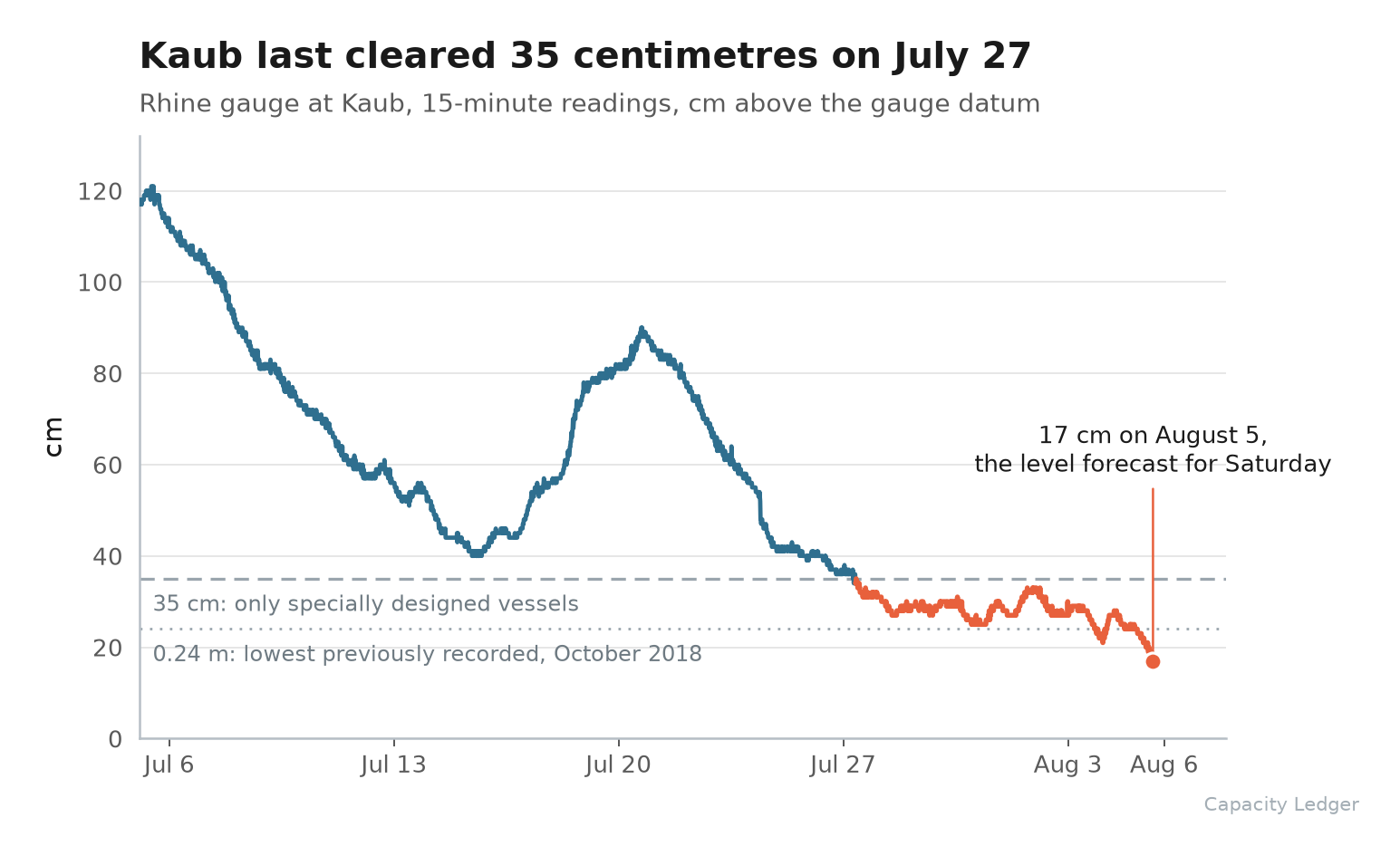
The run below 40 cm is longer still, unbroken since 26 July, 251.2 hours across 1,005 consecutive readings. Nothing has printed above 33 cm since 28 July.
That is the number with an invoice attached. A barge operator prices a voyage, a scheduler builds an inventory position, and a force majeure clause counts days, none of which care where the trough eventually lands.
Ask the plant that already stopped. LyondellBasell put its 170,000 t/yr butadiene extraction unit at Wesseling on force majeure effective 16 July, blaming low water for feedstock movement to its crackers.
The gauge ran between 43 and 46 cm that day. No lifting notice has appeared since, and the river has taken more than 25 centimetres off it.
Everyone else sits further back on the same curve:
- Evonik says the situation has hit production at Marl Chemical Park.
- Lanxess has stood up a crisis management team.
- Shell has moved Rhineland refinery fuel deliveries onto rail and truck.
- BASF, the largest single site on the wrong side of Kaub, is monitoring very closely after some supply bottlenecks, and has declared nothing. Correction (Aug 6): BASF had declared. Its Ludwigshafen force majeure on diisononyl phthalate and dipropyl heptyl phthalate was dated July 16, per a customer letter reported by ICIS, and it declared on several European surfactants on August 5. See "The Rhine Is Taking Whole Chains Now" (Aug 6).
Final Thoughts
The record is the part that travels. It is also the least useful number in the story, a seven-centimetre move on a gauge most of the people quoting it cannot define.
The useful ones are duller. Nine days under a threshold with no published loading table beneath it, a force majeure letter written 20 centimetres higher up that nobody has cancelled, and one producer describing a river in production terms while the biggest one still describes it in logistics terms.
If your delivered price into southern Germany or Switzerland has not moved yet, the reason is contractual rather than physical, and contracts renew. Somebody upstream of you is paying EUR 150 a tonne to move product that cost EUR 45 to move in June.
Thanks for reading.