Which December Deadline Did EPA Actually Move?
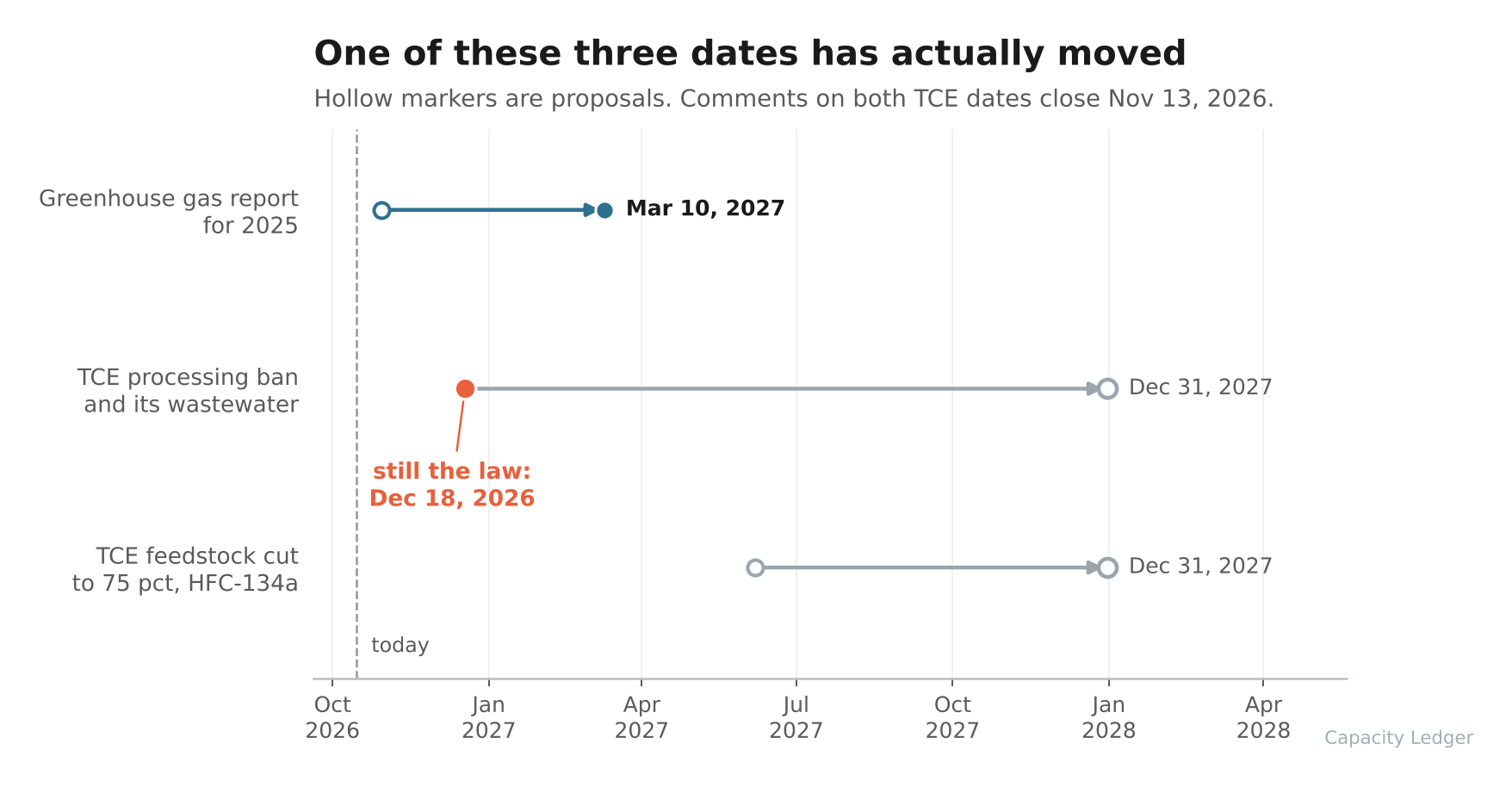
Three dated obligations on a chemical site's calendar changed in two days of the Federal Register. The greenhouse gas report due October 30 is now due March 10, 2027, and that one is law. The TCE processing prohibition that lands December 18 moved only on paper, with comments closing 35 days before it arrives. Also on the file: nineteen premanufacture substances pick up significant new use rules, and the Rhine at Kaub has gone 626 hours under its own record low.
If you process TCE as a reactant, you have 64 days.
The prohibition lands December 18, 2026. EPA spent Wednesday proposing to move it to December 31, 2027, and a proposal is not a date.
Comments close November 13, which leaves 35 days to write a final rule before the deadline it wants to replace arrives on its own.
That is the week's file in one line. Three dated obligations changed in two days of the Federal Register, and one of them changed in law.
Sixty-Four Days, and the Fix Is a Proposal
The proposed rule is FR Doc 2026-20964, docket EPA-HQ-OPPT-2026-7327, published October 14. It would push three compliance dates to the end of 2027: processing TCE as a reactant or intermediate, industrial and commercial use of TCE as a processing aid, and the wastewater disposal that goes with both.
The reason is worth reading in EPA's own words, because it is a logistics problem rather than a chemistry one. Byproduct TCE sitting in feedstock streams moves by railcar between plants, usually between two sites of the same company where one has a capability the other does not. Shut that movement off and the byproduct has to be incinerated, which EPA says would mean "exceeded permit limitations and potential facility closures."
The chains named as collateral are the ones that make TCE without meaning to: perchloroethylene, carbon tetrachloride, methylene chloride and 1,2-dichloroethane.
The second TCE date is narrower and worth knowing if you buy refrigerant. Under the 2024 rule, HFC-134a producers cut TCE feedstock to 75% of baseline by June 7, 2027. EPA proposes December 31, 2027 instead, on new information from Orbia Fluor & Energy Materials that it has drawn more AIM Act allowances than the 2024 rule assumed and that demand from critical-infrastructure and national-security users runs into the early 2030s.
Both of those dates are grey and hollow on the chart below. One date on it is neither.

The rest of this brief is for subscribers.
The capacity math, the trade-flow read, and what it means for the products you buy.
$50 a month, or $400 a year.
Already a subscriber? Sign in