 Capacity Ledger
Who Builds a New Chemical Plant in Germany Right Now?
UPM's Leuna biorefinery is selling wood-derived industrial sugars in volume, lignin fillers start this quarter, and the glycols are specified as drop-in. A 1.275 billion euro plant in Saxony-Anhalt, running.
In January 2020, UPM took the investment decision on a 220,000 tonne biochemicals plant at Leuna, in Saxony-Anhalt. Budget 1.275 billion euros.
Think about what has happened to European chemical manufacturing in the six and a half years since.
We have spent most of this month writing the subtraction side of it. Closures, consultations, a river too low to move barges, a rationalization wave that has become the sector's default press release.
Leuna is the other column, and last week it filed a progress report.
UPM's half-year, published July 23, gives the biorefinery two sentences. The ramp-up continued, customer deliveries of industrial sugars "reached substantial volumes", and deliveries of renewable functional fillers and other lignin derivatives are expected to start during the third quarter.
Two sentences is what a plant that works gets (chart below).
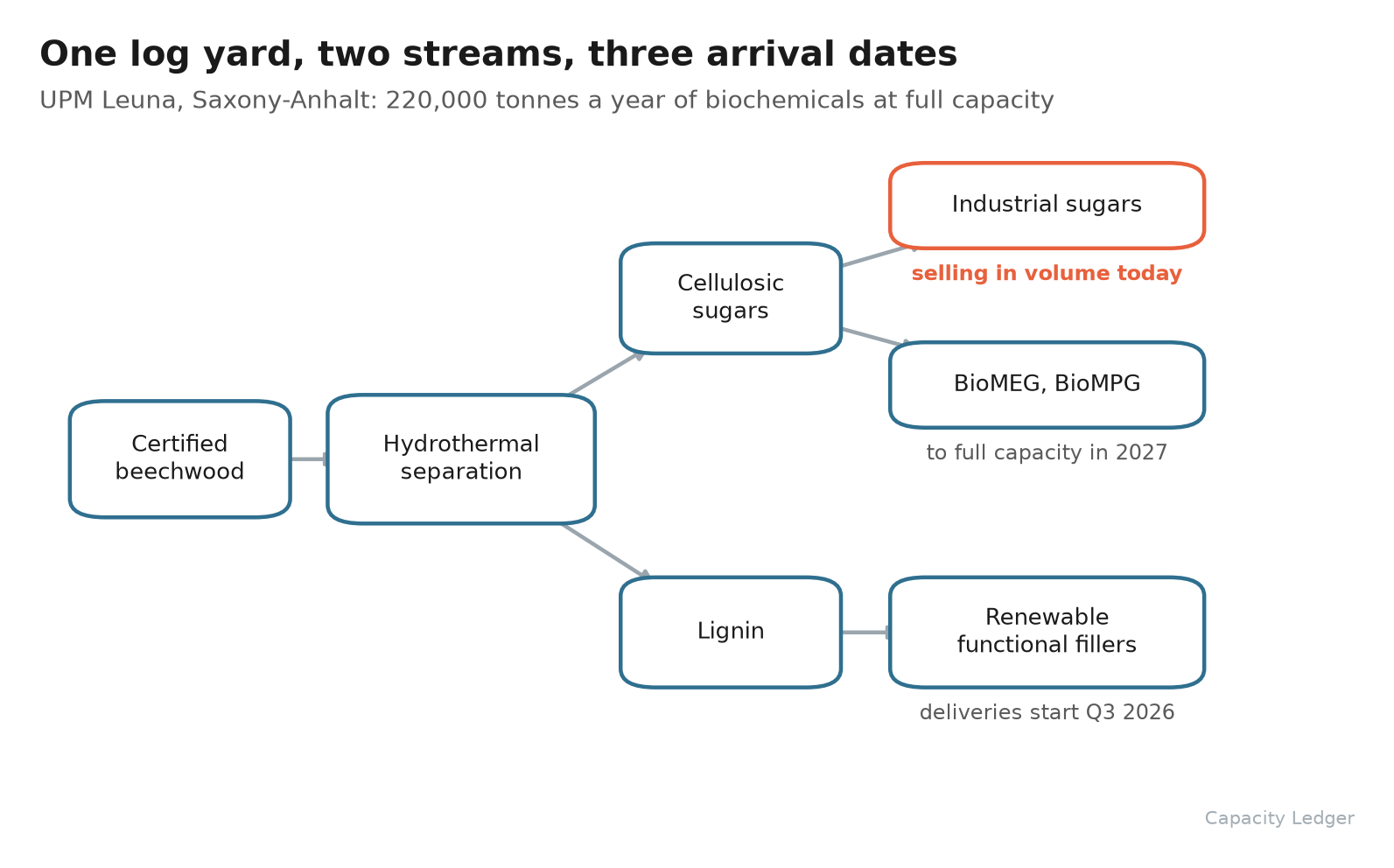
What Comes Out of a Wood Refinery
Certified beechwood goes in, from forests around the site. Saxony-Anhalt's state forest service south division, which manages roughly 21,500 hectares of broadleaf forest near Leuna, sent the first truckload in December 2022; rail-borne wood started arriving at a purpose-built yard in March 2024.
Then the plant does the hard part. Hydrothermal breakdown of the wood, and separation into two streams.
Cellulosic sugars go one way, lignin the other.
The sugar stream sells twice. Once as industrial sugars, which come off that separation with the least conversion behind them, and once as BioMEG and BioMPG after the sugars are converted to glycol.
The lignin stream becomes renewable functional fillers, sold under the BioMotion name into rubber and plastics as a replacement for carbon black and precipitated silica.
Full rate is 220,000 tonnes a year across all of it. UPM has never published the split between the three families, and we are not going to invent one for you.
The Order Things Arrived In
The sequencing is the part worth reading if you have ever watched a first-of-a-kind plant try to start (chart below).
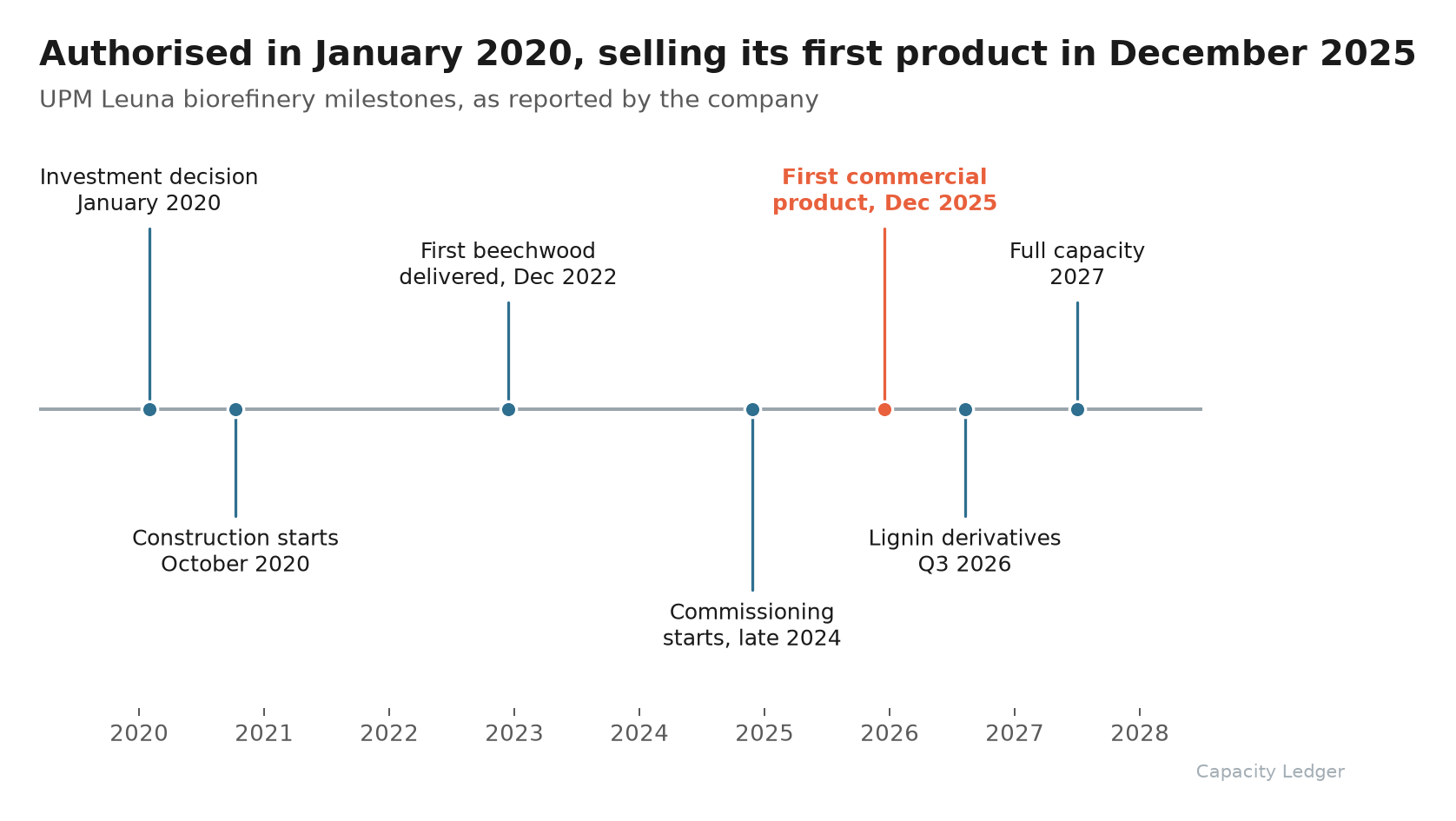
Construction started in October 2020. First wood two years later.
Commissioning began in late 2024.
Then 2025 settled the question that decides whether something like this is a plant or an expensive pilot. The hydrothermal breakdown of wood ran at industrial scale, and the separation of lignin from sugars reached stable operation.
On December 19, 2025, UPM said it had started production and commercialization of industrial sugars. Massimo Reynaudo, the company's president and CEO, called Leuna "the world's first commercial-scale biorefinery turning wood into bio-based chemicals."
So: sugars first, lignin derivatives this quarter, glycols scaling into 2027, which is when Reynaudo told analysts on the July 23 call the business reaches breakeven and full production capacity.
The formal site inauguration lands on October 15, a date he mentioned in passing on that same call. Ten months after the first tonne went out the gate, which tells you which of the two events UPM treats as the milestone.
The Glycols Are the Part That Concerns You
Here is the catch on almost every bio-based molecule pitched at a sourcing desk. The qualification bill eats the sustainability story.
UPM specified around that. The glycols are sold as fibre-grade MEG and industrial-grade MPG, and the company's own product language is unusually flat about what they are: they "have exactly the same properties as current, fossil based glycols", they integrate into existing production processes, and they "work in all existing recycling processes".
Same molecule, different carbon. If that holds at delivered spec, the polyester downstream never notices, and neither does the recycling stream your customers' packaging ends up in.
The filler is the harder sell and the more interesting one. Fillers run about 30% of a tire's raw materials, which makes a lignin-based carbon-black replacement one of the largest single substitutions available in rubber compounding.
Nokian Tyres built a concept tire with UPM in June 2024, the Green Step Ligna, with all the fossil carbon black in the sidewalls swapped out. Initial lab tests, per that announcement, put the material ahead of traditional carbon black on some properties.
That was a concept. Q3 is a delivery.
Two things worth doing with this:
- Ask for the grade sheet first. Fibre-grade MEG and industrial-grade MPG are specification claims, and a specification claim is testable against whatever you buy today. Run it against your incumbent before anyone shows you a carbon number.
- Get in the qualification queue ahead of the rate. Glycol volumes scale through next year toward a plant that UPM expects at full capacity in 2027. A qualification you start after the plant is full is a qualification you run against somebody else's allocation.
Final Thoughts
None of this is charity from where you sit. Leuna will sell glycol into a global MEG market that does not care where the carbon came from, and it will win or lose on spec, price and delivery like every other supplier on your list.
What is worth marking is narrower and, this year, rarer. The plant exists, it runs, and it is shipping.
Six years, one and a quarter billion euros, and a stretch in the middle that took a lot of European capacity off the map for good. Somebody finished putting one in anyway.
That entry goes in the addition column, and the addition column has been quiet.
Thanks for reading.