 Capacity Ledger
Who Is Selling Brazil the Resin You Used To?
Brazil's renewed import tariff on two dozen chemical headings took effect yesterday and runs to October 16, 2027. On the biggest line it is the smaller of two charges: the antidumping duty Braskem won in April works out to 20.7%, and it has already taken the American share of Brazil's import book from three quarters to a quarter. Brazil's monthly tonnage never moved.
Brazil's renewed tariff schedule for imported chemicals took effect yesterday. Two dozen customs headings, rates from 9% to 20%, every row running to October 16, 2027.
Adipic acid is on it. So are maleic anhydride, fumaric acid, hexamethylenediamine, monoethanolamine, MEK, ethyl acetate, n-butyl acetate, the dioctyl and dinonyl phthalates, unsaturated polyesters and a line of anionic surfactants.
The biggest line on the list by a distance is 3901.40, the ethylene alpha-olefin copolymers, where American resin has owned about three quarters of Brazil's import book for years.
Owned, past tense. And the tariff renewal is the smaller of the two reasons.
Twenty percent, for the third year running
The instrument is Resolução Gecex nº 963, signed October 2 and published in the Diário Oficial on October 5. It adds products to Anexo IX of Resolução Gecex nº 272/2021, the schedule Brazil keeps for tariff increases justified by trade imbalances arising from the international economy.
This is the third consecutive year these lines have sat there. Resolução 648 put 3901.40.00 at 20% from October 15, 2024, Resolução 800 carried it to October 16, 2026, and 963 carries it another twelve months.
Three years is long enough to score. So here is the question worth asking of any wall that has been standing since 2024:
"Did Brazil stop buying, or did somebody else start selling?"
The tonnage never moved
Brazil imported 489,713 tonnes of 3901.40 in the first eight months of 2026, against 481,749 tonnes in the same months of 2025. That is +1.7%, which is noise.
The American share of it went from 73.5% to 36.3% (chart below).
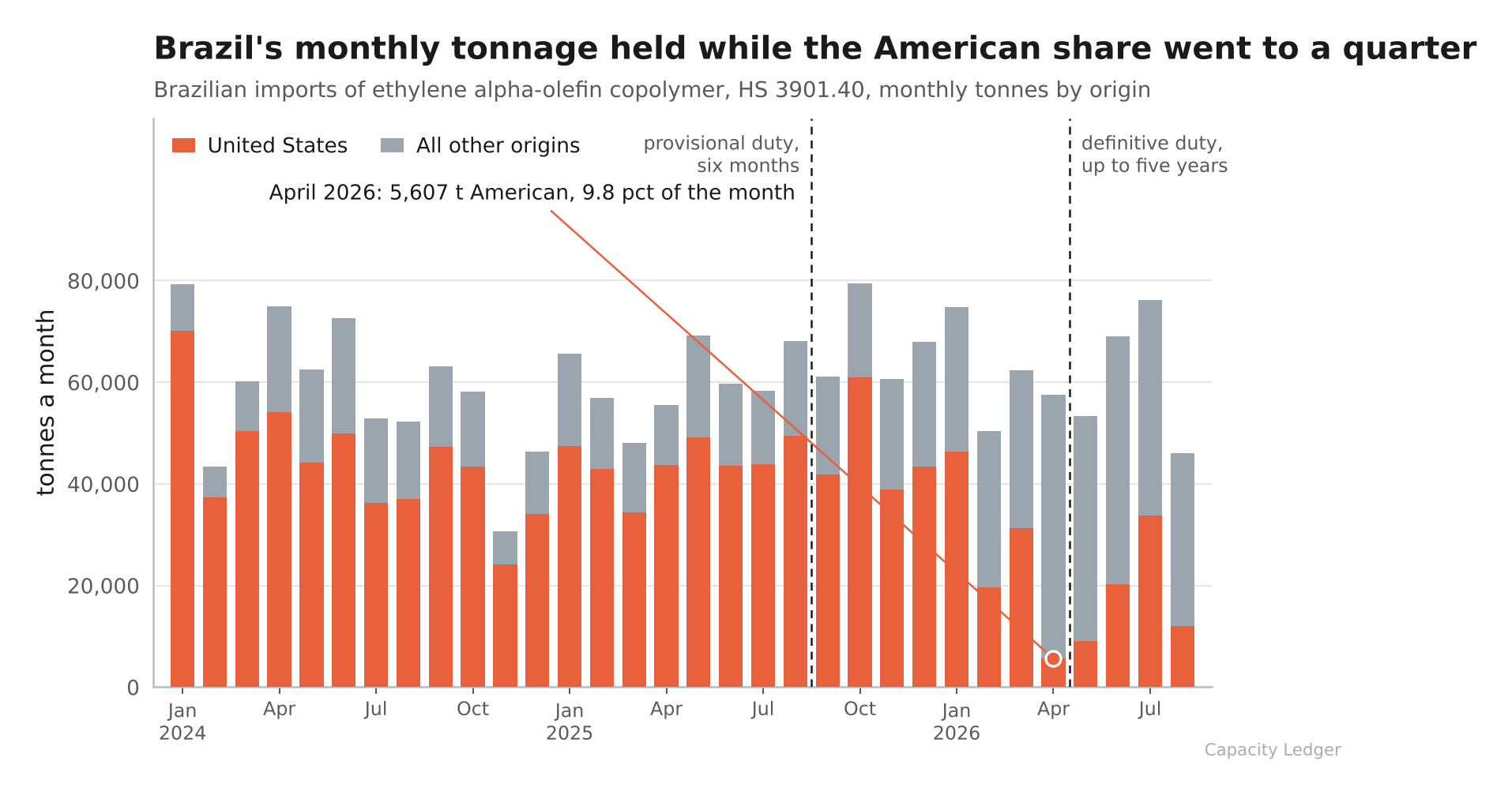
Narrow it to April through August, after the second wall went up, and the share is 26.7%, down from 73.8% a year earlier. American tonnage across those five months fell 64.9%, from 229,594 tonnes to 80,697.
April alone booked 5,607 tonnes of US-origin resin, 9.8% of the month, against 78.6% the April before.
Brazilian demand for the heading did not blink. The passport on it changed.
The duty that actually did it
Braskem petitioned on July 31, 2024. A provisional antidumping duty landed on August 29, 2025 at US$199.04 a tonne on every American exporter and US$238.49 on every Canadian one, good for six months.
The definitive duty followed on April 14, 2026, at the identical amounts, for up to five years.
Same number, twice. Only the second one emptied the line, and the chart shows exactly where.
Through the provisional months of September to December 2025, American shipments averaged 46,264 tonnes a month, slightly above the 44,277 they had averaged across the first eight months of the year.
A six-month deposit against an open case is a working-capital problem. A five-year specific duty is a sourcing decision, and Brazilian converters made it inside a single month.
Scale it against price and you can see why. US$199.04 a tonne is 20.7% of the $961.26 a tonne American resin was declaring at the Brazilian border in the first quarter of 2026.
Stack the renewed import tariff on top and a US-origin tonne of 3901.40 clears Brazilian customs this morning against roughly 41% in combined charges.
Saudi Arabia Took the Biggest Piece
The 148,897 tonnes the United States lost between April and August did not go unsold into Brazil. They were replaced, almost one for one, and the replacement list is worth reading:
- Saudi Arabia: 2,087 tonnes to 43,450, a twenty-fold increase and now 14.4% of the Brazilian import book.
- Argentina: 48,813 to 70,426 tonnes. The Mercosur member pays no tariff at all.
- Netherlands: 789 to 18,254 tonnes, and Spain: 1,850 to 13,741.
- China: 25 tonnes to 17,775. Not a rounding error any more.
- Korea: 4,260 to 16,351 tonnes, with Vietnam arriving from nothing at 6,068.
- Canada: 19,563 to 17,890 tonnes, essentially flat, which is the tell. Canada carries the higher duty of the two and barely moved, which reads as the marginal American tonne leaving while the specified grade stayed.
Final Thoughts
The number to carry out of this on the US side is 29,779 tonnes a month. That is the Gulf Coast resin that used to clear to Brazil and now has to find another buyer, and it will keep having to until April 2031, longer if a sunset review extends the duty.
That volume does not evaporate. It goes to the next-best netback, it sits in warehouses, or it stays home and competes with your domestic contract.
Brazil's renewed 20% is the part that got written up yesterday, and it is the part that comes up for renewal every October. The specific duty underneath it has four and a half years left to run.
If you price resin off a Gulf Coast posting, that is the clock to watch.
Thanks for reading.