 Capacity Ledger
Who Makes Decene Out of a Rapeseed Field?
Verbio started industrial production at Bitterfeld on Tuesday, in what it calls the world's first large-scale ethenolysis plant running on rapeseed methyl ester. Nameplate is 17,000 tonnes a year of 1-decene and 32,000 of 9-DAME, and the reaction makes them one molecule for one molecule. Your access to the lubricant feed moves with somebody else's detergent qualification.
Verbio expected around 200 guests at the Bitterfeld-Wolfen Chemical Park on Tuesday. One of them shared the Nobel Prize in Chemistry in October 2005.
Richard Schrock came to watch somebody push a button.
What the button started is, in its operator's words, the world's first large-scale ethenolysis plant running on rapeseed methyl ester. Verbio SE put just under EUR 100 million into it and rates it at up to 60,000 tonnes a year of bio-based chemicals.
Two of the molecules inside that number have names. One of them is 1-decene.
"What changes for a buyer when the C10 cut stops coming off an oligomerisation unit?"
The Slate Is Two Molecules Wide
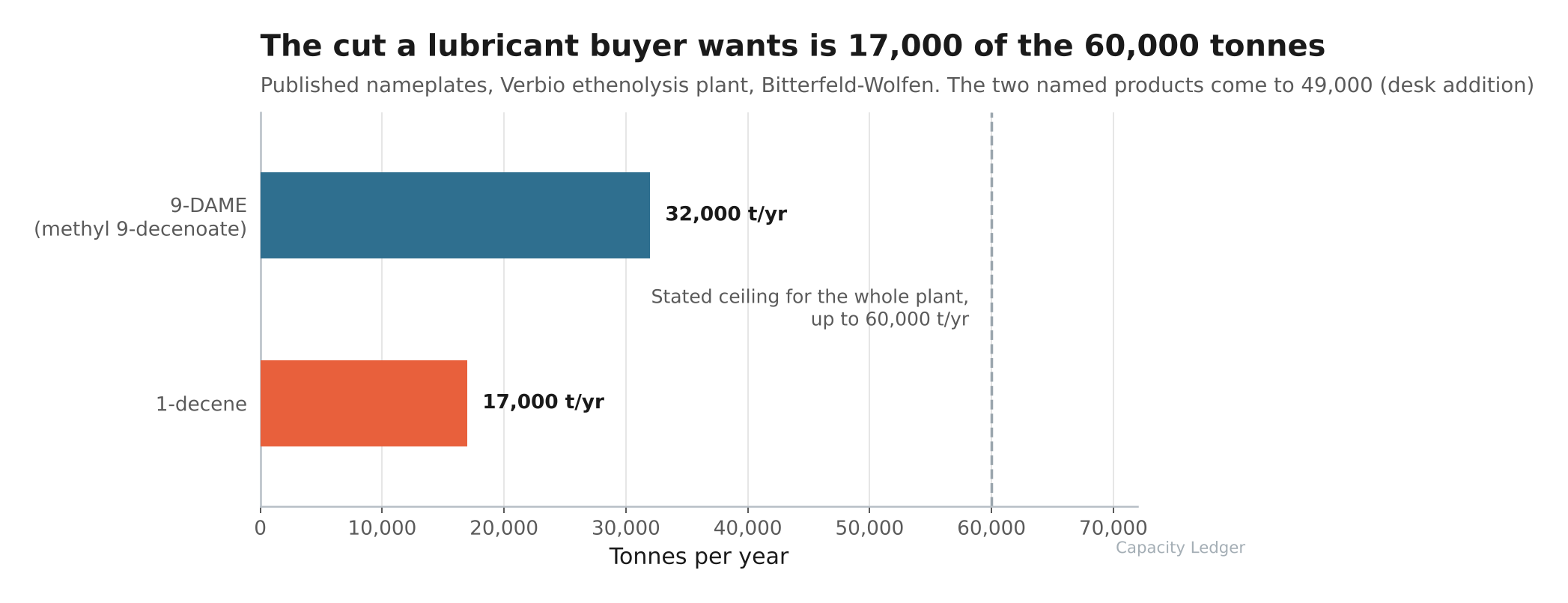
Verbio's fact sheet, dated the day of the commissioning, prints two nameplates and no others (chart below).
9-DAME, methyl 9-decenoate, at 32,000 tonnes a year. 1-decene at 17,000. The sheet calls those the main products and names nothing else, so 49,000 of the stated ceiling is spoken for and the balance stays unallocated in public.
Verbio's application lists for the two overlap almost everywhere: detergents and cleaning agents, personal care, flavourings. They separate at the top end.
- 9-DAME picks up plastics, coatings, adhesives and sealants.
- 1-decene picks up high-performance lubricants, which here means polyalphaolefin base stock for engine, gearbox and wind turbine oils.
What a Full Range Unit Makes You Buy
The conventional road to a tonne of 1-decene starts at an ethylene cracker. The ethylene goes through oligomerisation into normal alpha olefins, and the unit comes up making the whole even-numbered ladder: C4, C6, C8, C10, C12 and on up.
You do not get to order the rung you want.
Jim Herman, who ran the polyalphaolefin business at Chevron Phillips Chemical, laid the problem out for Lubes'n'Greases: any full-range NAO plant has to make the entire slate, "meaning each of these diverse molecules has to find a buyer." Most C4 and C6 goes to polyethylene. When polyethylene is slack, rates come down to keep from overstocking the cuts nobody wants, and, in his words, "that will also dry up the supply of decene, of course."
The C10 rung has form here. INEOS's own corporate timeline puts the Pasadena linear alpha olefins plant at 431,000 tonnes by 1987 and closed in 2005, and Herman counted 156,000 tonnes of decene among what that closure took off the market.
Its US replacement, a 420,000 tonne plant at Alvin, Texas, opened in 2019.
And this desk spent a 7am slot on September 23 hunting for a lifting notice on Chevron Phillips' normal alpha olefins force majeure at Cedar Bayou, declared to customers on June 9. There was none then.
There is none this morning either.
Set Verbio's 17,000 tonnes against Herman's Pasadena figure and it is about a tenth of one closure. Also the first plant of its kind anywhere.
One Ester In, One of Each Out
Here is the catch.
Ethenolysis cleaves the double bond in the middle of a C18 ester and caps both halves with ethylene. One molecule of methyl oleate and one of ethylene give one 9-DAME and one 1-decene.
The carbon balance is C18 + C2 = C10 + C10, and a US patent on the route reports both products at 55 mol percent, which is what equal production looks like (diagram below).
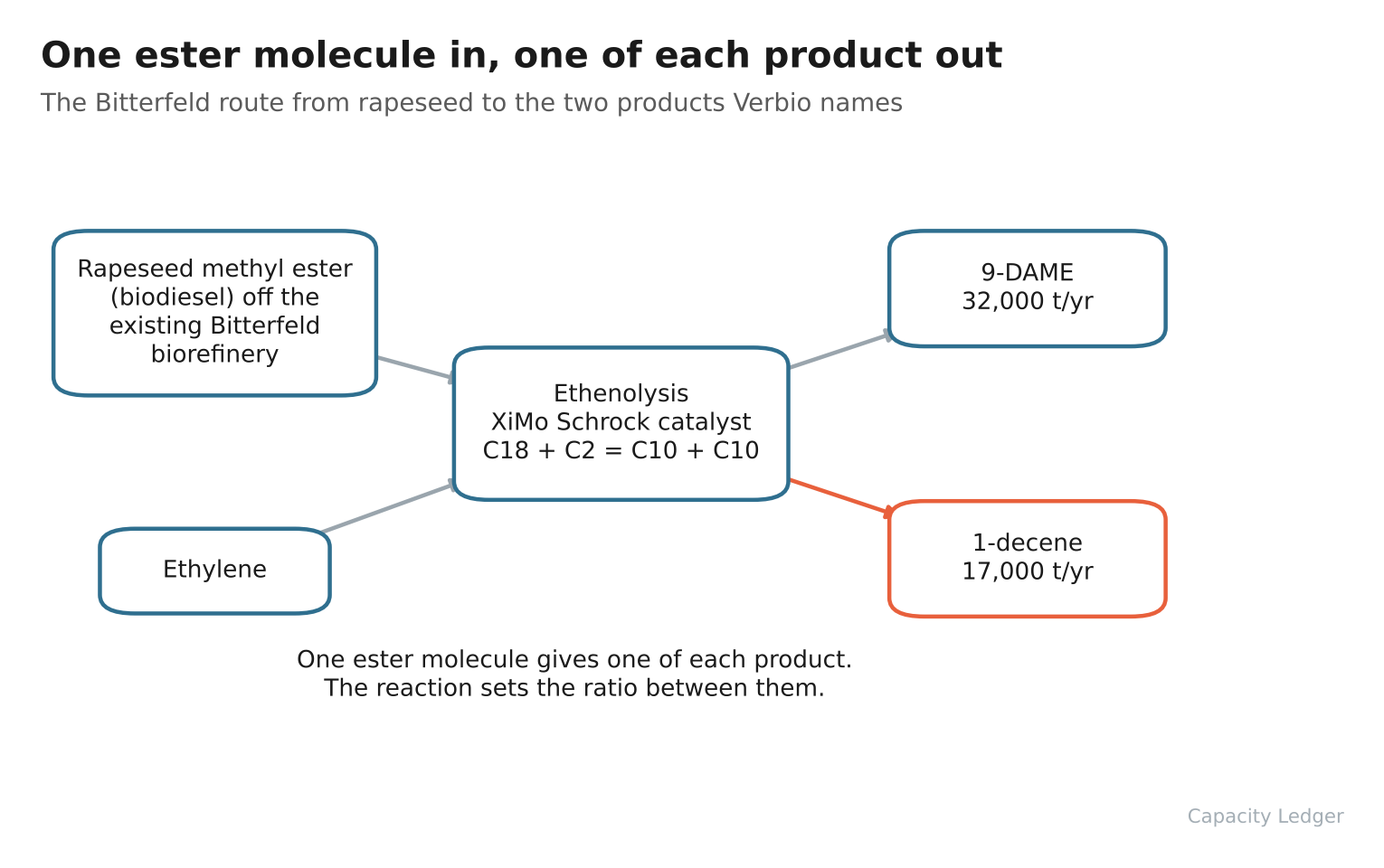
The ratio between the two is therefore set in the reactor, and the plant has to find homes for both.
Verbio says so itself: the building blocks made at Bitterfeld "must be qualified by customers for their respective applications," and volumes will grow in line with those qualifications.
Sixty of the guests on Tuesday were customers and partners from the chemical industry, and Verbio says enquiries have come from Europe, the Americas and Asia.
Read the ramp as a buyer and it has an edge on it. Your decene availability moves with somebody else's detergent programme.
CEO Claus Sauter was direct about where the work sits now: "We have made an upfront investment of just under EUR 100 million to provide the renewable molecules needed for the transformation. It is now up to the chemical industry to make use of this new option."
The Catalyst Plant Is the Other Half
Metathesis at this scale lives on its catalyst, and Verbio owns that end outright. It bought XiMo in 2018 and has built the catalyst side out since.
- Gödöllő, Hungary. XiMo broke ground on a metathesis catalyst plant on June 27, 2025: EUR 27.7 million, a 20 percent Hungarian government subsidy worth EUR 5.5 million, and 44 high-tech jobs. Verbio guided production to start in summer 2026.
- Who it serves. Bitterfeld first, then outside customers in renewable chemicals, polymer production, fragrances and odorants, agrochemicals and research.
The chemistry is molybdenum and tungsten, the catalyst family Schrock's decades of work laid the foundation for. Verbio's fact sheet says the reaction runs at mild temperature and moderate pressure, needs no solvent, and is highly selective.
Selling your own catalyst to the people who might compete with you is a bet that there will be more ethenolysis plants than yours.
Final Thoughts
2005 was a busy year for this molecule. The chemistry prize went to Chauvin, Grubbs and Schrock in October for the metathesis method, and Pasadena's alpha olefins plant shut the same year.
The decene that used to come off it has been somebody's sourcing problem ever since.
It took twenty one years for the prize and the shortage to turn up in the same building.
Seventeen thousand tonnes does not reset a market, and the ramp depends on qualification work that has barely begun. What Tuesday did was put a second kind of plant on the list of places the C10 cut can come from, and that list has been one item long for a very long time.
Schrock, on the day: "The fact that olefin metathesis is now being used on this scale is a moving moment for me."
Thanks for reading.