 Capacity Ledger
Who Shipped the MDI Geismar Now Makes?
BASF cut the ribbon yesterday on a $1 billion expansion that almost doubles MDI capacity at Geismar, Louisiana, to about 600,000 tonnes. The 300,000 tonnes it added at one site is roughly one and a half times everything the country imported on the polymeric MDI line in 2025, and the origin that used to be that line has shipped 437 tonnes all year.
In January 2018 BASF published a sentence about Geismar with two numbers in it. The Louisiana site made 300,000 tonnes of MDI a year, and it was going to make close to 600,000.
Yesterday the company cut the ribbon on the unit that finishes the sentence.
The expansion "almost doubles the annual MDI production capacity at the Geismar site to approximately 600,000 metric tons," at a cost of about $1 billion, and BASF calls it the largest wholly owned investment it has ever made in the United States.
Three Phases and a Splitter
Planning and engineering started in 2016. Construction on the first phase, a new MDI synthesis unit, began in the second quarter of 2018 and that unit was commissioned in 2020.
The second phase expanded several upstream units in 2021.
The third is the one that just finished: more upstream units plus a splitter, about three years and ten months in the building.
Markus Kamieth, who chairs BASF's board, spent his inauguration quote on the thing anyone who has run a capital project would notice first. The team "delivered this complex project on time."
Ramkumar Dhruva, who runs the Monomers division, said the commercial half out loud: "With this expansion BASF is taking the lead in MDI production in North America."
Who Was Shipping It
Polymeric MDI enters the United States under HS 3909.31, one of the two subheadings Commerce names in the scope of its antidumping order on Chinese MDI. Pull that line and you can see what 300,000 tonnes at one site is walking into (chart below).
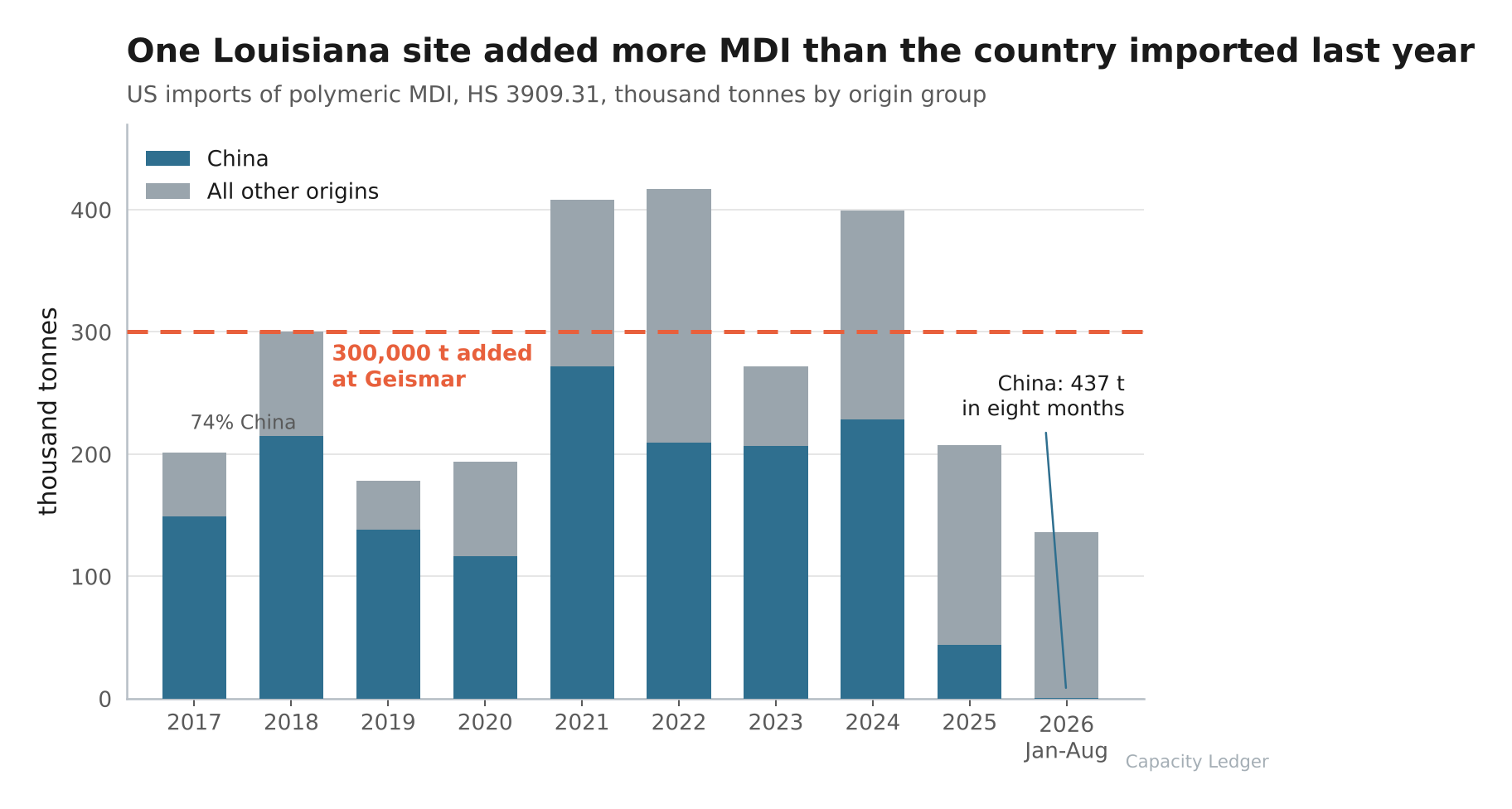
America imported 398,911 tonnes of it in 2024. The 2025 line came in at 207,316, and January through August of this year is 136,195.
China was that line. 74.0% of it in 2017, still 57.2% of it in 2024, which was 228,358 tonnes in a single year.
Then the Ad Hoc MDI Fair Trade Coalition's case landed. Commerce published its preliminary determination on September 16, 2025, the ITC found injury the following May, and the order in case A-570-200 took effect June 25, 2026.
Cash deposits run 87.25% for Covestro Polymers (China) and for Wanhua's named exporter, and 161.61% for the China-wide entity.
China's share of the line in 2025: 21.3%. Through August 2026: 437 tonnes, which is 0.3%.
What covers the line now is long-haul. For the eight months of 2026, Hungary is 44.1% of it, Belgium 24.3%, Germany 11.3%, Spain 10.1%, Korea 6.5%.
So the tonnage Geismar added is about one and a half times the entire 2025 import line, and it lands in a market where the nearest alternative tonne is on a vessel from Antwerp or the Danube.
The Aniline Underneath It
One more sentence in the release is worth your time. BASF "also increased its aniline production capacity in Geismar," with no tonnage attached.
Some of that is plumbing, because aniline is what MDI is made from and a doubled synthesis train has to be fed. The release points the rest of it at agricultural chemicals, rubber, and dyes and pigments, which is merchant language, not captive language.
Aniline is a thin filing population to begin with. We pulled EPA's reporting forms for reporting year 2024 this morning, and 35 US facilities filed one for aniline, nationwide.
Two of those 35 sit in the same Geismar zip code, and one of them is BASF Corp at 8404 Highway 75.
If you buy aniline or anything downstream of it, that unquantified clause is the part of yesterday's news that touches your 2027 sheet.
Final Thoughts
A capacity decision taken in 2018 arrived in a market that looks nothing like 2018. The tonnes this plant was sized against were Chinese, and by the time it opened they were gone, replaced by European and Korean cargo that costs more to land and takes longer to arrive.
Nameplate is not delivery, and a site that has just finished eight years of construction has a ramp in front of it. The first honest scoring will be the 2027 import line: if Geismar is running the way BASF says it will, those Hungarian and Belgian tonnes have nowhere to go but down.
Thanks for reading.