 Capacity Ledger
Who Still Has Steam to Sell?
Phoenix Tailings picked Eastman Business Park in Rochester last Tuesday for a $375 million rare earth separation plant, after what it calls a nationwide search. Kodak's leasing sheet for the park explains that choice better than the press release does: 800,000 pounds an hour of uncommitted steam, 50 megawatts behind the meter, and half of a 54 million gallon a day industrial effluent plant.
Kodak started making photographic film and paper on Lake Avenue in Rochester more than a century ago. The people who bought the park's energy assets in late 2016 broke ground on a gas powerhouse inside 30 days, spent $75m on it, and had the old coal plant retired about eighteen months later.
A rebuilt steam plant on a hundred year old film campus is the kind of asset that normally gets written down and forgotten.
Then last Tuesday a rare earth separation plant picked the site.
Phoenix Tailings announced on October 20 that it had selected Eastman Business Park for Freedom Separation, a $375m, 500,000 square foot facility that takes mixed rare earth feedstock in and ships separated oxides out. The company says the park was chosen "after a nationwide search," and that it "combines the industrial infrastructure Phoenix's process requires" with Rochester's workforce in engineering, advanced manufacturing and chemical processing.
Read the first half of that sentence literally.
"What does a separation plant need that Rochester already had?"
What the Park Is Actually Selling
Kodak publishes an attributes sheet for the park the way any landlord publishes a spec. It reads like a utility block looking for a plant, and the interesting column is the one marked available.
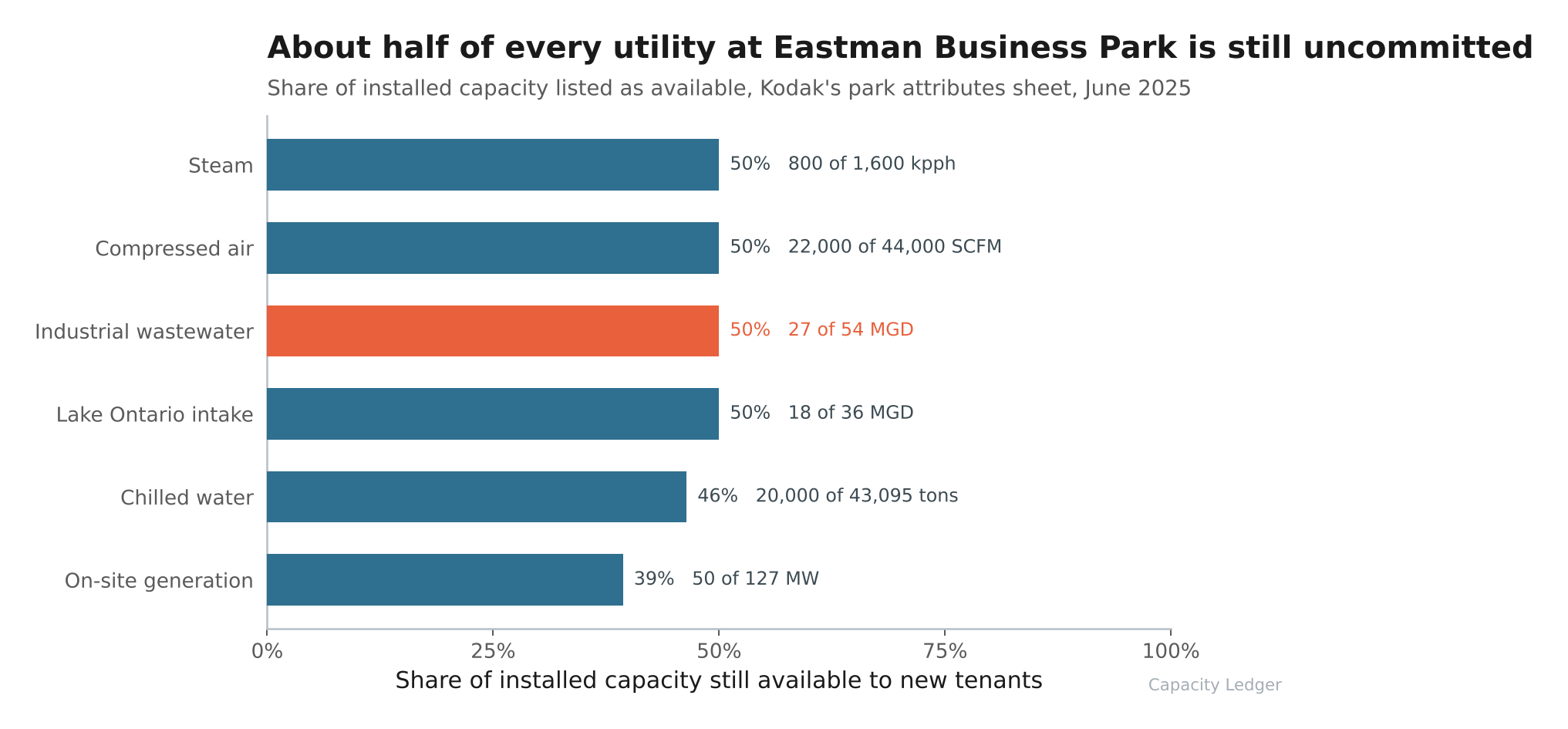
- Electricity: 127 MW of behind-the-meter generation across four locations with 50+ MW free, plus a 41 MW grid interconnect at three points.
- Steam: 1,600 kpph off five primary boilers with condensate return, 800 kpph of it uncommitted.
- Chilled water: 43,095 tons across eight locations, 20,000 tons free.
- Compressed air: 44,000 SCFM, half of it free.
- Demineralized water at 3,600 GPM, ultra high purity water at 400 GPM, and nitrogen at 150,000 SCFH and 99.999%.
- Water and effluent: a 36 MGD intake on Lake Ontario and an industrial wastewater plant at King's Landing rated 54 MGD maximum, both listed at 50% availability.
Roughly half of almost every line on that sheet is unsold (chart below).
Ironclad Energy, which rebuilt the powerhouse, counts 14 distinct utility services moving through about 90 miles of largely above-ground distribution pipe. It raises steam at 1,400 psi and distributes it down to 10 psig, and it describes the sewer plant in four plain words: designed for industrial effluent.
Why That List Is the Siting Decision
Separation is wet chemistry at scale. Phoenix will run more than 18,000 tons a year of variable feedstock through Rochester to get more than 4,400 tons a year of separated oxides, which New York's announcement puts at about 3,000 tons of metal once it reaches the company's downstream sites in Massachusetts and New Hampshire.
In utility terms none of that is exotic. It wants power that does not flicker, steam for evaporation and drying, deionized water in quantity, inert gas for anything that cannot see oxygen, and somewhere permitted for the water to go afterwards.
That last item is the one that sets greenfield schedules. A new industrial outfall and a new pretreatment plant are a multi-year permitting exercise that runs before anybody pours a foundation.
At Eastman Business Park the outfall exists, the treatment plant exists, and 27 MGD of its rated hydraulic capacity is listed as available.
Production starts ramping in 2027, with full production in 2028. That timeline is only credible on a site where the slow permits are already somebody else's.
The Part a Chemist Will Notice
The same sheet sells three things that are not utilities at all.
Kodak still runs analytical sciences on site: chemical and materials characterization, manufacturing problem solving, deformulation, routine testing. It still runs a specialty chemicals operation it describes as decades of custom synthesis and scale up to commercial manufacturing.
And it still runs precision roll-to-roll coating, pitched now at battery electrodes, prime foils, fuel cell membranes and optical films. That is the same multilayer coating competence that put emulsion on film base, sold to a different century.
So a tenant lands on a campus with spare steam, a toll synthesis shop and an analytical lab inside the fence. More than 100 companies are there already, employing over 6,000 people between them, on 1,200 acres with about 200 still open and 16 million square feet of building space zoned for manufacturing, distribution, office and labs.
Final Thoughts
The easy way to read an announcement like this is as an incentive story. New York is putting up $3m of performance-based Excelsior credits against $375m of private capital, which is eight tenths of one percent, and the federal side carries a $500m conditional loan commitment from the Office of Strategic Capital plus a $66m Department of Energy grant inside a $147.8m project.
The better read is on the leasing sheet. A century of process utilities stayed switched on after the film volumes left, and the steam header, the demin loop, the nitrogen plant and the effluent permit all stayed sized for an occupant much larger than the park now has.
If you are looking for somewhere in the United States to put a wet chemical process on a 2027 clock, the list of sites where the hard permits are already written is short, and most of the entries on it used to make something else at enormous scale. The chart above is the part of this one still for sale.
Thanks for reading.