 Capacity Ledger
Why Givaudan Owns Forty-Nine Percent of a Plant at Mahad
Privi Speciality Chemicals filed its half-year numbers on October 29, and its EBITDA margin has gone from 12.73 percent to 25.76 percent in three fiscal years, on revenue up 58.5 percent. The decision underneath that is older: in 2012 it bought its own crude sulphate turpentine step, and the world's largest fragrance house now holds 49 percent of a Mahad plant that makes 40-plus products for it alone.
In 2012 an Indian aroma-chemicals maker spent its money on the least glamorous thing available: processing capacity for its own crude sulphate turpentine.
The step before the step.
Fourteen years later that line sits on Privi Speciality Chemicals' competitive-advantages slide as the first bullet, and the sentence under it is blunt about why: "CST process know-how and sourcing is a prominent entry barrier."
The company filed its September-quarter numbers with the exchanges on October 29. They are worth twenty minutes of a buyer's attention, and not for the reason the headline writers took.
The Margin Is the Tell
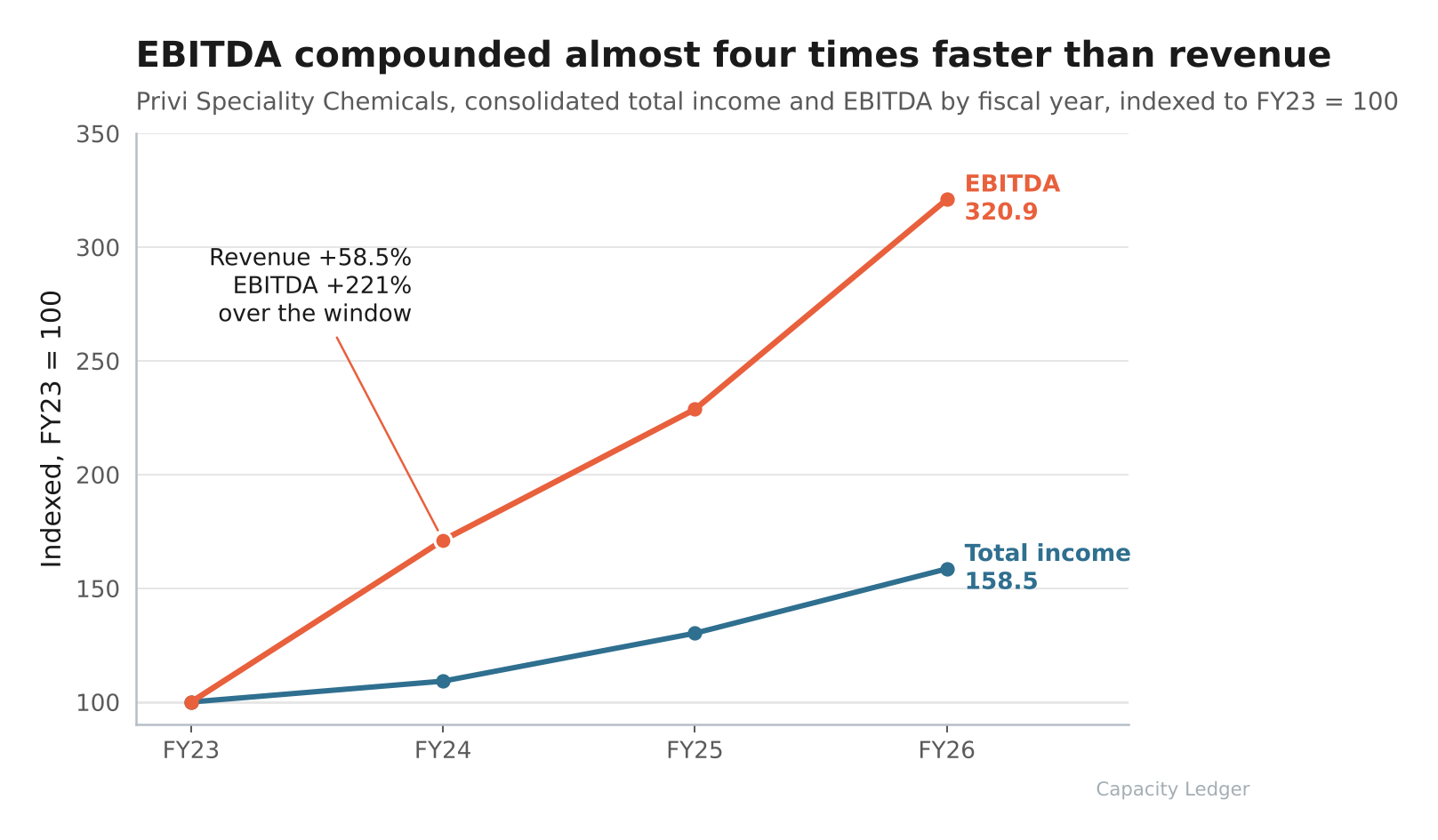
Revenue growth at Privi has been respectable and nothing more. Consolidated total income went from Rs 1,629.24 crore in FY23 to Rs 2,582.92 crore in FY26, up 58.5% across three fiscal years.
EBITDA over the same three years went from Rs 207.34 crore to Rs 665.45 crore, up 221% (chart below).
So the margin did the work. 12.73% in FY23, 25.76% in FY26, a hair over double.
The September quarter just filed came in at 27.48%, up 65 basis points on the same quarter last year, on total income of Rs 773.16 crore and profit attributable to the company of Rs 117.03 crore.
The balance sheet moved with it. Net debt to EBITDA was 4.96x in FY23 and 1.07x at September 30.
Net working capital came down from 182 days to 117, and return on capital employed went from 5.45% to 24.30%.
The same board meeting declared the company's first interim dividend, Rs 5 a share, record date November 4 and payment due by November 25.
Three years, the same two sites. That shape, revenue climbing steadily while the margin climbs faster, is what the filing means when it lists capacity debottlenecking across plants and a flagship augmentation project "nearing completion."
Who Buys Into Their Own Supplier?
Givaudan did, and the paperwork is specific.
The joint venture agreement with Givaudan SA, Switzerland is dated July 29, 2021, and the vehicle is Prigiv Specialties Private Limited, split 51% Privi, 49% Givaudan.
Givaudan's own release dated October 4, 2024 announced that the Mahad Fragrance Ingredients facility had commenced operations, with "a planned ramp-up of activities over the next two to three years."
Here's the part that tells you how the partnership is actually going. On March 26, 2026 both parties subscribed to a fresh preferential allotment:
- Privi put in Rs 25.50 crore, Givaudan Rs 24.50 crore, a combined Rs 50.00 crore at Rs 10 a share.
- Paid-up capital of the JV went from Rs 35.00 crore to Rs 85.00 crore.
- Givaudan's own money in the vehicle now stands at Rs 41.65 crore, and the 51/49 split held exactly.
Privi describes the plant as making more than 40 specialty products exclusively for Givaudan, and says the two are evaluating further capex for high-value molecules using in-house technology.
Read that as a sourcing manager rather than an investor. The largest flavour-and-fragrance company in the world looked at a portfolio of complex, small-volume ingredients and wrote an equity cheque into a plant inside its supplier's own fence.
Twice.
What Owning the Feedstock Step Buys You
Privi's published footprint is small enough to hold in your head:
- 48,000 MTPA of production capacity across 7 manufacturing facilities on two sites, Mahad in Maharashtra and Jhagadia in Gujarat.
- 36,000 MTPA of CST processing and 12,000 MTPA of GTO processing, the backward-integrated step from 2012.
- 75+ products, exports to 40+ countries, and about 70% of raw material derived from renewable sources.
- A single reported operating segment, "Aroma Chemical." No other business to hide behind.
The CST number against the production number is the whole argument. Privi buys its key pine-based raw material on long-term contracts and converts it itself, which is why the deck claims margin stability as a structural feature rather than a good year.
Now compare that to what this desk covered in September.
Symrise handed its US terpene aroma-chemicals business to a turnaround investor and took a write-down for the privilege, and the US turpentine import book had already rearranged itself around Canada.
Same chain, opposite direction. One operator treated the terpene step as a cost line to be divested, the other bought it in 2012 and spent a decade compounding on it.
Final Thoughts
None of this makes Privi a safe single source, and a company guiding to Rs 5,000 crore of revenue and Rs 1,000 crore-plus of EBITDA by FY29-30 is telling you it intends to be much bigger than the book it serves today. Expansion projects in the same filing are dated to the second half of 2028, which is a long time to wait if your qualification window is next year.
What it does tell you is where to point the question on your own next audit. When a fragrance house with its pick of suppliers puts equity into the plant rather than tonnage into a contract, it has concluded that the capability is scarce and that the operator is the one holding it.
That conclusion is cheaper to borrow than to reach on your own.
Thanks for reading.