 Capacity Ledger
Why the Silicone Network Needed Three More Hectares
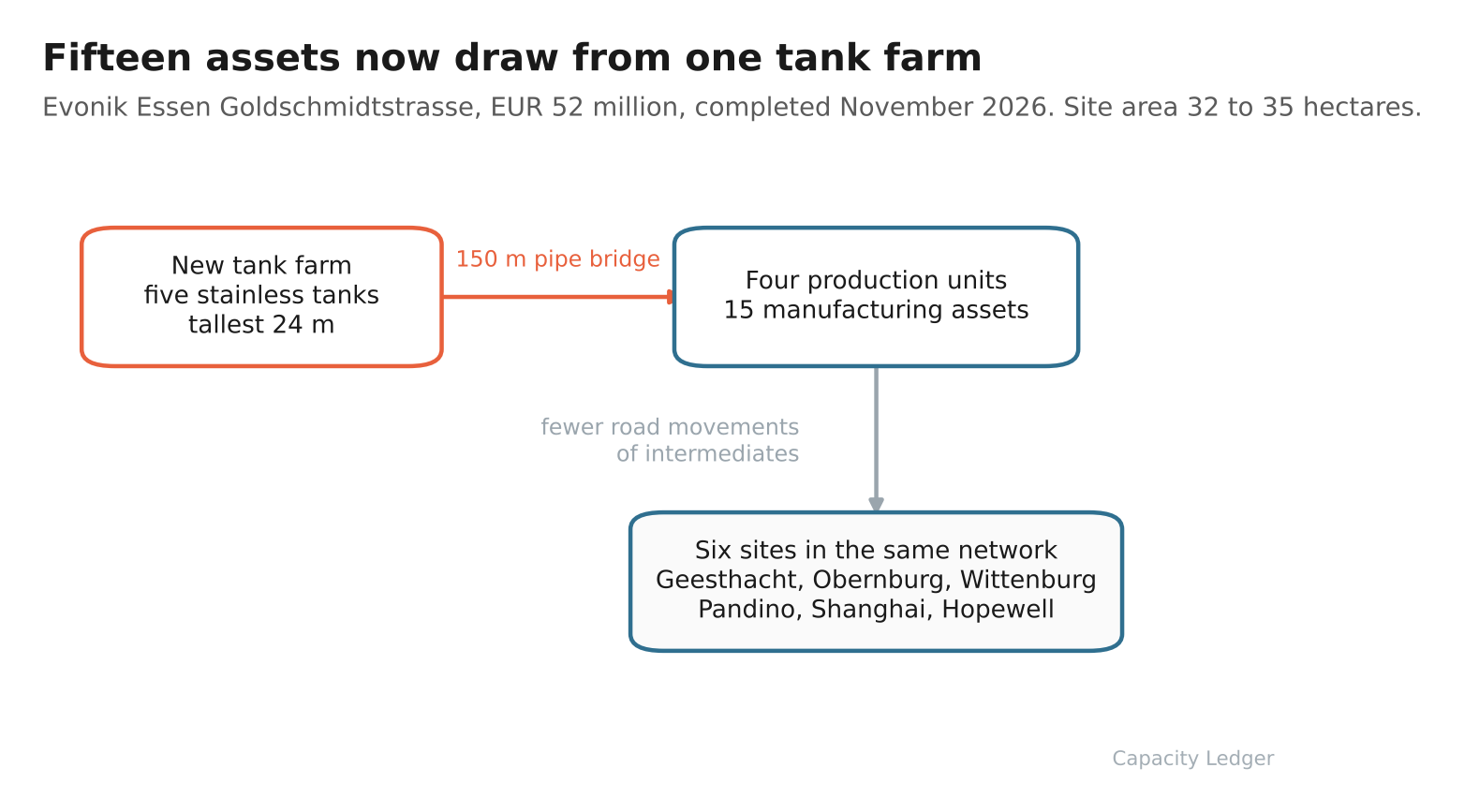
Evonik has finished a €52 million build at its Essen Goldschmidtstraße site: a new organomodified silicone plant plus a tank farm of five stainless tanks, tied to four production units and 15 manufacturing assets by a 150-metre pipe bridge. No capacity figure was published. The dimensions that were published say what the money was for.
We went looking for the tonnage in Evonik's Essen announcement, and there isn't one.
What the company published on November 4 is a set of dimensions.
Five stainless-steel tanks, the tallest 24 metres. A pipe bridge 150 metres long. Four production units and 15 manufacturing assets tied to the far end of it. A site that grew from 32 hectares to 35.
"What does fifty-two million euros buy at a silicone plant that is already running?"
The list answers the question, in the units the people who built it actually work in (chart below).
Nobody Spends Fifty-Two Million on Storage by Accident
The product is organomodified silicones, and the Essen platform feeds the jobs where a silicone surfactant sets the cell structure:
- polyurethane foams for insulation, mattresses and automotive seating
- adhesives and coatings
- personal care
Those are formulation businesses. The grade count is high, the batch sizes are not, and the raw-material slate behind them is wide.
Evonik counts Goldschmidtstraße as one of its six major production locations, with Marl, Wesseling, Darmstadt/Weiterstadt, Rheinfelden and Hanau, and describes it as a centre of excellence for customer-specific formulations.
Customer-specific is the operative word. A site whose job is bespoke blends runs more changeovers than a site whose job is one molecule at scale.
So the binding constraint in a plant like this is rarely reactor volume.
Roberto Vila-Keller, who runs Evonik's Interface & Polyurethane Additives business line, said the investment is "significantly expanding production capabilities, avoiding bottlenecks." The second clause is the one worth reading twice.
Fifteen Assets, One Tank Farm
The mechanism the dimensions describe:
- Five stainless tanks hold the key raw materials on site.
- A 150-metre pipe bridge carries them to four production units and 15 manufacturing assets.
- Material that used to be trucked between units and sites now arrives in a pipe.
Lauren Kjeldsen, the management board member for the Custom Solutions segment, put it as strengthening the silicone platform and "increasing our supply chain resilience."
Resilience in a formulation plant usually comes down to one question. When you call for a grade you have not ordered in four months, does the site have the feed on hand, or does it have to schedule a delivery first?
Tankage answers that question.
The execution is the part an operations reader will respect. The whole thing went in while the site kept running, on a constrained footprint, with about 80 Evonik employees and more than 230 contractors from 25 partner companies.
Three hectares is what it cost in land, 9.4% more site than Essen had before.
Where Hopewell Comes In
Essen does not run alone. The release names the sites it works with: Geesthacht, Obernburg and Wittenburg in Germany, Pandino in Italy, Shanghai, and Hopewell in the United States.
That last one is why this is a US story.
Hopewell, Virginia is where Evonik began its own American production in 1980, by the company's own history, and it is still a live PU-additive site. Evonik's May 2025 release on moving PU-additive production to green electricity names Hopewell alongside Isehara, Japan, and calls the amine and silicone platforms "the backbone of our portfolio offering."
So if you buy silicone surfactant for rigid foam in North America, your plant sits at the end of this network. And the stated purpose of the Essen build is to cut how often intermediates and finished product travel between its nodes.
Final Thoughts
A ledger of capacity runs on tonnes, and this entry has none. Evonik published no figure for the additional annual output the new plant adds, and we are not going to invent one.
What it did publish is arguably more useful.
A nameplate gives you the ceiling on a good day. Fifteen assets drawing from one tank farm tells you what happens on an ordinary Tuesday, when three grades are queued and the fourth one is a rush.
Debottlenecking is the least glamorous thing a specialty producer does, and frankly it is the thing that moves a buyer's lead time most.
It lands in no capacity count, no closure tally, no import statistic. It lands in the quarter the grade ships on time.
Thanks for reading.