 Capacity Ledger
Wood Sugar Was the Easy Part
UPM inaugurated its Leuna biorefinery on October 15: 1,370 million euros, 220,000 tonnes a year, beechwood from inside a 200 kilometre radius. The clause worth reading is the one about lignin, because the lignin line is the half that was still a forecast the last time we wrote about this site.
UPM cut a ribbon at Leuna on October 15, three in the afternoon, and the release that went with it is a short document.
One clause in it is worth the rest of the page.
Enzymatic hydrolysis and the production of lignin-derived specialty chemicals, UPM says, "have reached stable operation."
We wrote about this site on July 29, when the sugars were shipping in volume and the lignin side was a forecast with a quarter attached to it.
"Which half of a wood biorefinery is the hard half?"
The lignin half. And that is the half UPM now says is running.
What Actually Got Inaugurated
The figures the company prints today: 1,370 million euros, 220,000 tonnes a year, and the largest facility of its kind anywhere in the world.
The investment was announced in January 2020. Six years and nine months from that announcement to the ribbon, which is roughly what a first-of-a-kind plant costs in calendar.
Feedstock is beechwood thinnings and sawmill residues from inside a 200 kilometre radius, and UPM is precise about the grade. The wood it takes is wood with no higher use, the material that misses the timber and furniture grades.
Massimo Reynaudo, the company's president and CEO, called Leuna "a transformative investment for UPM and an important milestone in our growth journey," and framed the site as a bet on the continent. With Leuna, he said, UPM "turns Europe's strengths in science and engineering into a new growth business."
The ceremony is the lagging indicator here. The plant has been selling since last December.
Why the Lignin Half Is the Interesting One
Pull wood apart at industrial scale and two streams come out. Cellulosic sugars, and lignin.
The sugar stream has precedent behind it. Sugars came off the separation first, on December 19, 2025, and UPM called them the plant's first commercial product that day.
Lignin is where projects like this have historically stopped. It arrives heterogeneous and variable, and getting it into a form a compounder will accept in a recipe is a different class of problem from fermenting a sugar.
UPM's own statements this year track that ordering exactly (chart below).
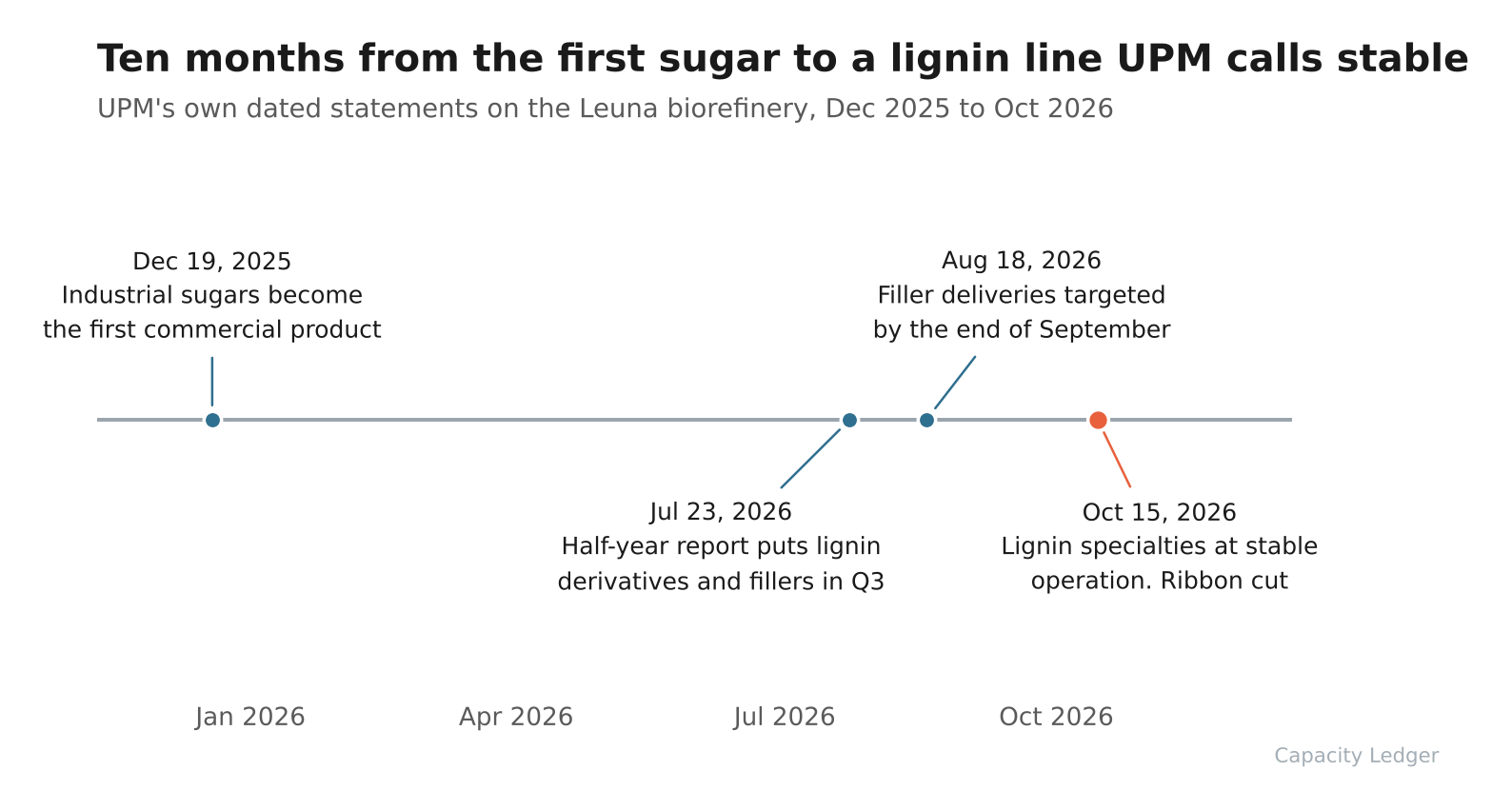
On July 23, the half-year report put deliveries of renewable functional fillers and other lignin derivatives in the third quarter.
On August 18, the target got sharper: customer deliveries of fillers out of Leuna by the end of September.
On October 15, the lignin specialties line is described as being in stable operation, with sales ramping up.
Ten months, first sugar to a lignin line that runs.
What a Buyer Can Do With This
Four product families come off the site, and they sit at different distances from your purchase order:
- Industrial sugars, commercial and shipping since December.
- Renewable functional fillers, sold under the BioMotion name against carbon black and precipitated silica, into tires, automotive profiles, hoses, seals, footwear and flooring.
- BioMEG, sold as UPM BioPura.
- BioMPG.
Two pieces of the commercial scaffolding are older than this month's news and worth knowing anyway. Brenntag has been UPM's sole European distributor for BioPura BioMEG since September 2023, so the glycol reaches you through a channel you almost certainly already buy from. And the site has carried ISCC PLUS, PEFC and FSC chain-of-custody certification since June 2025, which is the paperwork a customer audit asks for before it asks for anything else.
Reynaudo told analysts in July that the sales and qualification pipeline runs at several times the plant's annual capacity, with customer contracts confirmed, and that full capacity and positive EBIT land during 2027.
Read the second half of that sentence as the queue notice it is. A qualification you open after the plant is full is a qualification run against somebody else's allocation.
Final Thoughts
UPM has published no tonnage split, no price, and no customer name for any of this, and we are not going to supply you with one. What the October release gives you is narrower: a company saying, on the record, which of its unit operations is stable.
That is a smaller claim than a ribbon-cutting usually carries, and a more useful one.
The glycols are still ahead, the 2027 guidance is still guidance, and the filler has to win in compounding trials against an incumbent that has had a century of head start. None of that is settled this week.
What is settled is the part everyone expected to break. The wood comes in from 200 kilometres away, the enzymes do their work, and the lignin that comes out the other side is going somewhere other than a boiler.
Thanks for reading.