 Capacity Ledger
Your Peroxide Has Two Prices and One Tariff Line
Solvay said on September 3 it will more than double its Taiwan electronic grade hydrogen peroxide plant by the end of the year. US import data puts 94.8 percent of the tonnes on that same tariff line at 45 cents a kilogram, and the Japanese tonnes at $3.40. Taiwan's shipments to the US are down 38 percent this year.
The United States imported 62,203 tonnes of hydrogen peroxide in the first seven months of this year. Canada sent 94.8 percent of it, at 45 cents a kilogram.
Japan sent 1,061 tonnes, at $3.40 (chart below).
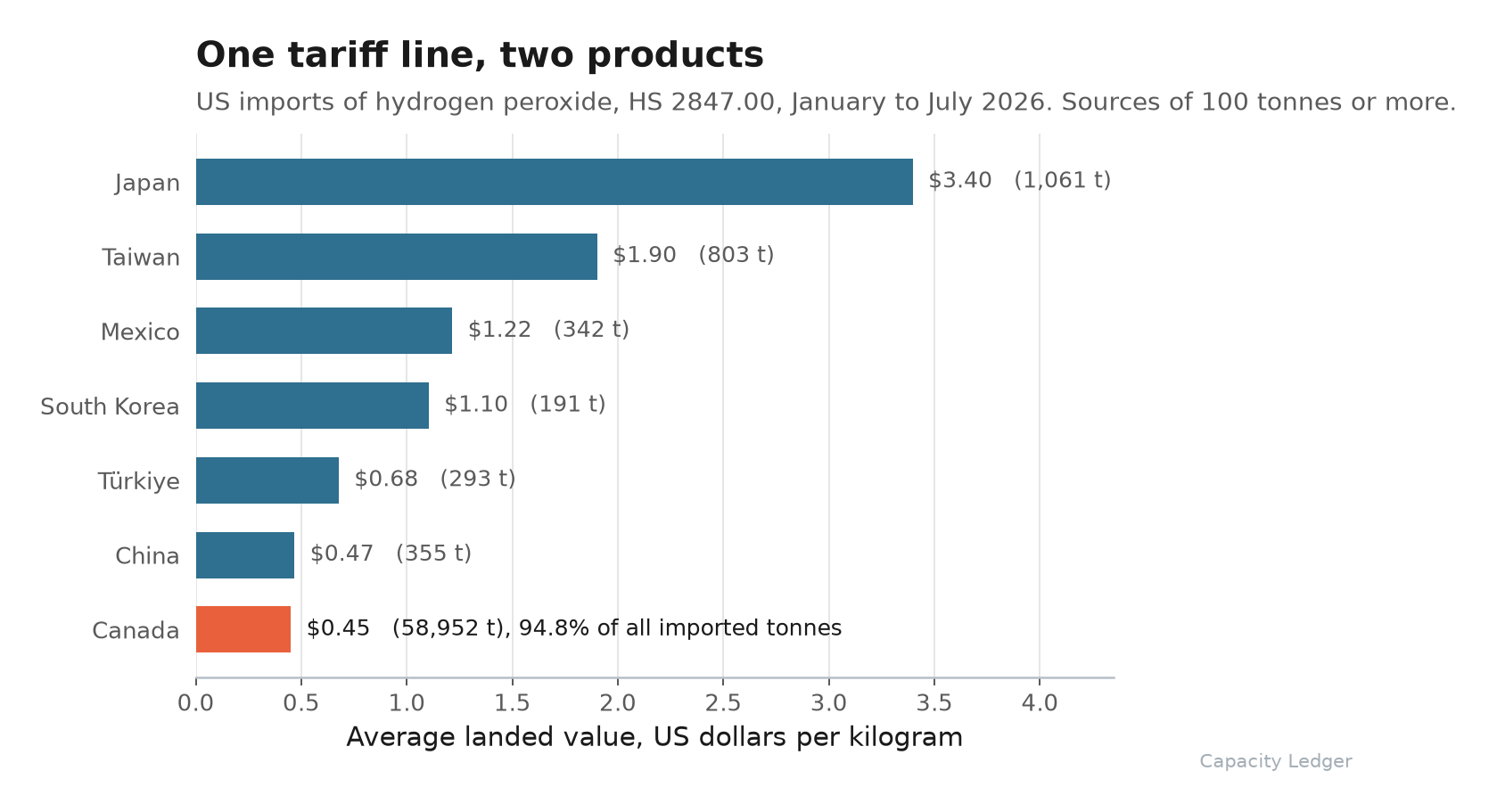
Same six-digit line. Same entry summary field. A factor of 7.5 between the two ends of it.
"Which of those two books is your peroxide actually coming out of?"
The Cheap Book Rides a Truck
The Canadian tonnage is the whole story of the line if you only read the total. 58,952 tonnes in seven months, at $0.45 a kilogram against $0.43 in the same window last year.
That book is a logistics question. Peroxide ships as an aqueous solution in dedicated equipment on standing contracts, and Canada is a truck and a rail car away.
It is also the book that drives the headline. US imports on this line ran 79,001 tonnes in 2023, the lowest year since at least 2010, then jumped 33.9 percent to 105,800 in 2024 and held at 107,163 in 2025, the highest since 2015.
Nearly all of that swing was Canadian.
The Expensive Book Comes by Sea
Now look at the top of the chart. Japan at $3.40, Taiwan at $1.90, and together the two of them move 1,864 tonnes, three percent of the line.
Taiwan is the interesting one, because Taiwan was not on this line in any size before 2024.
The annual partner rows run 4.6 tonnes in 2019, 5.1 in 2021, zero in 2022, 0.3 in 2023. Then 1,316 tonnes in 2024 and 2,004 in 2025.
Solvay's Shinsol Advanced Chemicals joint venture with Shinkong Synthetic Fibers, at Tainan, was commissioned in December 2023 and reached full production in early 2024 at 35,000 tonnes a year of electronic grade high-purity peroxide. We would not call the timing a coincidence, though the customs line will never confirm whose molecules those were.
On September 3, Solvay said it will more than double that plant by the end of 2026.
Read the release for who it is for.
Carlos Silveira, who runs Solvay's Peroxides business, frames it as confidence in Taiwan's "long-term growth prospects" in the semiconductor value chain. Gregory Wu, Shinsol's chairman, frames it as supporting "the growth of Taiwan's semiconductor industry."
Nobody in the announcement is talking about a US customer.
And the US line already reflects that. Taiwan shipped 803 tonnes here in January through July, against 1,295 in the same seven months of 2025.
Down 38 percent, in the year before the expanded plant starts up.
What the Line Will Not Tell You
HS 2847.00 is one line for hydrogen peroxide, whether or not solidified with urea. It does not separate electronic grade from pulp-bleaching or technical grade, and it does not separate concentration.
So landed value per kilogram is a proxy. Part of the spread on the chart is purity and part of it is how much water each shipment is carrying, which is a bit of an oversimplification for time. At 7.5 times, the direction of it is not in doubt.
Two things worth doing with it anyway:
- Pull your own entry summaries for this line and sort them by unit value rather than tonnage. The tonnage view tells you your peroxide supply is a Canadian trucking question, and for a fab-adjacent buyer that answer is wrong.
- If you hold a 2027 electronic grade position, ask where the qualified tonnes are made before the Shinsol expansion lands. New Asian capacity aimed at Asian fabs does not automatically become export supply, and this year's trade data is already running the other way.
Final Thoughts
US exports on this line went the opposite way over the same seven months, up about 18 percent year over year, so nothing here says the country is short of peroxide in any bulk sense. Full-year 2025 was 107,163 tonnes in and 62,040 out, and that market clears.
The tonnes that matter to a specialty buyer were never the bulk ones. They are the three percent at the top of the chart, they cost seven times as much, and the plant being built to make more of them is on the other side of the Pacific, sized against the fabs on its own island.
Thanks for reading.